
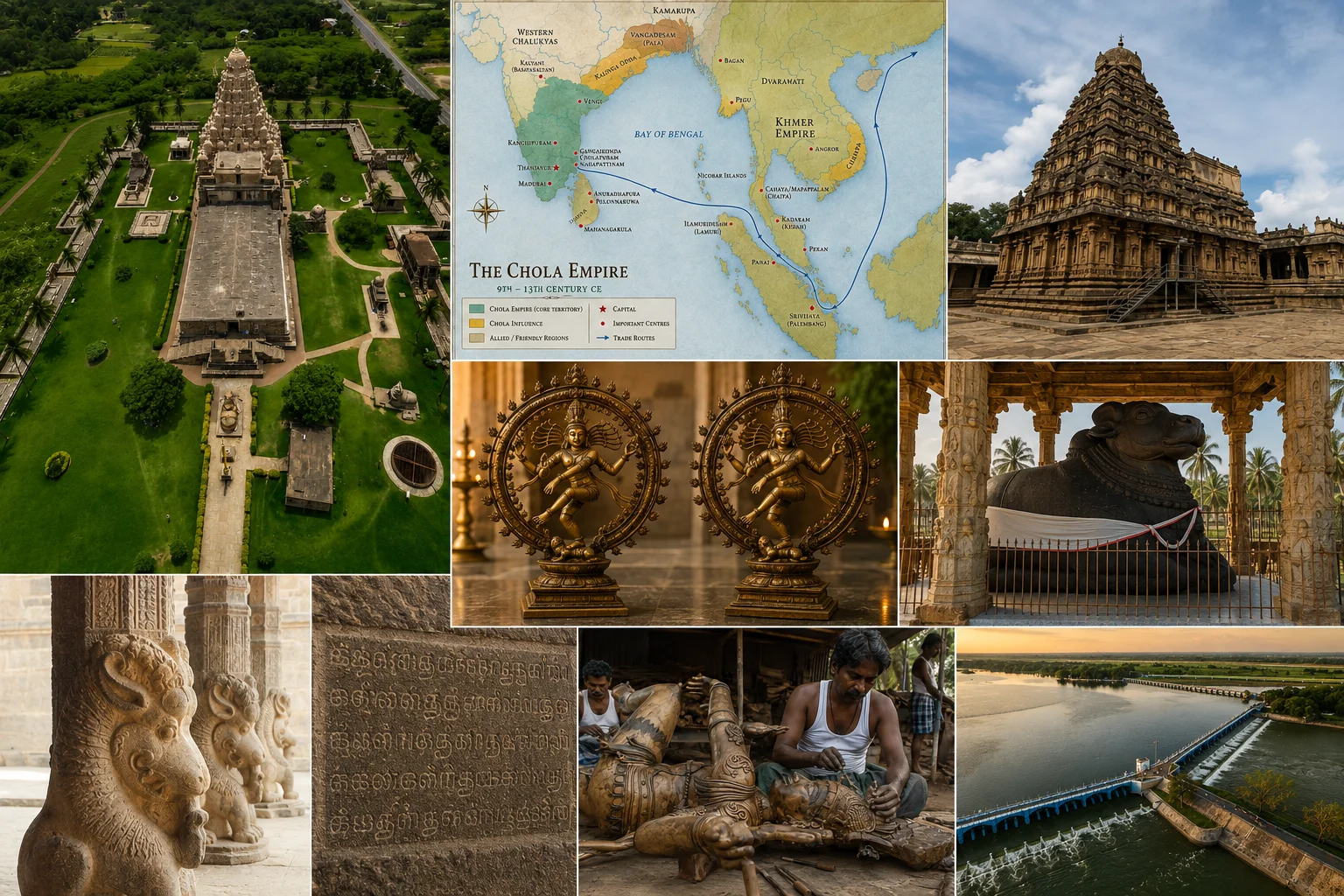
Great Living Chola Temples: A Complete Cultural & Travel Guide
Beyond Monumentality
The temples of the Chola world are often introduced through superlatives. The tallest vimana of its time. Monumental granite engineering. UNESCO recognition. Imperial ambition translated into architecture.
These descriptions are accurate, yet none of them fully explain why the Great Living Chola Temples continue to hold such extraordinary cultural weight more than a thousand years after their construction.
Most visitors encounter the Chola circuit through compressed itineraries that prioritise movement over understanding. A vehicle leaves Thanjavur in the morning, three temples are visited, photographs are taken, and by evening the journey is considered complete.
What remains unseen in this approach is the relationship between the temples themselves. The progression from imperial assertion to refinement disappears.
The connection between agrarian wealth and granite monumentality becomes invisible. The role of inscriptions, ritual continuity, sacred geography, and architectural sequencing is reduced to background detail.
Approached without context, the temples remain visually impressive but conceptually fragmented.
The Great Living Chola Temples were never designed as isolated monuments. They emerged from a civilisation that organised irrigation, governance, temple economies, sacred architecture, sculpture, ritual institutions, and artisanal systems into a remarkably coherent cultural framework.
The architecture was not intended merely to inspire admiration. It was designed to communicate order, hierarchy, cosmology, and imperial stability through space itself.
This is what makes the Chola world fundamentally different from a conventional heritage circuit.
The temples functioned as part of a larger civilisational system linked to agricultural productivity across the Kaveri Delta, administrative institutions documented through inscriptions, ritual continuity sustained across centuries, and artistic traditions that remain active even today.
The Chola world therefore survives not merely through stone monuments, but through continuity. Rituals continue. Temple towns remain active.
Bronze casting traditions endure. Sacred processions still move through streets shaped by medieval spatial planning. The relationship between architecture and living culture has not entirely disappeared.
To move through the Chola landscape carefully is to encounter more than monuments. It is to witness the surviving logic of a civilisation that expressed governance, sacred order, and artistic discipline through architecture of extraordinary precision.
This guide approaches the Great Living Chola Temples not as destinations to be completed, but as chapters within one of the most sophisticated cultural systems in South Asian history.
What Are the Great Living Chola Temples?
The “Great Living Chola Temples” refer to a group of monumental temple complexes in Tamil Nadu recognised collectively as UNESCO World Heritage Sites for their architectural, historical, and cultural significance.
The UNESCO inscription includes three principal monuments: Brihadisvara Temple, Gangaikonda Cholapuram Temple, and Airavatesvara Temple.
Constructed between the 11th and 12th centuries under successive Chola rulers, these temples represent the height of mature Chola architecture. Yet their significance extends far beyond monumentality.
Together, they document the evolution of an architectural and cultural language in which engineering, ritual, administration, sculpture, cosmology, and sacred geography operated together rather than independently.
The term “living” is especially important. Unlike archaeological ruins separated from contemporary life, these temples continue to function as active centres of worship.
Daily rituals continue inside sanctums originally consecrated nearly a thousand years ago. Temple bells still regulate sacred time.
Processions still move through ceremonial pathways. Priests, musicians, artisans, and devotees continue to animate spaces designed within the Chola period.
This continuity fundamentally changes how the temples should be understood. They are not preserved as static historical objects. They remain inhabited ritual systems.
At Brihadisvara Temple, sacred activity still unfolds beneath one of the most monumental granite superstructures in the world.
At Airavatesvara Temple, sculptural narratives remain integrated into spaces still shaped by ritual movement.
Even the quieter atmosphere of Gangaikonda Cholapuram Temple retains a sense of ceremonial continuity that cannot be understood purely through archaeology.
This is one of the principal reasons the Great Living Chola Temples remain globally significant. They preserve not only architecture, but the cultural logic that originally sustained it.
Understanding the Chola Civilisation
The Chola dynasty emerged as one of the most influential powers in South Asian history between the 9th and 13th centuries.
From the fertile Kaveri Delta, the Cholas developed an imperial system that extended across much of South India and into maritime trade networks linking the Indian subcontinent with Southeast Asia.
Yet what distinguished the Cholas was not territorial expansion alone. Their greatest achievement lay in their ability to organise interconnected systems at scale.
The Chola world integrated irrigation networks, agrarian management, temple administration, maritime trade, artistic patronage, inscriptional governance, sacred architecture, and ritual continuity into a remarkably stable civilisational framework.
The temples that survive today must therefore be understood not as isolated acts of devotion, but as products of a much larger system of economic organisation, agricultural productivity, and institutional discipline.
The Kaveri basin formed the foundation of this world. Through canals, distributaries, sluices, reservoirs, and irrigation systems, the Cholas transformed the delta into one of the most productive agrarian landscapes in medieval South India.
This agricultural surplus generated the resources necessary for quarrying granite, mobilising labour, supporting artisan communities, maintaining temple institutions, and financing monumental construction.
The temples themselves preserve extensive inscriptional records documenting taxation systems, land grants, irrigation obligations, merchant activity, temple maintenance, ritual responsibilities, and administrative appointments. Architecture and governance operated together.
Under Parantaka Chola I, administrative structures and local governance systems became increasingly organised. Under Rajaraja Chola I, imperial monumentality reached unprecedented scale through the construction of Brihadisvara Temple.
Under Rajendra Chola I, the empire expanded outward across maritime routes while Chola architecture evolved toward greater refinement and spatial sophistication.
The Chola temples therefore represent more than artistic achievement. They are visible expressions of a civilisation built upon water systems, governance structures, sacred institutions, economic organisation, and long-term political stability.
This broader framework explains why the Chola world continues to feel unusually coherent even today. The temples were never intended to function independently from the systems surrounding them.
Architecture, ritual, administration, sacred geography, and agrarian infrastructure formed part of the same civilisational logic.
Why Chola Architecture Still Feels Extraordinary
The Chola architectural tradition represents one of the most refined expressions of Dravidian temple architecture in South Asia. What distinguishes the Chola approach is not merely scale, but continuity.
Across multiple generations, the Cholas developed a remarkably stable architectural language that remained recognisable while continuously evolving in proportion, sculptural complexity, and spatial refinement.
The result is a body of work that feels unified rather than fragmented. The same architectural grammar appears across temples of different scales and periods, creating continuity across the Chola landscape while still allowing each monument to develop its own emotional and spatial character.
The towering vimana above the sanctum forms the visual and symbolic centre of the Chola temple complex.
At Brihadisvara Temple, the vimana rises in sharply disciplined geometric tiers that establish overwhelming vertical dominance through proportion rather than ornament. The structure directs attention upward while simultaneously anchoring the entire spatial composition.
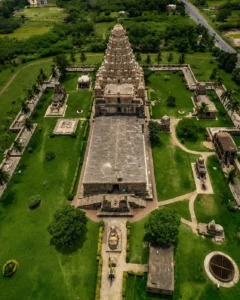
At Gangaikonda Cholapuram Temple, this same architectural form evolves into a softer and more fluid profile. The vertical force remains, yet the geometry becomes more relaxed and spatially balanced.
At Airavatesvara Temple, monumentality contracts while sculptural precision intensifies. The progression reveals architectural evolution rather than repetition.
The scale of Chola granite engineering remains extraordinary even today. Massive stone blocks were quarried, transported, lifted, and interlocked without modern machinery.
At Brihadisvara Temple, the capstone crowning the vimana is estimated to weigh approximately eighty tons.
Historians widely believe the Cholas used an inclined earthen ramp extending across several kilometres to gradually move the stone upward rather than relying upon vertical lifting systems.
This achievement reflects sophisticated planning, coordinated labour organisation, structural understanding, and state-level logistical capability. The temples therefore demonstrate not only artistic ambition, but administrative intelligence. Architecture here becomes evidence of governance capacity.
Movement through Chola temples is equally deliberate. Gateways, courtyards, mandapas, and sanctums align along carefully controlled axes that regulate both physical progression and psychological orientation.
The visitor does not encounter the temple all at once. The architecture stages revelation gradually. Sightlines narrow progressively. Thresholds regulate transition. Spatial compression increases as movement approaches the sanctum.
The temple is therefore not merely observed. It is unfolded through movement.
Sculpture functions in a similar way. Chola sculptural programmes are not decorative additions applied to architecture after construction. They form part of an integrated sacred language.
Narrative reliefs, divine iconography, dancers, guardians, mythological scenes, and symbolic motifs operate together within a carefully organised visual system.
At Darasuram and later Chola monuments such as Kampaheswarar Temple, sculptural density becomes increasingly refined. Miniature narrative panels compress complex mythological sequences into tightly controlled surfaces that reward sustained observation rather than immediate spectacle.
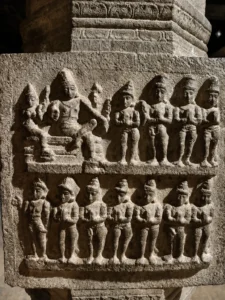
The architecture also operates cosmologically. The vimana rising above the sanctum symbolically represents Mount Meru, the cosmic axis within Hindu cosmology.
Movement from the outer courtyard toward the sanctum mirrors a transition from multiplicity toward sacred concentration. Light decreases. Sound changes. Spatial intensity increases.
The Chola temple therefore functions simultaneously as engineering achievement, ritual environment, symbolic order, and cosmological structure translated into built form.
This integration of geometry, ritual movement, sculpture, cosmology, and spatial sequencing is one of the reasons Chola architecture continues to feel intellectually and emotionally powerful even after a thousand years.
The Three Temples in Sequence
One of the most important aspects of understanding the Great Living Chola Temples is recognising that the three UNESCO monuments should not be approached as disconnected destinations.
They form a chronological and conceptual sequence. Seen individually, they are impressive. Seen together, they reveal the evolution of an architectural and civilisational language across generations.
Brihadisvara Temple, Thanjavur
Brihadisvara Temple was commissioned by Rajaraja Chola I and completed in the early 11th century. This is the canonical statement of Chola monumentality.
The temple asserts authority through scale, geometry, axial precision, and spatial discipline. The vast courtyard immediately establishes a relationship between human presence and imperial architecture.
The sharply ascending vimana dominates the surrounding landscape with controlled precision rather than ornamental excess.
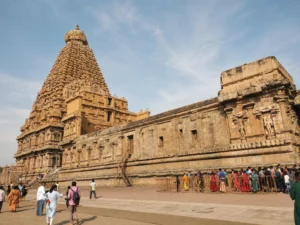
Movement through the complex reinforces this authority. Sightlines narrow progressively toward the sanctum. Thresholds regulate psychological transition. The architecture directs attention rather than competing for it.
The temple functions simultaneously as sacred space, political declaration, administrative centre, artistic programme, and cosmological diagram. The inscriptions preserved on its walls remain among the most important surviving records of Chola governance and temple administration.
The experience of Thanjavur is fundamentally one of certainty. The architecture does not experiment. It establishes. Brihadisvara Temple defines the foundational language of imperial confidence from which the later Chola monuments evolve.
Gangaikonda Cholapuram
Gangaikonda Cholapuram Temple was constructed by Rajendra Chola I following campaigns that extended Chola influence across much of the Indian subcontinent and into maritime Southeast Asia.
While clearly connected to Thanjavur architecturally, the emotional tone shifts noticeably. The vimana softens into a subtly concave form. The geometry becomes more fluid. The composition feels less rigidly assertive.
The architecture no longer appears concerned with proving legitimacy. It operates instead with refinement and spatial confidence.
The surrounding landscape intensifies this atmosphere. Unlike the denser urban environment of Thanjavur, Gangaikonda Cholapuram exists within a more open setting. The absence of the once-great Chola capital creates an unusual sense of spatial isolation. The temple feels simultaneously monumental and restrained.
This transition from assertion toward refinement makes Gangaikonda Cholapuram one of the most intellectually rewarding sites within the Chola circuit. The architecture reflects a civilisation expanding outward while becoming increasingly comfortable with its own artistic language.
Airavatesvara Temple, Darasuram
Airavatesvara Temple completes the UNESCO sequence through precision rather than scale.The monument is smaller than either Thanjavur or Gangaikonda Cholapuram, yet the density of sculptural detail increases dramatically.
The famous chariot-form mandapa introduces movement directly into the architectural composition. Miniature relief panels compress mythological and narrative sequences into tightly controlled sculptural surfaces.
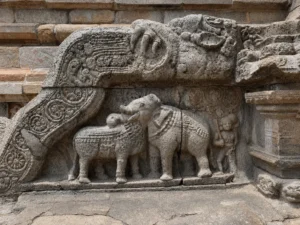
The experience becomes more intimate. The visitor is encouraged to slow down. Observation replaces immediate awe. Details reward sustained attention rather than quick movement through monumental space.
Where Thanjavur overwhelms through scale and Gangaikonda Cholapuram refines monumentality through proportion, Darasuram resolves the sequence through sculptural precision and controlled intimacy.
The progression from Thanjavur to Gangaikonda Cholapuram to Darasuram demonstrates how the Chola architectural language evolved across generations while preserving remarkable continuity. This continuity transforms the Chola circuit from a collection of monuments into a coherent architectural argument.
Beyond the UNESCO Core
The Chola world extends far beyond the three UNESCO temples. To understand the civilisation properly, the broader sacred and political landscape must also be considered.
Narthamalai represents one of the earliest and most important stages in the development of Chola stone architecture. The Vijayalaya Choleeswaram temple preserves a period of experimentation before the monumental certainty of Thanjavur.
The scale is smaller and the atmosphere quieter, yet the architectural vocabulary that would later define the Chola world is already beginning to emerge. Narthamalai reveals that Chola architecture evolved gradually through refinement rather than appearing suddenly at imperial scale.
Before Thanjavur became the political centre of the Chola empire, the region around Pazhayarai functioned as an important royal landscape. Temples such as Somanatha Swamy Temple preserve a more intimate dimension of Chola history.
These spaces connect visitors not to imperial projection, but to the lived environment of the dynasty itself. Pazhayarai introduces dynastic continuity, sacred geography, royal residence culture, and the formative world surrounding the Chola court.
The architectural journey reaches its later refinement at Kampaheswarar Temple, constructed under Kulothunga Chola III. The temple preserves the axial discipline and vertical energy of earlier Chola structures while introducing increased sculptural density and theological complexity.
The Sharabeshwarar shrine reflects the growing sophistication of late Chola iconography and religious culture. Thirubuvanam therefore represents not a departure from the Chola tradition, but one of its final monumental flourishes.
Together, these sites expand the Chola story beyond UNESCO recognition alone. They reveal the civilisation as a continuous architectural and sacred landscape evolving across centuries rather than a collection of isolated monuments.The Kaveri Delta, Governance, and the Chola World.
To understand how the Chola monuments fit within the wider network of sacred cities, pilgrimage routes, and dynastic temple traditions across the state, explore Tamil Nadu’s broader temple landscape.
The Kaveri Delta, Governance, and the Chola World
The Chola temples cannot be separated from the Kaveri Delta. The river systems surrounding the Kaveri River sustained one of the most productive agrarian landscapes in medieval South India and formed the economic foundation of the Chola world.
Through canals, distributaries, reservoirs, sluices, and irrigation systems, the Cholas transformed the delta into a highly organised agricultural network capable of generating enormous surplus.
This surplus financed monumental construction, sustained artisan communities, supported temple institutions, mobilised labour, and maintained administrative systems across the empire.
The temples therefore functioned not as isolated religious structures, but as institutional centres embedded within a much larger framework of economic management and political organisation.
One of the clearest examples of this organisational sophistication appears in the inscriptional records associated with the Kudavolai system under Parantaka Chola I.
Inscriptions at Uthiramerur document a highly structured form of local self-governance involving village assemblies, committee-based administration, qualification criteria, rotational selection systems, and inscriptional accountability.
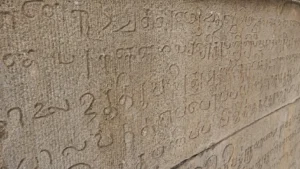
These records reveal a civilisation dependent not solely upon kingship and monumentality, but upon disciplined local institutions capable of sustaining long-term administrative continuity.
Temple inscriptions therefore functioned as operational records as much as sacred documents. They preserved information relating to taxation, irrigation obligations, merchant activity, land administration, ritual duties, and governance systems. Architecture and administration operated together.
This integration of water management, sacred institutions, local governance, and economic organisation is one of the defining characteristics of the Chola civilisation.
The temples survive today not merely because they were built in stone, but because they emerged from a larger system of institutional stability and agrarian productivity.
The Cholas and the Indian Ocean World
The Chola civilisation was never regionally isolated. Through maritime trade, merchant guilds, naval expansion, and cultural exchange, the Cholas participated in a wider Indian Ocean network that connected South India with Sri Lanka, Southeast Asia, and parts of the broader maritime world.
Under Rajendra Chola I, Chola influence extended across maritime routes linking the Tamil region with areas of present-day Indonesia, Malaysia, Thailand, and Cambodia.
While military campaigns formed part of this expansion, the larger significance of the Chola maritime world lay in exchange rather than conquest alone.
Merchant guilds, sacred traditions, artistic forms, and economic systems circulated across interconnected trade networks.
Tamil merchant communities established influence far beyond the Indian subcontinent, contributing to the transmission of religious ideas, temple culture, and artistic practices throughout maritime Asia.
This wider perspective transforms the Chola story from regional dynastic history into a transnational civilisational narrative.
The temples of Tamil Nadu were not isolated architectural achievements. They existed within a larger world shaped by trade, movement, exchange, and cultural circulation across the Indian Ocean.
Understanding this maritime dimension also changes how the Chola monuments themselves are perceived. The wealth required for monumental architecture did not emerge from isolation.
It emerged from a civilisation deeply connected to wider economic and cultural networks extending far beyond the Kaveri Delta.
Kumbakonam and the Living Continuity of the Chola World
If the UNESCO temples represent the monumental core of the Chola civilisation, Kumbakonam preserves much of its living continuity. Set within the fertile Kaveri basin, the town has functioned for centuries as a centre of temple ritual, Vedic learning, artisanal production, and sacred movement across the Tamil landscape.
What distinguishes Kumbakonam is not the scale of any single monument, but density. Temples appear not as isolated heritage sites, but as part of the fabric of everyday life.
Ritual calendars continue to regulate movement through the town. Priests, flower sellers, bronze artisans, silk merchants, musicians, and pilgrims all remain connected to systems that evolved during the Chola period and continued through later dynasties.
This continuity becomes especially visible in the artisanal traditions surrounding the region. Nearby Swamimalai remains one of the most important centres for bronze casting in South India, where hereditary sthapathi families continue the lost-wax casting process associated with Chola bronze sculpture.
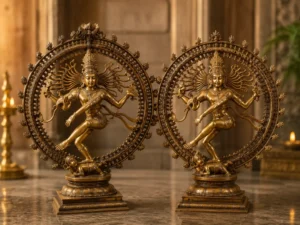
The creation of a Nataraja image today still follows principles and techniques preserved across generations. The process is not presented as reconstructed heritage, but as living practice.
The same continuity appears in ritual culture. Temple processions, sacred music, liturgical recitation, and ceremonial movement continue to animate spaces shaped by medieval planning.
This transforms the Chola landscape from archaeology into continuity. The civilisation survives not merely through stone architecture, but through living systems that continue to adapt without fully severing themselves from their historical foundations.
Kumbakonam therefore plays an essential role in understanding the Great Living Chola Temples properly. Without it, the Chola world can appear monumental but distant.
With it, the temples become part of an ongoing cultural ecosystem where architecture, ritual, craftsmanship, and sacred geography still interact in everyday life.
Why Sequence Matters
One of the most overlooked aspects of the Chola circuit is sequencing. Most visitors encounter the temples through logistical convenience rather than conceptual progression, moving rapidly between sites without understanding how the monuments relate to one another architecturally or historically.
This weakens the experience significantly.
The Chola temples should ideally be approached in sequence, beginning with Thanjavur, progressing toward Gangaikonda Cholapuram, and concluding at Darasuram. This movement mirrors the evolution of the Chola architectural language itself.
Thanjavur establishes imperial certainty through monumentality and axial force. Gangaikonda Cholapuram softens that assertion into greater refinement and spatial fluidity. Darasuram resolves the sequence through sculptural precision, intimacy, and technical sophistication.
Without sequence, the temples become disconnected monuments. With sequence, they become chapters within a continuous architectural argument.
This is also why pacing matters. The Chola world cannot be meaningfully absorbed through hurried movement between sites.
These temples were designed around controlled progression, ritual timing, spatial transition, and gradual revelation. Their logic unfolds through movement and observation rather than instant visual consumption.
Interpretation-led travel therefore becomes essential. A meaningful encounter with the Chola world depends not simply upon access, but upon understanding how architecture, landscape, ritual, and historical continuity interact across the larger sacred geography of the Kaveri basin.
The most rewarding journeys through the Chola landscape are rarely the fastest. They are the most carefully structured.
What Most Visitors Miss
Many visitors leave the Chola temples remembering primarily their scale. Yet some of the most important dimensions of the experience are quieter and easier to overlook.
The inscriptions along shaded corridors are often passed without attention, despite preserving administrative records that reveal how the civilisation functioned.
Thresholds between spaces subtly regulate psychological transition through compression, darkness, and controlled visibility. Ritual sound changes as movement approaches the sanctum. Light shifts across granite surfaces throughout the day, altering the emotional character of the architecture itself.
At Darasuram, miniature sculptural panels reward sustained observation rather than quick photography. At Gangaikonda Cholapuram, the relationship between monument and open landscape becomes part of the architectural experience.
At Thanjavur, the overwhelming scale of the courtyard can obscure the precision with which movement and sightlines have been orchestrated.
The Chola world rewards stillness more than speed.
This is why compressed itineraries often fail to communicate the depth of the civilisation. Monumentality alone is not the essence of the experience. The deeper understanding emerges through pacing, observation, sequence, and attention to the quieter systems embedded within the architecture.
The temples were never intended to function merely as visual spectacle. They were designed as environments where ritual, movement, sound, geometry, and sacred order operated together.
How to Experience the Chola World Properly
The Chola civilisation cannot be meaningfully reduced to a day trip. The temples were conceived within a highly organised cultural system where architecture, ritual, administration, sacred geography, and movement operated together.
To experience them properly requires more than transportation between monuments. It requires sequence, pacing, interpretation, and an understanding of how the spaces were intended to function.
This is where most standard itineraries fail. They prioritise coverage rather than comprehension. Time is compressed, movement becomes mechanical, and the temples are encountered as isolated highlights rather than as parts of a continuous civilisational landscape.
A more considered approach changes the experience entirely.
Entering Brihadisvara Temple at first light reveals the structure before the courtyards fill with movement and heat. Granite surfaces retain clarity. Inscriptions remain legible. The axial force of the architecture becomes easier to perceive.
At Gangaikonda Cholapuram Temple, time spent within the surrounding landscape becomes as important as the monument itself, allowing the relationship between openness and refinement to emerge gradually.
At Airavatesvara Temple, slower observation becomes essential because the architecture reveals itself through sculptural density rather than overwhelming scale.
Interpretation also matters enormously. The Chola temples cannot be fully understood through disconnected historical facts or memorised dates alone.
The deeper experience emerges when architecture is explained as part of a larger system involving irrigation networks, governance structures, sacred cosmology, ritual sequencing, and imperial administration.
The journey therefore must be designed rather than assembled.Such a guided masterpiece allows the architectural progression of the Chola world to unfold naturally.
Distances between sites should function as transitions rather than interruptions. Pacing should allow the architectural language to unfold progressively.
The sequence from Thanjavur to Gangaikonda Cholapuram and finally Darasuram should remain intact because it mirrors the evolution of Chola architecture itself.
The most meaningful journeys through the Chola world are rarely defined by how much is covered in a single day. They are defined by how clearly the civilisation becomes legible across landscape, monument, ritual, and time.
Best Time to Visit the Great Living Chola Temples
The ideal period for exploring the Great Living Chola Temples is generally between November and February, when temperatures across the Kaveri Delta are comparatively moderate and extended movement through open granite courtyards becomes more comfortable.
During these months, the softer winter light also reveals sculptural detail and surface texture with greater clarity.Early morning visits are especially valuable.
At Brihadisvara Temple, the first hours after opening preserve a sense of spatial calm before visitor movement intensifies.
Granite surfaces remain cooler, inscriptions are easier to observe without glare, and the axial geometry of the architecture becomes more legible in softer light.
The same principle applies across the Chola circuit.
At Gangaikonda Cholapuram Temple, morning light enhances the softer contours of the vimana and reinforces the relationship between monument and open landscape.
At Airavatesvara Temple, quieter hours allow the sculptural density of the mandapas and relief panels to be experienced without interruption.
Festival periods can provide extraordinary ritual atmosphere, particularly in temple towns such as Kumbakonam, though they also introduce larger crowds and altered movement patterns.
For visitors seeking deeper architectural observation and interpretive clarity, slower travel outside peak festival congestion often allows the Chola landscape to reveal itself more fully.
Closing
The Great Living Chola Temples represent one of the most coherent architectural and civilisational achievements in South Asian history. Their significance lies not merely in monumentality, but in integration.
Architecture, governance, irrigation, ritual, sculpture, trade, and sacred geography operated together within a remarkably organised cultural framework sustained across centuries.
The temples that survive today are therefore not isolated artistic achievements. They are visible expressions of a civilisation that understood built space as an extension of sacred order, political structure, and cultural continuity.
More than a thousand years later, that continuity remains partially intact across the landscapes of Tamil Nadu.
The granite vimanas still dominate the horizon. Rituals continue within sanctums consecrated during the Chola period. Temple towns remain active.
Bronze casting traditions survive through hereditary artisans. Sacred processions continue to move through spaces shaped by medieval planning.
The Chola world survives not as ruin, but as continuity.
To move through this landscape carefully is to encounter more than temples. It is to witness a civilisation that translated governance, cosmology, engineering, ritual, and artistic discipline into architecture of extraordinary permanence and precision.
That is why the Great Living Chola Temples continue to matter, not only as monuments of the past, but as one of the clearest surviving expressions of how an entire civilisation understood order, space, and the sacred.
Related Blogs
Thanjavur Beyond Brihadeeswara Temple: Exploring the Cultural Heart of the Cauvery Delta
More Than a Temple City For many travellers, Thanjavur begins and ends with Brihadeeswara Temple. The soaring vimana, vast courtyards,…
Read More ›
Kanchipuram: Sacred Architecture and Living Traditions
More Than the City of a Thousand Temples Kanchipuram is often introduced as the “City of a Thousand Temples.” While…
Read More ›