
Airavatesvara Temple, Darasuram: The Chola Masterpiece That Rewards Slow Observation
A Monument Measured in Detail
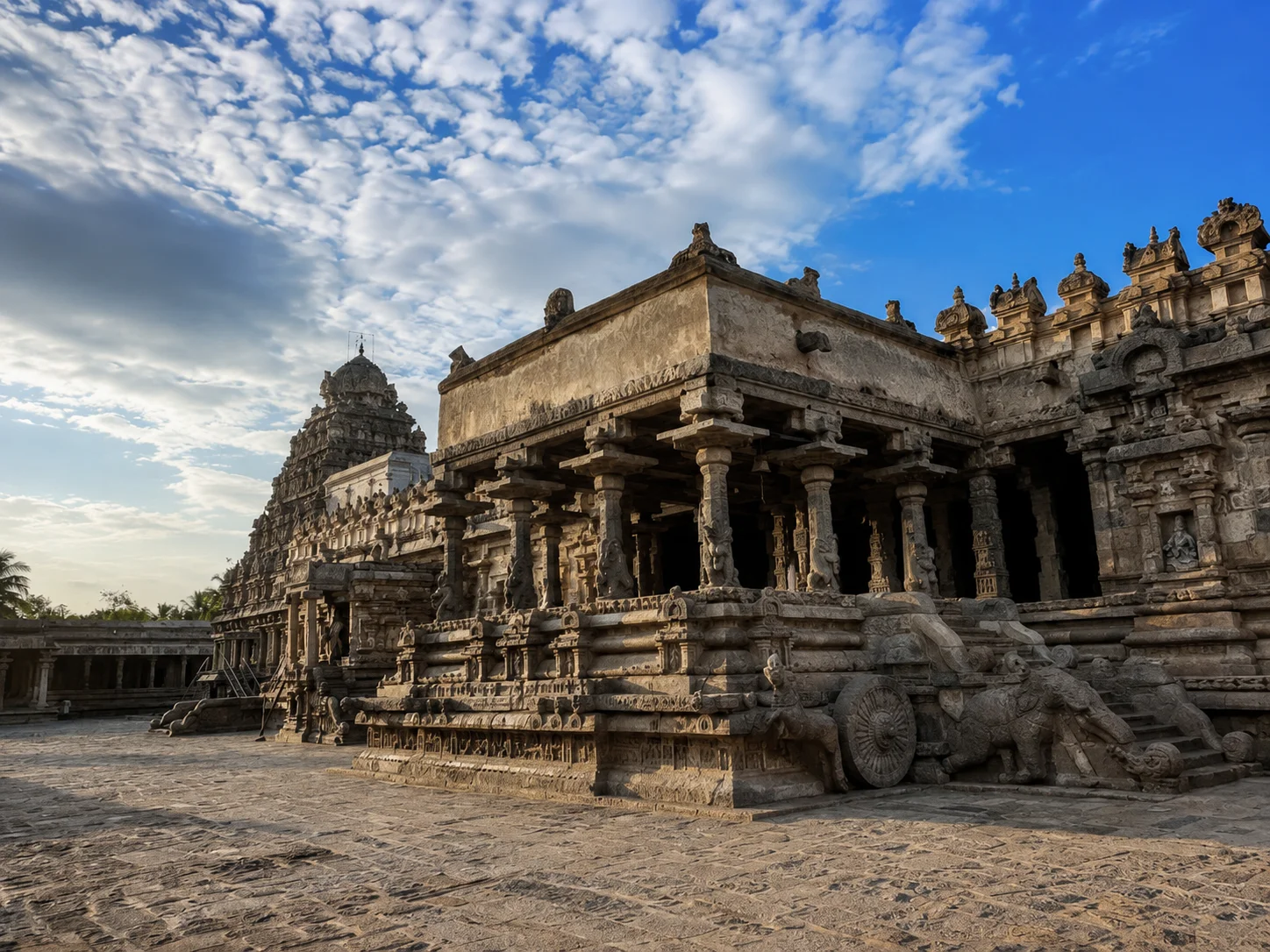
Airavatesvara Temple does not dominate the landscape in the way Brihadisvara Temple does. The first impression is quieter. The vimana rises with elegance rather than force, the mandapas unfold gradually, and the sculptural programme reveals itself layer by layer instead of through overwhelming scale.
For many visitors arriving after Thanjavur or Gangaikonda Cholapuram, Darasuram can initially seem restrained. That impression changes the moment one begins to look closely.
This is not a temple built for distant admiration alone. Airavatesvara Temple rewards proximity, patience, and repeated observation.
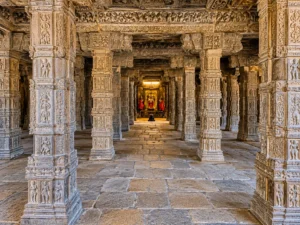
What appears measured from afar becomes extraordinarily dense at close range. Pillars carry miniature narrative worlds.
Staircases respond with sound. Light shifts across sculpted granite throughout the day. Architectural rhythm replaces monumental assertion.
Built during the reign of Rajaraja II in the 12th century, the temple belongs to a mature phase of Chola architecture. Earlier monuments had already established imperial authority through scale, geometry, and engineering ambition.
Darasuram takes the same architectural language and refines it into something more concentrated. The focus shifts from monumentality toward precision, sculptural richness, and sensory experience.
That transformation is what makes the temple so important within the larger Chola tradition.
Airavatesvara Temple is one of the three UNESCO-recognised monuments collectively known as the Great Living Chola Temples, alongside Brihadeeswarar Temple in Thanjavur and Gangaikonda Cholapuram.
The monument asks to be read slowly, almost like a carefully layered text rather than a singular visual statement. That is precisely why it remains one of the most rewarding architectural experiences in the Kaveri Delta.
Rajaraja II and the Mature Phase of Chola Architecture
By the time Rajaraja II commissioned Airavatesvara Temple, the Chola Empire had already passed through its great age of territorial expansion.
Under Rajaraja I and Rajendra I, the empire projected power across much of South India and beyond the Indian Ocean. Architecture during that earlier period carried a strongly imperial character. Temples asserted authority through scale, axial planning, and monumental verticality.
Darasuram belongs to a different stage within that evolution. The empire remained culturally influential, but the architectural language had matured.
Instead of constructing ever-larger monuments, later Chola builders intensified sculptural sophistication and ornamental precision. The emphasis shifted from pure scale toward artistic concentration.
This change becomes immediately visible at Airavatesvara Temple. The monument is smaller than the earlier Brihadisvara temples, yet the reduced scale allows for extraordinary density of detail.
Surfaces become more animated, more tactile, and more rhythmically composed. The architecture no longer depends solely on mass to create impact. It draws attention through intricacy and movement.
Rajaraja II himself is remembered more as a patron of religion and artistic culture than as a conquering emperor. Under his reign, temple-building evolved through refinement rather than repetition.
Darasuram reflects that confidence. It does not attempt to imitate Thanjavur directly or compete with Gangaikonda Cholapuram in scale. Instead, it demonstrates how deeply the Chola architectural vocabulary could evolve while remaining structurally coherent.
The result is a monument where architecture, sculpture, movement, and ritual begin operating almost seamlessly together. Darasuram is not simply built space. It is carefully orchestrated experience.
The Architecture of Airavatesvara Temple
The Chariot Mandapa and Architecture in Motion
The most distinctive feature of Airavatesvara Temple is the remarkable chariot-form mandapa positioned before the sanctum.
Unlike the monumental rigidity of earlier Chola structures, this mandapa introduces movement directly into the architecture itself. Stone wheels, carved spokes, leaping horses, and elephant motifs transform the structure into a ceremonial vehicle frozen in motion.
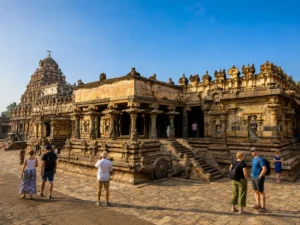
This treatment changes how the monument is perceived. The architecture feels rhythmic rather than static. Attention moves horizontally across sculptural surfaces instead of being directed immediately upward toward the vimana.
The effect is subtle but significant. Darasuram does not rely on overwhelming height to establish presence. It creates energy through sculptural choreography.
The detailing of the mandapa rewards close observation. The carved wheels are deeply articulated, the horses appear muscular and animated, and the elephants ground the lower visual field with weight and balance. Together they generate a controlled sense of procession through stone.
Movement is reinforced further through spatial sequencing. Steps rise gradually into pillared mandapas, corridors compress and release visual fields, and repeated sculptural patterns establish rhythm across the built environment. Architecture here behaves almost like unfolding narrative rather than static enclosure.
This rhythmic quality is one of Darasuram’s defining achievements. The monument does not merely contain sculpture. It transforms architecture itself into movement.
Sculptural Density and Narrative Compression
If Thanjavur demonstrates the power of monumental geometry, Darasuram demonstrates the power of concentration. Few South Indian temples compress such extraordinary sculptural detail into such an intimate architectural field.
Miniature relief panels cover pillars, stairways, and mandapa surfaces with remarkable precision. Mythological episodes appear beside scenes from daily life, devotional traditions, dance, warfare, and ritual performance. Some carvings are scarcely larger than a human hand, yet retain astonishing clarity and control.
The sculptural programme dedicated to the sixty-three Nayanmars is particularly important. These panels do more than honour Shaivite saints. They transform the temple into narrative architecture, where movement through space becomes movement through devotional memory.
Darasuram is also notable for the way it incorporates ordinary human activity into sacred architecture. Dancers, musicians, devotees, and ritual specialists appear repeatedly throughout the sculptural field. This broadens the emotional texture of the monument. The temple feels inhabited rather than purely ceremonial.
Dance and music motifs recur across the architecture in carefully organised rhythms. Circular medallions frame dancers in motion, while ornamental bands create continuity between structural and sculptural surfaces. The detailing never feels chaotic because repetition and spacing maintain visual discipline throughout the monument.
Material contrast also plays an important role. Dark basalt figures placed within lighter granite surfaces create subtle emphasis without disrupting architectural harmony. The eye is guided carefully across the structure rather than overwhelmed by decorative excess.
Darasuram rewards viewers willing to slow their pace. At a distance, the temple appears elegant and composed. Up close, it becomes almost inexhaustible.
Musical Steps and Sensory Architecture
Among the temple’s most fascinating features are the famous musical stone steps near the bali peetha. When lightly tapped, different sections produce distinct tonal responses. Whether approached as acoustic experimentation or ritual design, the effect expands the architectural experience beyond visual form alone.
This sensory dimension is central to understanding Darasuram. The temple was never intended as silent stone architecture. It functioned within an environment shaped by music, chanting, lamps, dance, and ceremonial movement. Architecture here participates in ritual experience rather than merely containing it.
The idea often associated with the temple as “nitya-vinoda” can be understood as continuous sensory engagement. Darasuram integrates rhythm into nearly every aspect of the built environment. Sculptures imply movement, pillars establish cadence, and musical steps transform stone into sound.
This changes how the monument is experienced physically. One moves through the temple differently, pausing more often, noticing tonal shifts in light and surface, and gradually recognising the relationship between sculpture, rhythm, and space.
Unlike monuments designed primarily for distant visual impact, Darasuram becomes richer through proximity. Its details are not secondary embellishments. They are fundamental to how the architecture communicates.
Light, Stone, and Spatial Precision
Another defining quality of Airavatesvara Temple is its extraordinary spatial control. Compared to the vast courtyards of Brihadisvara Temple, Darasuram operates through intimacy and precision.
Spaces narrow, surfaces move closer to the observer, and sculptural detail becomes inseparable from movement through the monument.
Light plays a major role in this experience. Stone jaalis and openings filter sunlight unevenly across corridors and pillars, creating changing textures throughout the day. Certain carvings emerge only under angled light, while recessed surfaces remain in shadow, sharpening sculptural contrast.
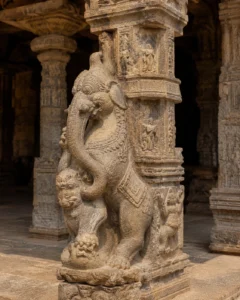
The gaja-yali pillars are especially effective in this regard. Their curled forms generate complex patterns of shadow and depth that animate the surrounding stone surfaces. The architecture feels dynamic rather than fixed.
Even the reduced height of the vimana contributes to this atmosphere. At roughly twenty-four metres, it remains elegant and commanding, yet never overwhelms the human scale entirely. Attention therefore remains distributed across the full architectural field rather than focused exclusively upward.
Darasuram represents concentration rather than reduction. Nothing feels diminished. Instead, the artistic energy of Chola architecture becomes more focused, tactile, and refined.
Why Darasuram Rewards Slow Observation
Many historic monuments communicate immediately through scale or visual dominance. Darasuram works differently. Its richness emerges gradually through attention and repetition.
A hurried visit inevitably misses much of what makes the temple exceptional. The miniature carvings require proximity. Sculptural rhythms become visible only through sustained observation.
Light changes the surfaces constantly, altering the visual texture of pillars, niches, and corridors throughout the day.
This slower mode of engagement changes the relationship between visitor and monument. Instead of standing before a singular visual statement, one becomes immersed within a layered architectural environment.
Details accumulate gradually: repeated dance motifs across pillars, tonal variation in stone surfaces, compressed transitions between spaces, and sculptural sequences hidden within larger ornamental patterns.
The contrast with Brihadisvara Temple is revealing. Thanjavur establishes authority instantly through monumental scale and geometric force. Darasuram develops intimacy through sustained observation. Both approaches are equally sophisticated, but they produce fundamentally different architectural experiences.
This is what makes Airavatesvara Temple so significant within the Chola tradition. It demonstrates that architectural greatness does not depend solely on size.
Precision, rhythm, sensory richness, and sculptural intelligence can create an equally powerful experience through entirely different means.
Airavatesvara Temple Within the Great Living Chola Temples
As part of the Great Living Chola Temples recognised by UNESCO, Airavatesvara Temple represents the final major stage in the architectural evolution of the Chola world.
At Thanjavur, the Cholas established monumental authority through geometry and engineering ambition.
At Gangaikonda Cholapuram, that language evolved toward greater fluidity and compositional refinement. Darasuram completes the progression by concentrating artistic sophistication into sculptural density and sensory precision.
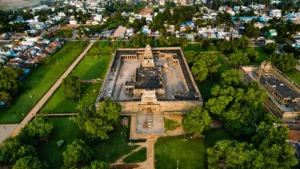
Importantly, the temple remains a living monument rather than an archaeological relic. Ritual continuity preserves the original relationship between architecture, movement, sound, and devotion that shaped the monument historically. This continuity remains central to understanding the “living” dimension of the UNESCO designation.
Darasuram therefore occupies a unique place within South Indian architectural history. It is not merely the smallest of the three great Chola temples. It is the monument where the Chola architectural tradition reaches its highest level of ornamental maturity.
Why Airavatesvara Temple Still Matters
In contemporary discussions of heritage, large monuments often dominate public imagination. Darasuram offers a different lesson. Its significance lies not in monumental scale, but in the extraordinary refinement of its artistic vision.
The temple preserves one of the most sophisticated integrations of architecture, sculpture, rhythm, and sensory experience found anywhere in South Asia. Stone here functions simultaneously as structure, ornament, movement, and narrative.
Darasuram also matters because it encourages a slower form of cultural engagement. The monument resists hurried consumption. It asks for patience, attention, and close observation in a way increasingly rare within modern tourism.
Even today, filtered light across carved granite, rhythmic corridors, sculptural shadows, and carefully sequenced spaces continue shaping the experience much as they did centuries ago. That enduring precision is what makes Airavatesvara Temple extraordinary.
Conclusion
Airavatesvara Temple represents the final maturity of Chola architecture. Here, monumentality gives way to concentration, scale yields to precision, and architecture becomes inseparable from rhythm, sculpture, and sensory experience.
The temple rewards those willing to slow down. Its richness does not announce itself immediately. It emerges gradually through carved surfaces, shifting light, miniature narratives, and architectural movement experienced over time.
That is what makes Darasuram exceptional within the Chola world. It demonstrates that artistic greatness can be achieved not only through size, but through extraordinary control of detail, atmosphere, and observation.
Related Blogs
Thanjavur Beyond Brihadeeswara Temple: Exploring the Cultural Heart of the Cauvery Delta
More Than a Temple City For many travellers, Thanjavur begins and ends with Brihadeeswara Temple. The soaring vimana, vast courtyards,…
Read More ›
Kanchipuram: Sacred Architecture and Living Traditions
More Than the City of a Thousand Temples Kanchipuram is often introduced as the “City of a Thousand Temples.” While…
Read More ›