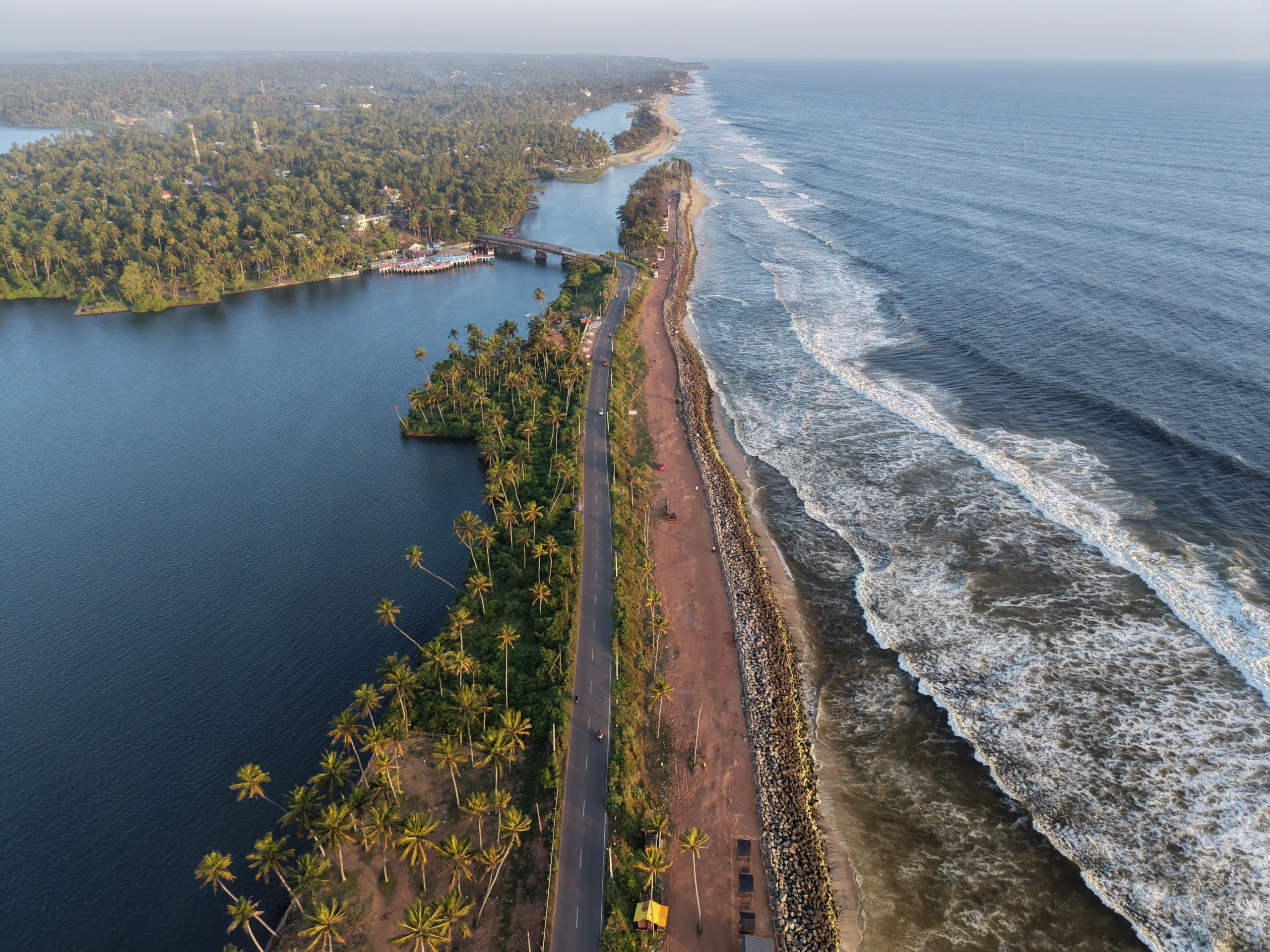
The Living Coast-Kerala

The Living Coast
Kerala

Maritime cultures shaped by trade,tides and time

The Context

Kerala has always faced the sea. Long before borders were drawn, its shores received merchants, monks, physicians, and pilgrims—each leaving traces without unsettling the core. What emerged was not a culture of conquest, but one of quiet absorption: ideas arrived, were refined, and became inseparable from the land.
Life here followed water, wind, and season.
Monsoons shaped agriculture, backwaters shaped settlement, and the ocean shaped outlook. Knowledge travelled through households and lineages—nowhere more clearly than in Ayurveda, practiced not as retreat or remedy, but as an everyday science of balance, diet, and longevity. Healing was embedded in routine, not separated from life.
Temples functioned as centres of learning; performance evolved as ritual rather than spectacle; wellness matured as inheritance rather than industry. Power was rarely asserted. It was practiced—through continuity, restraint, and care.
Kerala’s traditions remain alive because they were never ornamental. They were functional, disciplined, and enduring. Within Southern India, Kerala stands apart as a civilization shaped by exchange, equilibrium, and intelligent living.

The Context

Cultural Landscape

Backwater Civilization
The Ayurvedic South
The Spice Coast
Highland Forest Cultures
Living Malabar
Backwater Civilization
Kerala’s backwaters are not a landscape created for leisure; they are a civilisation shaped by water as infrastructure. Canals, rivers, and lakes functioned as arteries of movement, commerce, and agriculture long before roads arrived. Villages grew inward toward water, not outward toward land, producing a rhythm of life governed by tides, seasons, and monsoon intelligence. Farming below sea level demanded precision—sluice gates, bunds, and collective labour—creating communities defined by cooperation rather than isolation. Boats were everyday necessities, markets floated, and time itself slowed to the pace of water. This civilisation did not seek to dominate nature; it learned to negotiate with it. Even today, the backwaters remain lived spaces, where work, faith, and domestic life unfold in continuity. The Backwater Civilisation represents Kerala’s most enduring lesson: prosperity achieved through balance, patience, and environmental intelligence.
The Ayurvedic South
The Ayurvedic South is rooted not in wellness indulgence, but in disciplined medical knowledge refined over centuries. Here, Ayurveda functions as a clinical science—diagnostic, time-bound, and lineage-based—transmitted through gurukul traditions rather than commercial institutions. Healing begins with understanding the individual: constitution, climate, diet, and rhythm of life. Treatments unfold slowly, demanding commitment, observation, and restraint. This medical culture evolved in dialogue with Kerala’s ecology—its humidity, medicinal forests, and seasonal cycles—creating a system inseparable from place. Families of physicians preserved texts, practices, and ethical codes through uninterrupted transmission. In the Ayurvedic South, healing is not an escape from life but a recalibration of it. The body is treated as an ecosystem, health as balance, and recovery as a process requiring time. It is a tradition that values precision over promise, continuity over trend.
The Spice Coast
The Spice Coast marks one of history’s earliest global trade corridors, where Kerala entered the world economy long before modern Europe emerged. Pepper, cardamom, clove, and ginger moved from forest interiors to coastal ports, guided by monsoon winds and maritime knowledge. This trade shaped a culture fluent in negotiation, measurement, and trust—values essential for long-distance commerce. Unlike empires built on conquest, the Spice Coast thrived on relationships, contracts, and seasonal intelligence. Arab, Jewish, Chinese, and European traders arrived not as discoverers, but as participants in an already functioning system. The legacy of this exchange lives on in coastal towns, culinary traditions, and mercantile ethics that prize reliability over spectacle. The Spice Coast reveals a civilisation that understood global connectivity early, engaging the world with confidence, adaptability, and cultural self-assurance.
Highland Forest Cultures
Kerala’s highlands rise quietly from the coast, forming a cultural world shaped by altitude, rainfall, and forest intelligence. The Western Ghats nurtured indigenous communities, plantation societies, and ecological knowledge systems attuned to fragile landscapes. Life here evolved through observation—of soil, mist, monsoon, and biodiversity—producing cultures grounded in restraint rather than extraction. Tea estates, spice plantations, and forest settlements introduced layered histories, blending indigenous wisdom with agrarian enterprise. These highlands function as ecological reservoirs, sustaining rivers, climate balance, and medicinal resources for the lowlands below. Silence, distance, and slow rhythms define the experience of the highlands, offering contrast to the coast’s movement. Highland Forest Cultures represent Kerala’s ecological conscience—a reminder that prosperity depends on stewardship, and that cultural continuity is inseparable from environmental care.
Living Malabar
Living Malabar reflects a cultural landscape shaped by coexistence rather than uniformity. Along this northern stretch of Kerala, faith, language, and social practice evolved through sustained interaction—Hindu, Muslim, Christian, and Jewish traditions developing side by side within everyday life. Rituals here are not staged; they are practiced as routine, aligned with agricultural cycles, trade rhythms, and community memory. Markets, mosques, temples, and homes exist in close proximity, reinforcing a social fabric built on familiarity rather than segregation. Malabar’s culture absorbed influences without losing coherence, producing a society comfortable with plurality and debate. This is not a region defined by monuments alone, but by continuity—of ideas, customs, and shared space. Living Malabar represents Kerala’s quiet confidence: a civilisation that learned to sustain diversity through practice, not proclamation.
Stewardship by Design

Stewardship by Design

Sustainability at Lux Crafter is embedded into how we choose partners, shape journeys, and operate on the ground. Our approach prioritises responsible destination management, respect for local communities, and long-term environmental stewardship—delivered with the same discipline, reliability, and precision that define our operations.