
The Kudavolai System: Governance in the Chola World
Governance Beyond Kings and Temples
The history of the Cholas is usually remembered through monumental temples, imperial conquests, bronze sculpture, and maritime expansion across the Indian Ocean. The towering granite vimana of Brihadisvara Temple, the sacred landscapes of Pazhayarai, and the architectural refinement of Darasuram often dominate conversations about the dynasty.
Yet the endurance of the Chola world depended on something far less visible but equally extraordinary, deeply organised systems of local governance.
Behind the imperial spectacle stood a civilisation sustained by village assemblies, irrigation management, taxation systems, administrative committees, and public accountability.
Across medieval Tamilakam, local institutions supervised agricultural resources, managed temples, resolved disputes, and regulated economic life with remarkable procedural sophistication. Some of the clearest surviving records of this administrative culture remain preserved in stone inscriptions at Uthiramerur.
These inscriptions, especially those associated with the reign of Parantaka Chola I, describe a structured process of village administration known today as the Kudavolai system.
While modern discussions often present it as an early form of democracy, the inscriptions reveal something more historically significant: a society that treated governance as a disciplined institutional responsibility embedded within everyday public life.
The Chola Empire was not governed solely from imperial capitals such as Thanjavur or Gangaikonda Cholapuram. Its stability relied upon local institutions capable of managing water systems, agrarian production, taxation, and communal order across hundreds of villages.
The Kudavolai inscriptions therefore offer one of the most important surviving windows into how governance actually functioned within the Chola world.
Uthiramerur and the Political Landscape of Early Medieval Tamilakam
Located in present-day Kanchipuram district, Uthiramerur was originally established as a Brahmadeya settlement during the Pallava period.
Under the Pallava ruler Nandivarman II in the 8th century CE, the village was formally granted to Brahmins and evolved into an important agrarian and ritual centre. Inscriptions refer to the settlement as “Uttaramerur Chaturvedi Mangalam,” a name that reflects its connection to Vedic scholarship and Brahmin institutions.
What makes Uthiramerur historically remarkable is not merely its antiquity, but the survival of inscriptions spanning several dynasties. Pallava, Chola, Pandya, and Vijayanagara rulers all left records in the region, preserving centuries of political continuity and institutional evolution. Long before the Cholas expanded their imperial authority across Tamilakam, Uthiramerur already possessed structured assemblies capable of administering land, irrigation works, and temple endowments.
The Cholas inherited this institutional landscape rather than creating it entirely anew. When the region came under Chola authority during the 9th century, local governance became increasingly systematised and integrated into a much larger imperial framework. The inscriptions associated with Parantaka Chola I reveal how village administration evolved into a more formalised and committee-driven structure under Chola supervision.
This continuity is extremely important because it demonstrates that Chola governance emerged from a broader political culture already developing under earlier South Indian dynasties. The Cholas strengthened, expanded, and institutionalised these systems with extraordinary precision, transforming local administration into one of the foundations of imperial stability.
The Chola Administrative World
The Chola Empire functioned through a layered administrative system that balanced central authority with strong local institutions. At the top stood the emperor and royal court, but beneath this imperial structure operated a vast network of provinces, districts, Nadus, and villages responsible for everyday administration across the agrarian landscape.
This decentralised arrangement was essential because the Chola state governed a civilisation deeply dependent on agriculture, irrigation, taxation, and temple economies. Royal authority alone could not manage such a vast territorial network. Stability required local institutions capable of supervising resources at the village level with consistency and accountability.
Village assemblies therefore became one of the defining features of Chola governance. In Brahmadeya settlements, administration was largely supervised by the Sabha, an organised assembly dominated by Brahmin landholders.
In non-Brahmin villages, the “Ur” functioned as a broader local assembly responsible for managing communal affairs. These institutions exercised real authority over land transactions, irrigation systems, taxation, temple administration, and dispute resolution.
What emerges from the inscriptions is a civilisation where governance operated through institutions rather than arbitrary authority alone.
Administrative responsibilities were distributed across committees, assemblies, and local bodies capable of sustaining order even far from imperial capitals. This institutional depth explains how the Cholas maintained political stability across such a large and economically productive empire for centuries.
The grandeur of Chola architecture may have projected imperial power outward, but the empire itself rested upon disciplined local administration embedded within the everyday life of villages.
Sabha, Ur, and the Structure of Village Administration
The inscriptions at Uthiramerur reveal that village administration in the Chola world operated through highly organised assemblies rather than informal local authority. The Sabha, which functioned primarily within Brahmadeya settlements, represented the most formal and influential of these institutions.
Its members were generally drawn from Brahmin landholding groups who possessed both ritual status and economic influence within the settlement.
The Sabha supervised an impressive range of responsibilities. It regulated taxation, managed irrigation resources, administered temple endowments, oversaw land transactions, and supervised public works. Decisions were often taken collectively within assembly meetings held inside temple halls, demonstrating how sacred and administrative life were deeply interconnected in the Chola world.
Alongside the Sabha operated the Ur, a village assembly found mainly in non-Brahmin settlements. Though less formal in structure, the Ur still played a crucial role in managing agricultural life, water distribution, communal obligations, and local order.
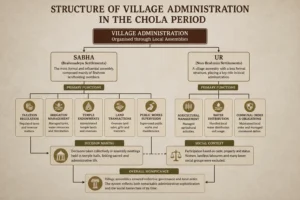
These institutions reveal the degree to which governance in medieval Tamilakam depended upon collective administration rather than centralised bureaucracy alone. Village assemblies functioned as durable local institutions capable of maintaining economic and social order across generations.
At the same time, the system reflected the social hierarchies of its period. Participation was shaped by caste, property ownership, and social status. Women, landless labourers, and many lower social groups remained excluded from formal political participation. The sophistication of the system therefore existed within the unequal social framework of early medieval society.
Recognising this complexity is important because it allows the Kudavolai system to be understood historically rather than romantically. Its significance lies not in modern democratic ideals, but in the remarkable administrative sophistication it achieved within its own political and social world.
The Kudavolai System and the Logic of Selection
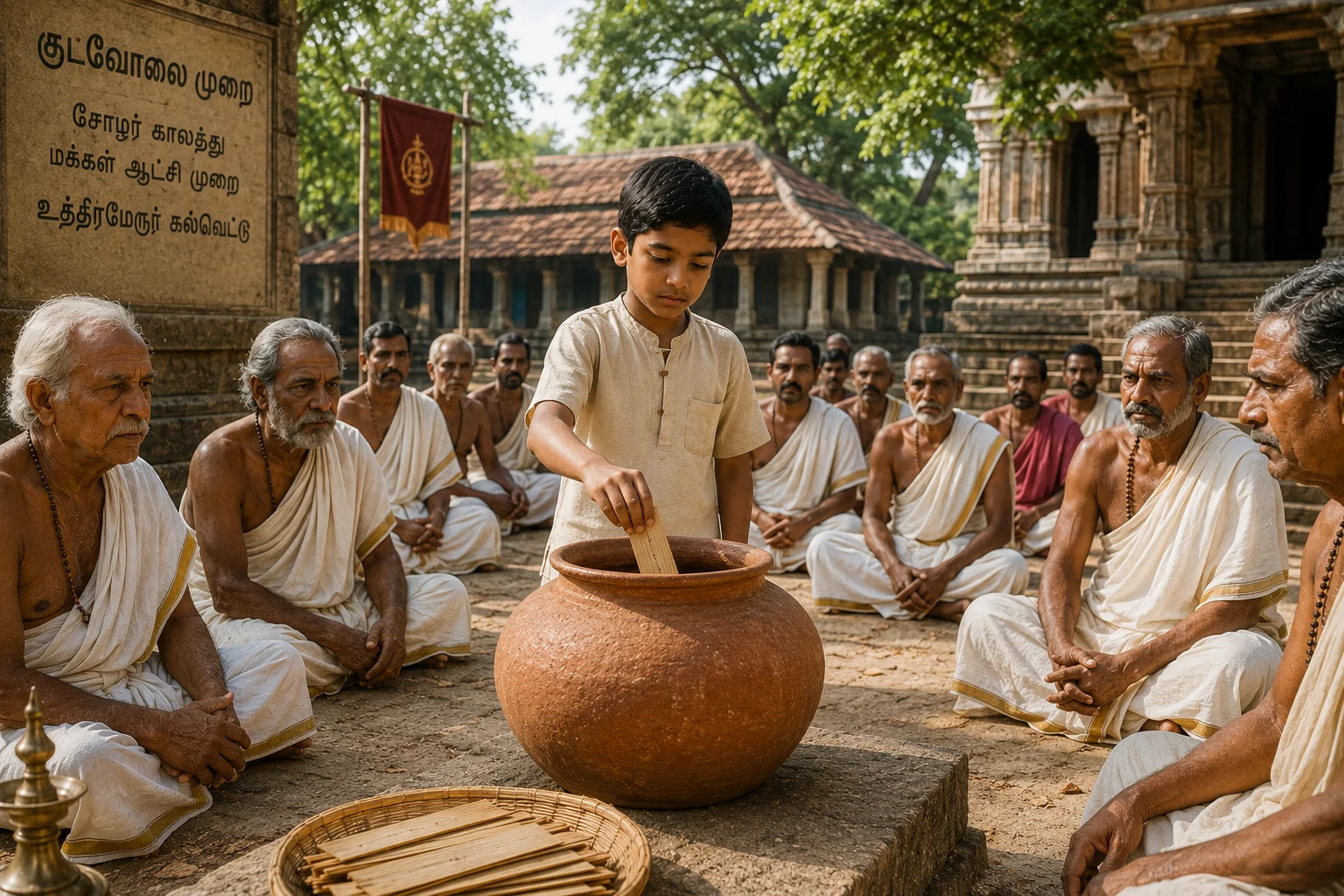
The Kudavolai system formed one of the most distinctive aspects of Chola local governance. The name itself derives from the Tamil words “Kudam,” meaning pot, and “Olai,” meaning palm leaf, referring to the method through which committee members were selected.

The process began only after a careful filtering of eligible candidates. Individuals considered qualified for public office had their names written on palm-leaf tickets and placed inside a pot before the assembled village community.
A young boy, chosen for his perceived impartiality, would then draw the required number of leaves publicly, after which the selected names were read aloud before priests and assembly members.
Modern interpretations sometimes reduce this procedure to a form of random lottery, but the inscriptions make clear that the process was far more structured.
Random selection operated only within a tightly regulated framework of eligibility, moral scrutiny, and public accountability. The Kudavolai system was therefore not unrestricted electoral participation, but a carefully designed administrative mechanism intended to balance procedural fairness with elite qualification.
The public nature of the process mattered greatly. Selection occurred before the assembled community, reducing opportunities for manipulation while reinforcing the legitimacy of office holders. Transparency, collective recognition, and institutional continuity appear repeatedly throughout the inscriptions.
What makes the system remarkable is not merely the drawing of names from a pot, but the existence of a political culture deeply concerned with regulating public office through procedural order. The inscriptions reveal a society that treated governance as a formal responsibility requiring both institutional discipline and communal oversight.
Qualifications, Disqualifications, and Administrative Discipline
One of the most striking aspects of the Uthiramerur inscriptions is the extraordinary detail devoted to qualifications and disqualifications for office. Eligibility for public administration was governed through carefully regulated criteria tied to land ownership, education, age, and moral reputation.
Candidates were generally expected to possess taxable land, reside in a house built on self-owned property, and fall within a prescribed age range. Knowledge of Vedic literature, mantras, and administrative matters was considered essential, particularly within Brahmadeya settlements where scholarly status formed part of political legitimacy.
At the same time, the inscriptions display an intense concern for accountability. Individuals involved in corruption, financial misconduct, theft, adultery, forgery, or failure to submit accounts could be removed from office and permanently disqualified from future participation. Even close relatives of serving committee members could face restrictions in order to prevent concentration of power within particular families.
The seriousness of these regulations is remarkable for the period. Governance was treated not as ceremonial privilege, but as an ethical and administrative obligation carrying significant public responsibility. The inscriptions even describe forms of public humiliation used as punishment for major offences, reflecting the importance attached to communal trust and institutional integrity.
This administrative culture reveals a sophisticated understanding of accountability. The Chola world clearly recognised that local governance depended not only upon authority, but also upon systems capable of regulating misconduct and preserving institutional credibility over time.
The Variyams and the Organisation of Village Life
The functioning of village administration depended heavily on specialised committees known as Variyams. These committees formed the operational core of local governance, distributing responsibilities across multiple institutional bodies rather than concentrating authority within individual officials.
The inscriptions refer to committees associated with irrigation management, gardens, annual supervision, finance, and public administration. The Eri Variyam, for instance, supervised tanks and water systems that sustained agricultural production across the region.
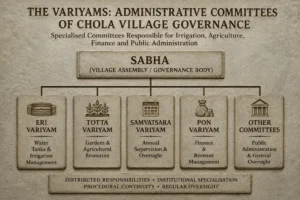
In an agrarian civilisation dependent upon irrigation, such responsibilities carried enormous economic importance. The Totta Variyam managed gardens and agricultural resources, while other committees supervised financial matters and general administration.
The existence of these differentiated committees demonstrates how structured village governance had become under the Cholas. Administration was not improvised or informal. It relied upon institutional specialisation, procedural continuity, and regular oversight.
This system also reflects the broader priorities of the Chola state itself. Irrigation management, agricultural productivity, and temple economies formed the foundation of imperial prosperity. Effective local administration therefore became essential not only for village stability, but also for sustaining the wider political and economic structure of the empire.
The Variyams reveal a civilisation where governance operated through distributed institutional management rather than solely through royal command. That administrative depth played a major role in the durability of Chola power across centuries.
Temples as Administrative Institutions
One of the most important insights from the Uthiramerur inscriptions is the role of temples as administrative institutions. In the Chola world, temples were not merely sacred spaces devoted to ritual worship. They also functioned as centres of governance, economic management, public assembly, and institutional memory.
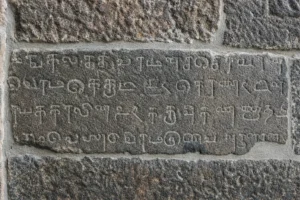
Village assemblies met inside temple halls. Administrative decisions were recorded on temple walls. Land grants, taxation arrangements, irrigation obligations, committee rules, and financial records were preserved through inscriptions carved directly into sacred architecture.
This fusion of ritual and administration formed one of the defining characteristics of medieval Tamil society. Temples acted simultaneously as religious centres, civic spaces, legal archives, and repositories of public memory. Their permanence in stone allowed administrative decisions to survive across generations with unusual durability.
The inscriptions themselves reveal how seriously governance was treated. Rules governing committee membership, qualifications, disqualifications, and procedural reforms were literally embedded into temple walls, making administration publicly visible within the sacred landscape of the village.
This relationship between temples and governance also helps explain why Chola inscriptions survive in such extraordinary detail today. The same civilisation that built monumental temples also transformed those temples into institutions capable of preserving legal, fiscal, and administrative memory across centuries.
Parantaka Chola I and Administrative Consolidation
Among the rulers associated with the Uthiramerur inscriptions, Parantaka Chola I occupies a particularly important place. His reign witnessed the increasing formalisation and refinement of local administrative systems that had already begun developing under earlier South Indian dynasties.
The inscriptions dated to the early 10th century reveal how governance evolved from systems centred on individual officers into more structured committee-based administration. Procedural rules became more detailed, committee responsibilities more clearly defined, and mechanisms of accountability more rigorously regulated.
Parantaka’s significance therefore extends beyond military expansion or dynastic consolidation. The inscriptions suggest a ruler deeply connected to institutional governance and administrative order. Under his reign, local assemblies became more systematised, and village administration acquired a degree of procedural sophistication that remains historically remarkable.
This institutional refinement helped strengthen the foundations upon which later Chola imperial expansion would depend. Monumental architecture and military campaigns required enormous economic resources, and those resources ultimately flowed from highly organised agrarian and administrative systems operating across the village landscape.
The inscriptions of Uthiramerur therefore preserve not only the mechanics of local governance, but also the administrative logic that sustained the Chola Empire itself.
Was the Kudavolai System Democratic?
The Kudavolai system is frequently described as an early example of democracy, largely because it involved public participation, collective assemblies, and procedural methods of selecting office holders. In certain respects, the comparison is understandable. The inscriptions reveal a society deeply invested in accountability, committee governance, and institutional transparency.
Yet applying modern democratic language without caution risks oversimplifying the historical realities of the period.
Participation within the system remained limited by caste, land ownership, education, and social privilege. The Sabha itself functioned largely within Brahmadeya settlements dominated by Brahmin elites.
Women, labourers, and landless communities were excluded from formal political participation. Eligibility depended heavily upon property ownership and scholarly qualifications inaccessible to much of the population.
At the same time, dismissing the system entirely would ignore its extraordinary sophistication. The inscriptions reveal procedural regulation, public scrutiny, financial accountability, committee rotation, and anti-corruption mechanisms at a level rarely associated with early medieval governance.
The Kudavolai system therefore should not be understood as democracy in the modern sense, but as evidence of a highly organised administrative culture that developed sophisticated forms of local governance within the social framework of its own time.
Why the Uthiramerur Inscriptions Still Matter Today
Today, the inscriptions of Uthiramerur remain among the most important surviving administrative records from medieval India. They preserve extraordinary evidence of how local governance functioned within one of South Asia’s most influential imperial systems.
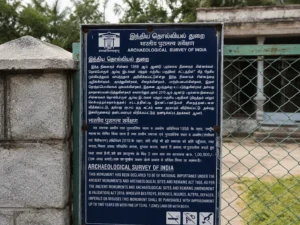
More importantly, they challenge simplified assumptions about premodern political life. The Chola world was not sustained merely through royal authority or military power. It depended upon institutional networks capable of managing irrigation, taxation, public accountability, and communal order across vast agrarian landscapes.
The inscriptions also demonstrate the remarkable durability of administrative memory in medieval Tamilakam. Carved into temple walls, these records survived political transitions, dynastic change, and centuries of social transformation.
They remain powerful reminders that the Cholas built not only monumental temples, but also enduring institutions.
Closing:Governance as the Foundation of Chola Power
The grandeur of the Chola world is often measured through architecture, conquest, and imperial expansion. Yet beneath the monumental temples and royal capitals stood an equally remarkable achievement, a deeply organised culture of governance embedded within village society.
The inscriptions of Uthiramerur reveal a civilisation where public administration operated through structured assemblies, specialised committees, procedural accountability, and institutional continuity. The Kudavolai system demonstrates how carefully the Chola world regulated authority, managed resources, and preserved communal order across local landscapes.
At the same time, the system reflected the inequalities of its age, limiting participation through caste and property restrictions. Its significance therefore lies not in modern democratic comparison, but in the extraordinary sophistication of its administrative vision.
Centuries later, the inscriptions still endure in stone, preserving the memory of a civilisation that understood governance not simply as royal power, but as a collective institutional responsibility woven into the fabric of everyday life.
Related Blogs

Thanjavur Beyond Brihadeeswara Temple: Exploring the Cultural Heart of the Cauvery Delta
More Than a Temple City For many travellers, Thanjavur begins and ends with Brihadeeswara Temple. The soaring vimana, vast courtyards,…
Read More ›
Kanchipuram: Sacred Architecture and Living Traditions
More Than the City of a Thousand Temples Kanchipuram is often introduced as the “City of a Thousand Temples.” While…
Read More ›