
Thrissur Pooram Festival: Kerala’s Grand Celebration of Ritual, Percussion, and Procession
Entering the Ceremonial Heart of Kerala
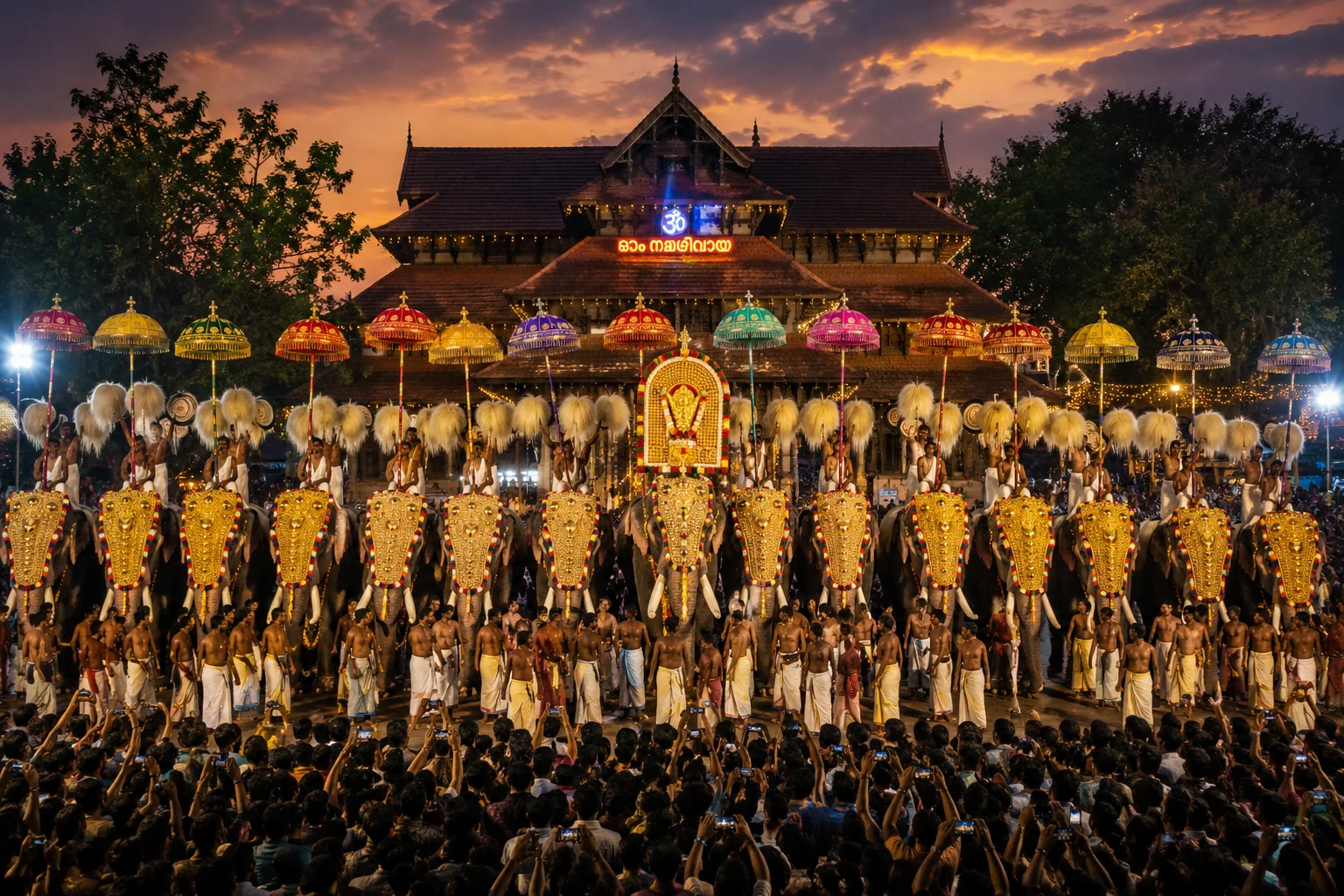
As evening descends over Thrissur, the vast grounds surrounding Vadakkunnathan Temple begin transforming into one of Kerala’s most immersive ceremonial landscapes.
Rhythmic percussion echoes across Thekkinkadu Maidanam while crowds gradually gather beneath illuminated arches and temple lights. Rows of caparisoned elephants stand beneath richly decorated parasols as drummers intensify their rhythms through the night air.
Fireworks occasionally burst above the temple skyline while anticipation slowly builds around the ceremonial grounds.
This is Thrissur Pooram.
Held annually during the Malayalam month of Medam between April and May, Thrissur Pooram is widely regarded as Kerala’s most iconic temple festival and one of South India’s largest ceremonial gatherings.
More than a public celebration alone, the festival represents a deeply layered combination of ritual continuity, temple tradition, percussion culture, sacred procession, and collective participation that has continued for more than two centuries.
Centered around Vadakkunnathan Temple in the heart of Thrissur, the festival brings together participating temples from across the region in a carefully choreographed sequence of processions, percussion performances, ceremonial exchanges, and nighttime celebrations.
For many visitors, Thrissur Pooram is initially remembered for its decorated elephants, fireworks, and visual grandeur. Yet the deeper significance of the festival lies in its atmosphere of collective ritual movement and cultural continuity.
The experience becomes less about watching a festival and more about entering a ceremonial environment shaped by rhythm, devotion, sacred space, and shared cultural memory.
The Origins of Thrissur Pooram
The origins of Thrissur Pooram are closely connected to the vision of Sakthan Thampuran, the ruler of the Kingdom of Cochin during the late eighteenth century.
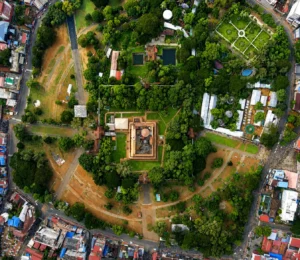
At the time, Thrissur was still developing as a major urban and cultural center. Sakthan Thampuran initiated significant changes across the town, including clearing the forested surroundings around Vadakkunnathan Temple to create the expansive open grounds now known as Thekkinkadu Maidanam.
The origins of the festival itself emerged partly from conflict surrounding participation in the older Arattupuzha Pooram, one of Kerala’s ancient temple festivals. Historical accounts describe how several temples were prevented from participating after delays caused by heavy rain.
In response, Sakthan Thampuran reorganized the ceremonial structure of temple festivals in the region and created a new annual celebration centered around Thrissur.
The ruler brought together ten participating temples and established a carefully structured ceremonial framework that continues influencing the festival even today.
The temples were broadly organized into two competing groups. The western side included Thiruvambady, Kanimangalam, Laloor, Ayyanthole, and Nethilakkavu temples, while the eastern side included Paramekkavu, Karamukku, Chembukkavu, Choorakottukavu, and Panamukkampilly temples.
This ceremonial duality became one of the defining features of Thrissur Pooram.
Rather than functioning solely as a religious gathering, the festival gradually evolved into a larger cultural institution where ritual traditions, artistic excellence, percussion performances, and public participation came together within a shared ceremonial landscape.
Even today, many of the organizational structures and ritual principles established during Sakthan Thampuran’s period continue remaining part of the festival’s identity.
Vadakkunnathan Temple and the Sacred Landscape of Thrissur
At the center of Thrissur Pooram stands Vadakkunnathan Temple, one of Kerala’s most historically and architecturally important Shiva temples.
Situated within the vast circular grounds of Thekkinkadu Maidanam, the temple forms both the spiritual and geographical heart of the festival.
The open ceremonial landscape surrounding the temple allows large processions, percussion ensembles, and ritual gatherings to unfold within a shared public space that remains deeply connected to the identity of Thrissur itself.
Unlike enclosed temple festivals restricted to smaller courtyards, Thrissur Pooram expands outward into the city’s collective cultural landscape.
Throughout the festival, processions from participating temples enter the ceremonial grounds, pay homage to the presiding deity of Vadakkunnathan Temple, and continue through carefully coordinated ritual sequences. The temple therefore functions not simply as a backdrop, but as the central sacred anchor around which the entire festival unfolds.
Thekkinkadu Maidanam itself plays an equally important role within the atmosphere of the festival.
As percussion rhythms echo across the open grounds and illuminated elephants move through the ceremonial arena, the relationship between sacred architecture, public space, ritual movement, and collective participation becomes increasingly visible.
For many visitors, this fusion of temple-centered devotion and large-scale public ritual is what gives Thrissur Pooram its distinctive atmosphere compared to many other festivals across India.
The Processions and Ceremonial Atmosphere
One of the defining features of Thrissur Pooram is its elaborate ceremonial processions involving richly decorated elephants, temple deities, percussion ensembles, parasols, and synchronized ritual movement.
Throughout the festival, participating temples arrive in carefully timed processions accompanied by Chenda Melam, Panchavadyam, and ceremonial music traditions that gradually intensify the atmosphere across the festival grounds.
Each deity is carried ceremonially upon caparisoned elephants adorned with gold-plated ornaments, decorative nettipattam, bells, and ritual accessories. The ceremonial role of elephants within Kerala’s festival culture extends far beyond visual symbolism alone.
Their presence is closely connected to evolving traditions of procession, sacred movement, craftsmanship, and contemporary conversations surrounding welfare and preservation.
Readers interested in this deeper cultural context may also explore our guide to Kerala’s temple elephants and sacred festival traditions.
Additional elephants flank the central ceremonial elephant, creating highly structured visual formations as processions move toward Vadakkunnathan Temple.
Despite the scale of the gathering, the movement of the festival follows remarkably disciplined ceremonial coordination.
The sound of percussion becomes inseparable from the movement itself. Rhythmic drumming guides the pace of the processions while spectators gather around the ceremonial routes watching the synchronized progression of elephants, musicians, parasols, and temple representatives moving through Thekkinkadu Maidanam.
The atmosphere shifts continuously throughout the day and night.
At certain moments, the focus remains intensely devotional as temple processions enter the sacred grounds. At others, the festival takes on a collective celebratory energy shaped by percussion rhythms, crowd anticipation, and ceremonial competition between participating groups.
Yet even within the visual grandeur of the festival, Thrissur Pooram remains deeply rooted in ritual continuity and temple tradition rather than spectacle alone.
The ceremonial movement of the festival reflects centuries of inherited structure, cultural memory, and collective participation that continue defining Kerala’s relationship with public ritual culture.
Kudamattam and the Divine Durbar
Among the most anticipated moments of Thrissur Pooram is the Kudamattam ceremony, often referred to as the Divine Durbar.
Held during the evening hours near the Southern Gopuram of Vadakkunnathan Temple, the ceremony brings together the Thiruvambady and Paramekkavu temple groups in a visually striking display of ceremonial coordination and artistic competition.
Rows of decorated elephants stand facing one another beneath the fading evening light while attendants hold aloft brightly colored parasols, alavattoms, and venchamarams above the ceremonial formations.
As percussion rhythms continue in the background, the parasol exchange begins.
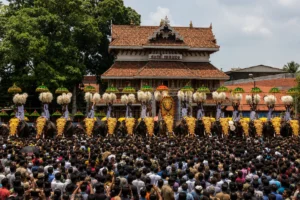
Within moments, entire rows of ornate parasols are rapidly replaced with new combinations of colours, textures, patterns, and decorative designs. The synchronized exchange unfolds repeatedly as each side responds with increasingly elaborate visual arrangements while the gathered crowds react with applause and excitement.
The elephants themselves remain remarkably still throughout the ceremony, creating an atmosphere of ritual discipline amid the visual intensity of the event.
The Kudamattom is often remembered for its color and pageantry, but the ceremony also reflects deeper themes of coordination, artistic expression, ceremonial balance, and inherited festival structure.
As dusk gradually transitions into night and percussion continues echoing across the maidanam, the atmosphere surrounding the Divine Durbar becomes one of the defining emotional experiences of Thrissur Pooram itself.
Panchavadyam, Ilanjithara Melam, and Kerala’s Percussion Traditions
Percussion lies at the emotional center of Thrissur Pooram.
Across the festival grounds, rhythmic performance traditions such as Panchavadyam, Pandi Melam, and Ilanjithara Melam create powerful layers of sound that shape the ceremonial atmosphere throughout the celebrations.
Among the most iconic performances is the Ilanjithara Melam, held near the Ilanji tree inside the Vadakkunnathan Temple grounds. Featuring hundreds of percussion artists, the performance gradually builds from measured rhythmic patterns into increasingly intense sequences that generate extraordinary collective energy among performers and spectators alike.
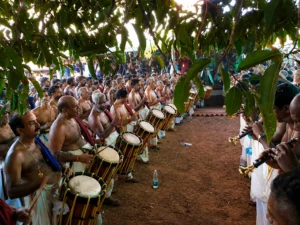
Traditional instruments such as the Chenda, Elathalam, Kombu, Kurumkuzhal, and Edakka together create the distinct sonic identity of the festival.
Rather than functioning merely as background music, these percussion traditions form an essential part of Kerala’s ritual culture and ceremonial architecture. The rhythms help structure processions, intensify ritual moments, and sustain the emotional atmosphere across the festival landscape.
Panchavadyam performances add further complexity through carefully coordinated ensembles involving percussion and wind instruments arranged in evolving rhythmic cycles.
For many visitors, the soundscape of Thrissur Pooram becomes one of the most unforgettable aspects of the experience.
The percussion is not simply heard; it is physically felt across the ceremonial grounds as rhythms reverberate through the crowd, temple spaces, and open landscapes surrounding Vadakkunnathan Temple.
Fireworks and the Night Atmosphere of Thrissur Pooram
As the night deepens, the atmosphere of Thrissur Pooram gradually shifts once again.
Crowds continue gathering across Thekkinkadu Maidanam while anticipation builds toward the festival’s famous fireworks displays. The illuminated temple surroundings, rhythmic percussion, and movement of people through the ceremonial grounds create an atmosphere that feels both festive and intensely immersive.
When the fireworks begin, the night sky above Thrissur fills with cascading light, sound, and smoke visible across large parts of the city.
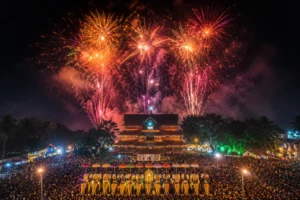
Rather than functioning as a separate entertainment segment, the fireworks form part of the larger ceremonial rhythm of the festival itself.
The collective energy of the crowd, the continuing percussion, and the illuminated skyline together create one of the most memorable nighttime atmospheres in Kerala’s festival calendar.
For many visitors, these late-night hours capture the emotional intensity of Thrissur Pooram most vividly.
Yet even during the celebrations, the connection to ritual continuity remains present through the temple-centered structure and ceremonial progression that continue guiding the festival until its conclusion.
Experiencing Thrissur Pooram Respectfully
For visitors experiencing Thrissur Pooram for the first time, approaching the festival with patience and cultural sensitivity greatly enriches the experience.
Although the festival attracts large public crowds and international attention, it remains deeply connected to temple traditions, ritual practices, and devotional participation. Respectful observation therefore becomes especially important within the ceremonial environment.
Photography is generally common throughout the festival, but maintaining awareness around temple rituals, ceremonial movement, and crowd conditions is essential. Flash photography during intense ritual moments or close interaction with elephants should generally be avoided.
Because of the scale of the gathering, planning movement carefully through the festival grounds is equally important. Thekkinkadu Maidanam becomes extremely crowded during major processions, Kudamattom, and nighttime fireworks.
For slower cultural travellers, some of the most meaningful moments often emerge not from rushing between events, but from observing the rhythm of the festival itself, the percussion building gradually through the evening, the synchronized movement of processions, and the collective atmosphere that transforms Thrissur during the Pooram season.
Best Time and Practical Information for Visiting
Thrissur Pooram is celebrated annually during the Malayalam month of Medam, usually between April and May.
Festival dates vary each year according to the Malayalam calendar and temple traditions, so confirming schedules in advance is recommended before planning travel.
Because Thrissur receives very large visitor numbers during the festival period, accommodation bookings should ideally be made well ahead of time. Hotels near Swaraj Round and central Thrissur are particularly sought after during the Pooram season.
Visitors should also prepare for large crowds, warm temperatures, and extended festival timings that often continue late into the night and early morning hours.
Thrissur Pooram Beyond Spectacle
Thrissur Pooram is often remembered through its visual grandeur, decorated elephants, percussion ensembles, parasol exchanges, and fireworks illuminating the Kerala night sky.
Yet beyond these powerful images lies a much deeper ceremonial tradition shaped by ritual continuity, collective participation, sacred movement, and inherited cultural memory.
For more than two centuries, the festival has remained woven into the cultural identity of Thrissur itself.
Vadakkunnathan Temple, Thekkinkadu Maidanam, percussion traditions, temple processions, and participating communities together create an experience that extends far beyond spectacle alone.
For travellers seeking Kerala through its living ritual landscapes rather than surface tourism, Thrissur Pooram offers one of the state’s most immersive encounters with ceremonial culture and public devotion.
Amid the rhythms of Chenda drums, the movement of processions, and the illuminated atmosphere of the festival grounds, Thrissur Pooram continues reflecting one of Kerala’s most enduring expressions of sacred celebration and cultural continuity.
Related Blogs
Thanjavur Beyond Brihadeeswara Temple: Exploring the Cultural Heart of the Cauvery Delta
More Than a Temple City For many travellers, Thanjavur begins and ends with Brihadeeswara Temple. The soaring vimana, vast courtyards,…
Read More ›
Kanchipuram: Sacred Architecture and Living Traditions
More Than the City of a Thousand Temples Kanchipuram is often introduced as the “City of a Thousand Temples.” While…
Read More ›