
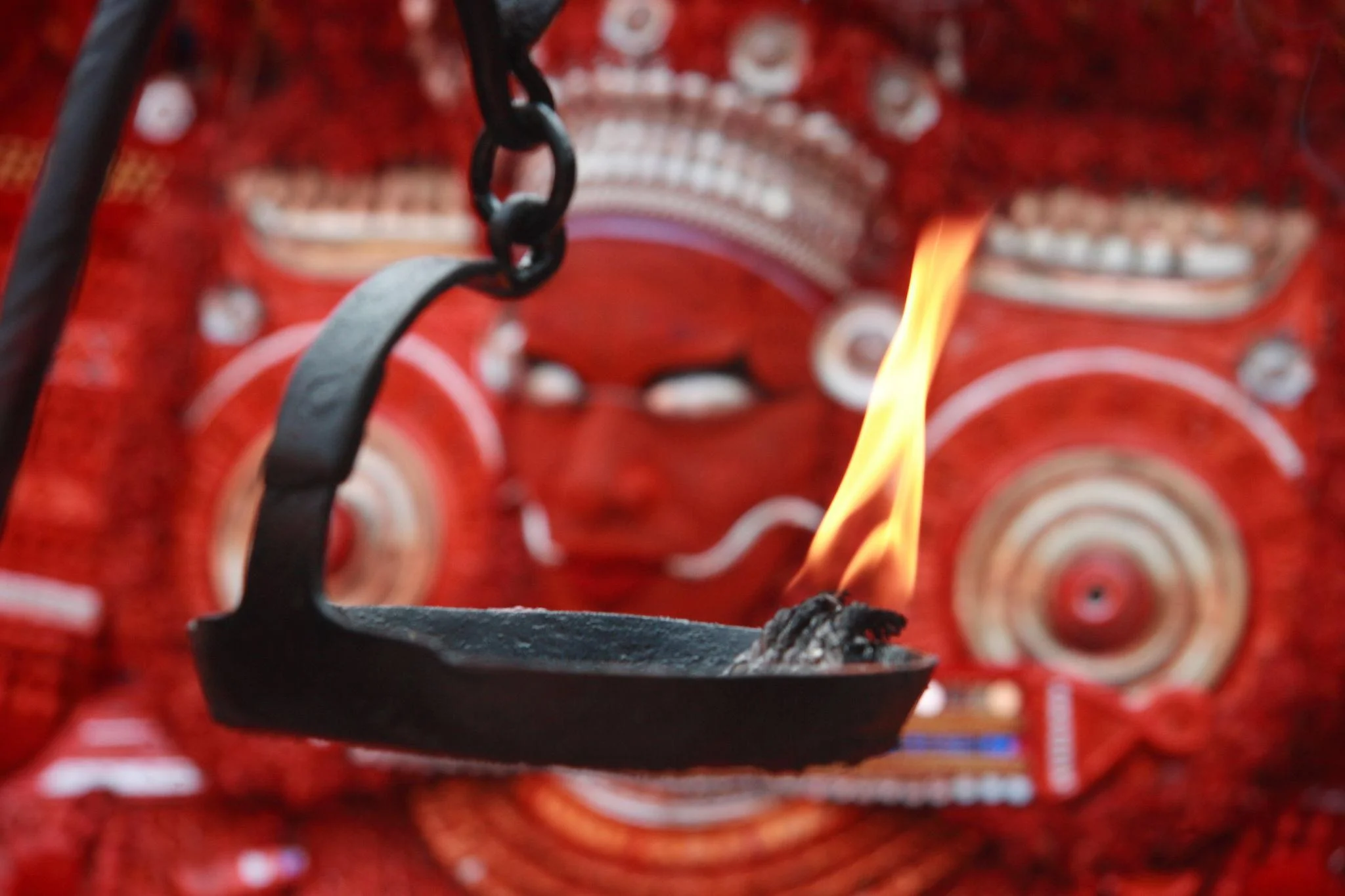
Theyyam Kerala: Sacred Ritual Traditions of North Malabar
Entering Kerala’s Sacred Ritual Landscapes
Long before sunrise, temple courtyards across parts of North Kerala begin slowly filling with sound.
Rhythmic percussion echoes through the darkness while oil lamps flicker beside sacred shrines and village pathways. Small crowds gather quietly beneath towering trees as ritual preparations continue through the night.
Drummers maintain steady rhythms while priests move between ceremonial spaces illuminated by firelight and incense smoke.
Within these ritual environments, Theyyam unfolds.
Practiced primarily across the northern districts of Kannur and Kasaragod, Theyyam remains one of Kerala’s most immersive and visually powerful ceremonial traditions. Yet despite its theatrical intensity, Theyyam is not approached simply as performance or entertainment.
It is a living ritual tradition deeply connected to devotion, ancestral memory, sacred transformation, and community identity across North Malabar.
Across temple courtyards, sacred groves, ancestral shrines, and village ritual spaces, elaborate costumes, face painting, percussion ensembles, fire rituals, and ceremonial movement come together within highly structured sacred performances that have continued across generations.
Unlike classical stage arts presented primarily for audiences, Theyyam remains closely tied to active ritual practice and local devotional traditions. Many performances continue through the night into the early hours of the morning, creating ceremonial atmospheres shaped equally by rhythm, firelight, movement, and collective participation.
For travellers exploring Kerala beyond beaches, backwaters, and conventional sightseeing routes, Theyyam offers one of the clearest windows into the region’s continuing relationship with ritual culture and living heritage.
In many ways, the experience becomes less about watching a performance and more about entering a ceremonial landscape where belief, memory, sound, and sacred identity continue remaining deeply woven into everyday life across North Kerala.
What Is Theyyam?
Theyyam is one of Kerala’s oldest ritual traditions and is widely believed to contain cultural influences that predate mainstream Hindu temple worship in the region.
Over centuries, the tradition gradually evolved through interactions between tribal belief systems, animistic practices, local hero worship, ancestral rituals, and later Hindu devotional traditions.
Even today, many Theyyam ceremonies continue reflecting these layered origins through the worship of spirits, warriors, protectors, deities, and ancestral figures connected to regional folklore and sacred memory.
Rather than functioning as a single ritual form, Theyyam includes hundreds of different ceremonial variations performed across North Kerala. Each form carries its own mythology, costume traditions, ritual symbolism, music patterns, and ceremonial structure.
In many communities, Theyyam is understood not merely as symbolic representation, but as a temporary transformation where performers embody sacred figures through ritual preparation, costume, percussion, and trance-like ceremonial movement.
The performances usually take place in temple courtyards, Kavus (sacred groves), village shrines, and ancestral ritual spaces rather than large urban temple complexes. This creates a ritual environment that often feels intimate and community-centered despite the visual intensity of the ceremonies themselves.
Oral traditions remain especially important within Theyyam culture. Stories associated with individual Theyyam forms are passed through generations and often preserve regional histories, social memory, local legends, and devotional narratives that remain deeply rooted within North Kerala’s cultural identity.
Because of this continuity, Theyyam continues functioning not simply as preserved folklore, but as a living ceremonial tradition that remains active within contemporary community life across parts of Kerala.
The Ritual Atmosphere of Theyyam
The atmosphere surrounding Theyyam is unlike most other ritual experiences in South India.
Many ceremonies begin late in the evening and continue through the night into the early morning hours. As darkness deepens, temple courtyards and sacred groves gradually transform into immersive ceremonial spaces shaped by percussion, firelight, incense smoke, and rhythmic movement.
The soundscape itself plays an essential role within the ritual experience.
Traditional percussion instruments such as the Chenda, Elathalam, Veekkuchenda, and Kurumkuzhal create powerful rhythmic layers that gradually intensify throughout the ceremony.
The percussion often begins slowly before building into increasingly complex and energetic sequences that shape the emotional atmosphere of the ritual space.
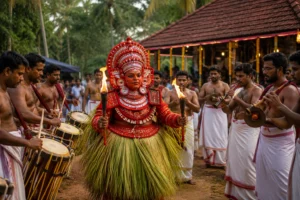
As the drumming intensifies, performers enter ritual movement patterns involving circular motion, rapid footwork, spinning, fire rituals, and ceremonial gestures connected to specific Theyyam traditions.
Oil lamps and burning torches illuminate the performers against the darkness, creating dramatic contrasts between shadow, costume, firelight, and movement. The experience becomes deeply sensory, shaped equally by sound, heat, colour, rhythm, and collective anticipation.
Yet despite the visual spectacle, the atmosphere within many Theyyam ceremonies remains strongly devotional rather than theatrical.
Local communities approach the ritual with reverence and participation rather than passive observation alone. Devotees may seek blessings, offer prayers, or participate in temple rituals connected to the performance itself.
The setting also contributes significantly to the experience. Many Theyyam performances unfold within smaller shrines surrounded by trees, village pathways, and open ritual grounds rather than monumental temple complexes.
This creates a ceremonial intimacy that remains deeply connected to the landscapes and communities where the traditions continue.
For many visitors, the combination of percussion, trance-like movement, fire rituals, costume symbolism, and overnight ceremonial atmosphere creates one of the most immersive cultural experiences in Kerala.
Costume, Face Painting, and Sacred Symbolism
One of the most visually striking aspects of Theyyam is its elaborate ceremonial costume tradition.
Towering headgear, layered ornamentation, palm-leaf structures, intricate body decoration, and vividly detailed face painting together create ritual identities that feel dramatically different from everyday life.
The process of costume preparation itself requires significant craftsmanship and inherited knowledge. Many ceremonial elements are handmade using natural materials including coconut leaves, cloth, wood, metal ornaments, and traditional pigments.
Face painting remains especially important within Theyyam traditions. Bright reds, black detailing, orange tones, white patterns, and highly symmetrical designs transform performers into sacred figures associated with specific ritual identities and mythological narratives.
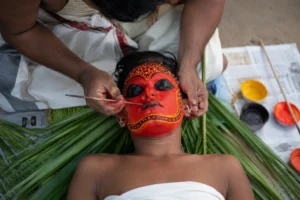
Each colour and pattern may carry symbolic meaning connected to particular deities, spirits, heroic figures, or ritual roles within the performance tradition.
The costumes themselves are designed not merely for visual effect, but to support ceremonial transformation. During performances, the movement of layered garments, decorative structures, ornaments, and ritual accessories contributes to the overall atmosphere of sacred intensity surrounding the ritual space.
In some forms of Theyyam, enormous circular backpieces and towering headdresses create highly dramatic silhouettes illuminated by torchlight during nighttime ceremonies.
Despite the visual grandeur, these elements remain closely tied to ritual meaning rather than decorative spectacle alone.
The costume traditions of Theyyam continue reflecting the remarkable continuity of North Kerala’s ritual craftsmanship, oral memory, and sacred performance culture across generations.
The Families Behind the Ritual Traditions
Behind the visual intensity of Theyyam lies a much deeper system of inherited cultural continuity preserved through performer communities across North Kerala.
In many cases, Theyyam traditions are passed through hereditary family lineages where ritual knowledge, ceremonial preparation, costume-making skills, music traditions, and oral histories continue transferring across generations.
Performers often begin learning ritual practices from a young age through observation, participation, and gradual involvement within community ceremonies.
Preparation for major performances may involve ritual discipline, fasting, prayer, dietary restrictions, and ceremonial purification practices connected to local traditions and temple customs.
The creation of costumes, headgear, and face painting designs also requires specialized craftsmanship that is often preserved within performer families themselves.
Beyond performance skills, practitioners must also learn ritual songs, oral narratives, ceremonial movements, percussion timing, and the symbolic meanings associated with specific Theyyam forms.
This inherited knowledge is one reason why Theyyam continues remaining deeply connected to community memory rather than functioning as detached stage performance.
For many performer families, Theyyam represents both cultural responsibility and sacred duty.
The continuation of these traditions depends not only on ritual performance itself, but also on the preservation of oral knowledge, ceremonial craftsmanship, music traditions, and community participation that sustain the larger ritual ecosystem surrounding Theyyam.
In a rapidly changing cultural landscape, this continuity remains one of the most important aspects of Theyyam’s enduring significance across North Kerala.
Where to Experience Theyyam in Kerala
For travellers interested in witnessing Theyyam in Kerala, the ritual season generally unfolds across the northern districts of the state between October and May, with peak activity often taking place between December and February.
Kannur remains one of the most important centers of Theyyam culture in Kerala and is widely considered one of the best regions to experience the tradition.
Across Kannur, village shrines, temple courtyards, and sacred ritual spaces host overnight ceremonies featuring elaborate performances accompanied by percussion, fire rituals, and devotional gatherings.
Locations such as Mathamangalam, Keecheri, and several smaller shrines across North Malabar continue preserving strong ritual traditions connected to Theyyam culture.
For many travellers searching specifically for Kannur Theyyam experiences, the district offers some of the most visually immersive and culturally active ceremonial environments during the ritual season.
Kasaragod also preserves deeply rooted Theyyam traditions associated with Kavus, ancestral shrines, and ritual spaces connected to communities such as the Thiyya, Nambiar, Vaniyar, and Maniyani groups.
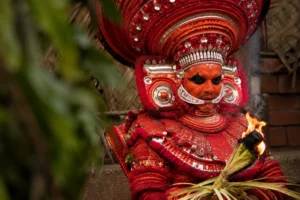
Performances here often unfold within more intimate ceremonial settings where local participation remains strongly preserved.
In parts of Wayanad, visitors may encounter regional variations of Theyyam associated with Kalanaadi communities and localized ritual practices shaped by the district’s forested landscapes and tribal influences.
The Vadakara and Koyilandy regions of Kozhikode district also host Theyyam performances during temple festivals and seasonal religious ceremonies connected to North Kerala’s broader ritual traditions.
Because Theyyam schedules follow local temple calendars and ceremonial timings, checking regional festival schedules in advance is highly recommended.
Many performances take place late at night or during the early morning hours, making timing especially important for travellers planning cultural journeys around the ritual season.
Best Time to Witness Theyyam
The main Theyyam season in Kerala generally begins around October and continues until May, with the most active ritual months typically falling between December and February.
During this period, temple courtyards, sacred groves, and village shrines across North Malabar host hundreds of performances connected to local ritual calendars and annual temple festivals.
Unlike conventional cultural performances arranged around fixed public schedules, Theyyam ceremonies often follow temple-specific timings that can extend late into the night or continue into the early hours of the morning.
Some rituals begin shortly before midnight, while others unfold gradually as dawn approaches.
For many travellers, witnessing Theyyam during the late-night or pre-sunrise hours creates the most immersive atmosphere.
Fire rituals, rhythmic percussion, oil lamps, and ceremonial movement become especially striking against the darkness of temple surroundings and village landscapes.
Because schedules occasionally shift according to temple customs, local rituals, or seasonal changes, checking festival calendars in advance is highly recommended.
Kerala Tourism resources, regional Theyyam calendars, and local guidance within Kannur or Kasaragod can help travellers plan visits more effectively during the ritual season.
For slower cultural journeys through North Kerala, the winter months often provide the best combination of weather, festival activity, and ceremonial intensity.
Experiencing Theyyam Respectfully
For visitors unfamiliar with Kerala’s ritual traditions, Theyyam is best approached with patience, cultural sensitivity, and awareness that these ceremonies continue functioning as active devotional practices rather than staged cultural performances.
Many rituals take place within sacred temple spaces and community-centered ceremonial environments where local participation remains deeply important. Respectful observation therefore becomes an essential part of the experience.
Photography is usually permitted during many performances, but flash photography should generally be avoided, particularly during intense ritual moments and fire ceremonies.
Maintaining distance from active ritual spaces and avoiding interruption of ceremonial movement is equally important.
Modest clothing is recommended when attending temple rituals and shrine ceremonies across North Kerala.
Since many performances continue overnight and involve crowded village spaces, comfortable attire and quiet observation often create a more meaningful experience for visitors.
Unlike commercial cultural shows designed purely for entertainment, Theyyam ceremonies are closely connected to devotion, local belief systems, ancestral traditions, and sacred identity. Many community members approach performers for blessings, prayers, and ritual offerings during or after ceremonies.
Understanding this devotional context changes the experience significantly.
Rather than viewing Theyyam simply as visual spectacle, visitors begin recognizing it as part of a much larger cultural landscape shaped by memory, ritual continuity, percussion traditions, sacred storytelling, and community participation.
For slower travellers interested in Kerala beyond conventional tourism, respectful engagement often creates a far deeper understanding of the region’s living ritual heritage.
Theyyam Beyond Performance
Theyyam remains one of Kerala’s most powerful examples of living ritual culture.
Across North Malabar, temple courtyards, sacred groves, ancestral shrines, percussion traditions, fire rituals, costume craftsmanship, and oral memory continue coming together within ceremonies that have survived across generations.
For many outside observers, the visual intensity of Theyyam initially captures attention through elaborate costumes, face painting, rhythmic drumming, and trance-like ceremonial movement. Yet the deeper significance of the tradition lies beyond spectacle alone.
Theyyam reflects a continuing relationship between community memory, sacred identity, inherited ritual practice, and regional cultural continuity.These qualities help explain why Theyyam is often regarded as one of South India’s most remarkable living traditions.
Rather than existing solely as a preserved cultural artifact, it continues to function as an active part of community life, reflecting the same continuity that can be seen in South India’s classical music, dance, craftsmanship, culinary heritage, and traditional wellness practices.
In many parts of North Kerala, these ceremonies remain closely woven into everyday life rather than existing solely as preserved heritage or staged tourism experiences.
Performer families continue passing ritual knowledge through generations while local communities remain actively connected to annual temple calendars and ceremonial traditions.
This continuity gives Theyyam its enduring cultural power.
For travellers exploring Kerala through slower and more immersive journeys, Theyyam offers one of the clearest windows into the region’s deeper ritual landscapes and living cultural identity.
Beyond the firelight, percussion, and ceremonial movement lies a tradition that continues preserving memory, devotion, sacred storytelling, and collective participation within contemporary Kerala itself.
Related Blogs
Thanjavur Beyond Brihadeeswara Temple: Exploring the Cultural Heart of the Cauvery Delta
More Than a Temple City For many travellers, Thanjavur begins and ends with Brihadeeswara Temple. The soaring vimana, vast courtyards,…
Read More ›
Kanchipuram: Sacred Architecture and Living Traditions
More Than the City of a Thousand Temples Kanchipuram is often introduced as the “City of a Thousand Temples.” While…
Read More ›