
The Chola Temple Circuit in Tamil Nadu – What It Takes to Do It Properly
The problem with the day-trip approach
Most visits to the Chola temple circuit Tamil Nadu follow a predictable pattern. A driver leaves Trichy or Thanjavur in the morning. By evening, three UNESCO sites have been visited, photographed, and ticked. The Brihadisvara temple is impressive.
Gangaikonda Cholapuram is quieter and perhaps more moving. Darasuram is intricate and easy to miss in a single pass. The traveller returns having seen a great deal and understood relatively little. This is not a failure of attention. It is a failure of preparation and sequence.
The three temples are not separate destinations. They are three chapters of a single argument-constructed over roughly 150 years. Read in the right order, with the right context, they form a continuous architectural and cultural statement.
For a broader understanding of their history, architecture, and cultural significance, explore our guide to the Great Living Chola Temples.
Approached without that structure, they remain visually striking but conceptually fragmented. This guide approaches them as they were intended to be experienced: sequentially, deliberately, and with an understanding of what each one contributes to the whole.
What distinguishes the Chola approach is not only scale but consistency. The same architectural grammar appears across sites of different sizes, indicating a system that was understood, transmitted, and executed with precision over generations.
This continuity is rare. In most historical traditions, variation dominates. Here, variation exists within a stable framework. The result is a body of work that can be read almost like a text-each temple contributing a variation on a shared idea rather than introducing something entirely new.
This is also why sequence matters. The temples are not isolated achievements. They are iterations within a sustained architectural and cultural programme. Seen individually, they are impressive. Seen together, they reveal intention.
Most itineraries are assembled. Locations are added based on popularity, logistics, or availability. The result is movement without structure, experiences that may be individually valuable but lack coherence when viewed as a whole.
A meaningful journey, however, must function like the system it is derived from. The most immersive cultural routes are rarely experienced through isolated destinations alone, but through carefully structured journeys where geography, architecture, ritual, and historical continuity gradually unfold across regions.
This is the foundation of how we approach journey design.
For a deeper understanding of this process, read “How We Design a Journey That Has Never Been Run Before”
What the Chola tradition is and why it matters
The Chola dynasty reached its height between the 9th and 13th centuries, governing much of South India and extending influence across the Indian Ocean. Yet what distinguishes the Cholas is not territorial expansion but cultural consolidation.
The temples they built in the Cauvery delta represent one of the most complete expressions of Dravidian civilisational thinking- a system in which architecture, ritual, and cosmology operate as a unified language. This is why a Great Living Chola Temples guide must look beyond the stone and into the “living logic” of the space
These temples are not relics. They remain active sites of worship, integrated into daily life. The Brihadisvara temple in Thanjavur, for example, has been in uninterrupted ritual use for over a thousand years. This continuity is not incidental. It preserves the original logic of the spaces-the way movement, light, sound, and ritual were designed to interact.
A Chola temple is best understood as a cosmological diagram translated into built form. The vimana, rising above the sanctum, represents Mount Meru-the axis of the universe in Hindu cosmology.
The movement from the outer gateway to the inner sanctum is a structured progression: from the multiplicity of the outer world to the singularity of the divine presence within. This is the essential frame of any Chola architecture travel guide. Without it, the visitor registers scale and ornament. With it, the temple becomes legible as a system-one in which proportion, alignment, and spatial sequencing all carry meaning.
For those looking to understand the broader context of this region, our guide to South India for the Culturally Serious Traveller – Where to Begin provides the essential framework for navigating these ancient landscapes. It is within this wider context that a Great Living Chola Temples guide must look beyond the stone and into the “living logic” of the space.
The three temples in sequence: what each one is saying
Brihadisvara, Thanjavur – the canonical statement
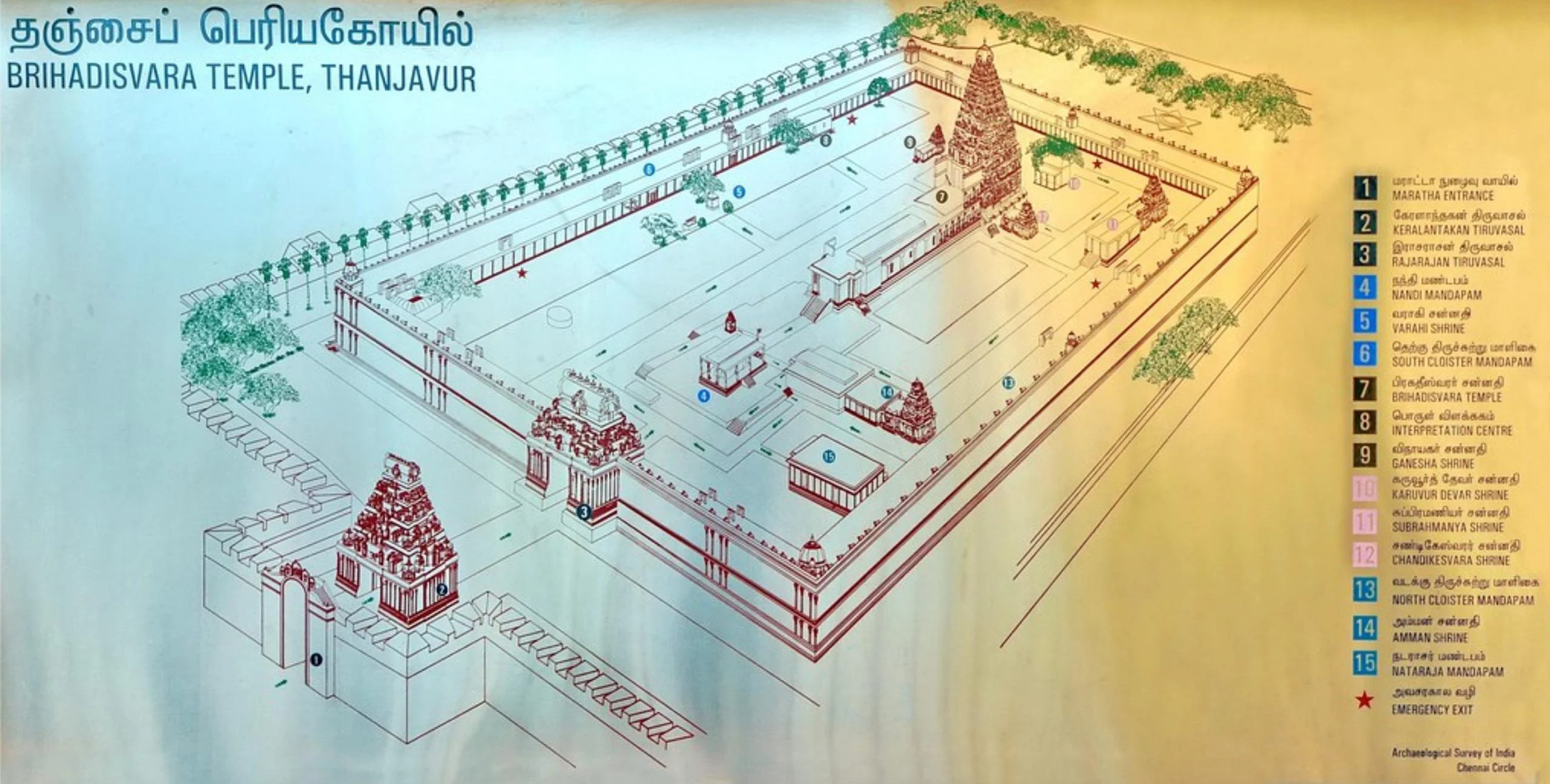
A considered Brihadisvara temple Thanjavur visit begins before the site fills with movement. The early morning light defines the structure differently, emphasising volume over detail. Completed in 1010 CE under Rajaraja I, the temple was conceived as a definitive architectural statement. Its scale is not ornamental-it is declarative.
The first courtyard establishes the relationship between human presence and monumental form. The towering vimana, rising in precise geometric tiers, directs attention upward while anchoring the entire complex. The experience is not of decoration but of order. This is a temple that asserts a correspondence between the structure of the state and the structure of the cosmos.
The interior spaces, darker and more contained, shift the experience from scale to focus. The massive Linga in the sanctum is not immediately visible in full; it emerges gradually as the eyes adjust. The fresco fragments along the inner walls, often overlooked, require deliberate attention.
They provide a glimpse into an earlier visual language that once extended throughout the temple. What distinguishes Thanjavur is not simply size, but clarity. It states its argument directly.
There is also a clarity in circulation that often goes unnoticed. The pathways through the temple are not arbitrary. They are aligned to guide movement in a way that reinforces the central axis. Even without prior knowledge, the visitor is directed, subtly but consistently, towards the sanctum.
This is architecture functioning as orientation, not decoration. It is this clarity that makes Thanjavur the correct starting point for the circuit.
Gangaikonda Cholapuram-confidence after assertion
The movement to Gangaikonda Cholapuram travel introduces a shift in tone. Built by Rajendra I after his northern campaigns, the temple records expansion without replicating the earlier assertion. It is slightly smaller than Thanjavur, yet many consider it architecturally more refined.
The proportions are more fluid. The lines of the vimana curve subtly, softening the rigid verticality seen in Thanjavur. The detailing feels considered rather than emphatic. This is a structure built with the assurance of an established tradition rather than the need to define it.
The surrounding environment contributes significantly to the experience. The once-extensive Chola capital has receded, leaving the temple within an open landscape. This absence creates a different kind of presence. The scale of what existed is understood indirectly, through what remains.
Details here reward closer observation. The lion sculptures, the sculptural panels, the handling of thresholds between spaces-all indicate a shift toward refinement. Walking the perimeter before entering allows the visitor to register the structure in its entirety, rather than encountering it in fragments. This is a temple that speaks in a quieter but more controlled register.
The experience here benefits from time spent in stillness rather than movement. Where Thanjavur compels attention through scale, Gangaikonda Cholapuram reveals itself through proportion. The relationship between built form and open space is more balanced. This allows the visitor to perceive not just the structure, but the intention behind its refinement.
Airavatesvara, Darasuram – a different kind of ambition
Darasuram completes the sequence not by extending scale but by redirecting attention. It is the smallest of the three, and therefore the most frequently underestimated. Yet it introduces elements that expand the expressive range of the tradition.
The temple base is conceived as a chariot, with intricately carved stone wheels that suggest movement. The entrance steps, known for their tonal properties, introduce sound as part of the architectural experience. These are not incidental details. They reflect a shift from assertion toward exploration.
The sculptural programme is notably denser. Scenes from mythology are interwoven with representations of daily life, suggesting a tradition comfortable enough to incorporate variation. The experience here is more intimate. The scale allows for sustained observation without being overwhelmed.
Visited after the first two temples, Darasuram resolves the sequence. It does not compete with Thanjavur or Gangaikonda Cholapuram. Instead, it completes the argument by demonstrating what the tradition becomes once it no longer needs to establish itself.
What the Standard Circuit Misses: The Living Pulse of Kumbakonam
The three UNESCO temples form the structural and imperial core of the Chola world, but Kumbakonam provides the atmospheric context that makes them intelligible. Set within the fertile Cauvery basin, Kumbakonam has functioned as the central nervous system for temple practice, Vedic learning, and high craftsmanship since the 9th century.
The density of temples here is not organized for the convenience of visitors; it is the organic result of a thousand-year-old system of ritual and community life. While the “Big Three” sites demonstrate the power of the state, Kumbakonam reveals the endurance of the culture. A Tamil Nadu temple tour luxury itinerary is incomplete without pausing here to witness how these traditions have transitioned into the 21st century without losing their soul.
The Mahamaham Tank: A Ritual Anchor
At the heart of the town lies the Mahamaham tank, a massive masonry reservoir framed by sixteen shore-side mandapas. It anchors a cyclical ritual calendar that extends far beyond individual temple walls. Even on a quiet afternoon, its geometry offers a masterclass in Chola town planning. The layout provides an essential insight: in the Chola world, the temple was not merely a destination, but a system one lived within.
The Interconnected Network of Craft
The surrounding districts sustain traditions traced directly to the Chola workshops. These are not curated “artisan villages” for tourism, but a living network that historically supported temple construction and ritual.
Silk Weaving:
The heavy, gold-threaded silks of the region remain integral to the temple economy, dressing both the deities and the devotees.
Swamimalai Bronze Casting:
Just outside town, hereditary Sthapathi families continue the lost-wax method, fundamentally unchanged since the era of Rajaraja I.
When you witness molten metal poured into a clay mould to create a Nataraja, you are seeing the exact process that produced the masterpieces in the Thanjavur galleries. These deities connect the visitor directly to the Chola artistic zenith. Access to these hereditary workshops requires more than a map; it requires introduction and context.
When approached correctly as a Chola temples cultural tour, Kumbakonam reframes the great monuments. They cease to be “completed” historical sites and are revealed as parts of a vibrant cultural system that refuses to be relegated to the past.
What “Doing It Properly” Requires
To transform this from a standard excursion into a profound cultural journey, four elements are non-negotiable:
- Time as a Luxury: The three temples cannot be meaningfully absorbed in a single day. A minimum of three days—one per major site—allows for engagement beyond surface observation. To compress the circuit is to reduce architectural genius to a blur of granite and dust.
- The Inviolable Sequence: The progression from Thanjavur to Gangaikonda Cholapuram and finally Darasuram follows both historical development and conceptual logic. Reversing this order disrupts the narrative of the Chola civilization’s growth and artistic refinement.
- The Calibre of Interpretation: The guide determines whether you encounter a “dead museum” or a living system. True expertise lies in making the cosmological framework of Dravidian design legible without the weight of dry, disconnected dates.
- The Space Between: The distances between sites are not mere transfers; they are “palate cleansers.” The rural landscape of the Cauvery Delta provides the necessary pause to process the monumental scale of one site before encountering the intimate refinement of the next.
Closing
The Chola temple circuit Tamil Nadu is one of the most complete cultural journeys available in India. It is also one of the most consistently underestimated. The standard approach treats the temples as destinations. A considered approach recognises them as a connected system.
With time, sequence, context, and interpretation, the circuit becomes more than a series of visits. It becomes an encounter with a civilisation that articulated its understanding of the universe through architecture and sustained that articulation over centuries of continuous use.
For a Chola circuit designed from the ground up-sequence, access, guide selection, and pacing, see how Lux Crafter builds Bespoke India journeys through Tamil Nadu.
Explore also our Guided Masterpiece experiences in India.
Related Blogs
Why Goa’s Maritime Estates Make the Right Backdrop for a Private Event
A private event in Goa is often reduced to a familiar format, music by the shore, a sunset gathering, and…
Read More ›
South India as an Incentive Destination: The Case Beyond the Obvious Choices
The Incentive Paradox The most effective incentives are not defined by where one stays, but by what one begins to…
Read More ›