
South India as an Incentive Destination: The Case Beyond the Obvious Choices
The Incentive Paradox
The most effective incentives are not defined by where one stays, but by what one begins to understand. High-performers today have already moved through the world’s most refined hospitality environments-private island retreats, architect-designed villas, seamless journeys that remove friction entirely. Comfort is no longer a differentiator. It is expected.
What remains rare is not luxury, but meaning.
A South India arts itinerary shifts the function of incentive travel from indulgence to interpretation. It replaces the idea of reward as consumption with reward as access. Not access to spaces alone, but to systems of knowledge that have been operating continuously, often quietly, for centuries.
In the Kaveri Delta, tradition is not preserved for display. It is lived through repetition. It exists in sound, in material, in movement. It is not interrupted for the visitor. The visitor enters it.
This creates a different relationship between the achiever and the destination. Instead of being placed at the centre of an experience, the individual is positioned within a continuum. Achievement, in this context, is not celebrated through spectacle, but reframed through proximity to systems that have endured.
An incentive, therefore, becomes something more precise. It becomes a lens through which scale is reinterpreted. Not the scale of luxury, but the scale of time, discipline, and continuity.
For those who operate in environments defined by acceleration, this shift is not decorative. It is necessary.
The Architectural Power Move
In South India, architecture is not an object of admiration. It is a system of execution.
The Great Living Chola Temples, particularly the Brihadisvara Temple, demonstrate a level of precision that extends beyond aesthetic ambition. Constructed in the 11th century, the temple’s central tower rises with controlled proportionality, each layer calibrated to maintain both structural integrity and visual balance.
Granite blocks, some weighing several tons, were transported across distances without modern infrastructure. Their placement is not approximate. It is exact.
The geometry of the temple is not symbolic. It is functional.
The base distributes weight across a wide plane, while the upper tiers narrow in precise increments. The alignment of corridors dictates movement. The positioning of entrances controls the flow of light and shadow throughout the day.
For an incentive group, this becomes more than an architectural encounter. It becomes a study in execution.
Standing within these structures, high-performers encounter a system that mirrors their own challenges. The temple does not rely on scale alone to create impact. It relies on precision.
The carvings, often perceived as decorative, are in fact repetitions of form that establish rhythm across surfaces. The repetition is not excessive. It is controlled.
This is where architecture begins to function as a framework. It demonstrates that scale, without alignment, collapses. That longevity is not achieved through expansion, but through calibrated design.
The experience does not overwhelm. It recalibrates.
It shifts the perception of achievement from accumulation to continuity.
Beyond the Stage: The Delta Narrative
The Kaveri Delta operates as a living system. Water moves through it in measured channels, feeding fields that respond to seasonal rhythms. The sound of this movement becomes part of the environment, constant, but never dominant.
It is within this setting that the Chola bronze trail unfolds, not as an exhibit, but as a process.
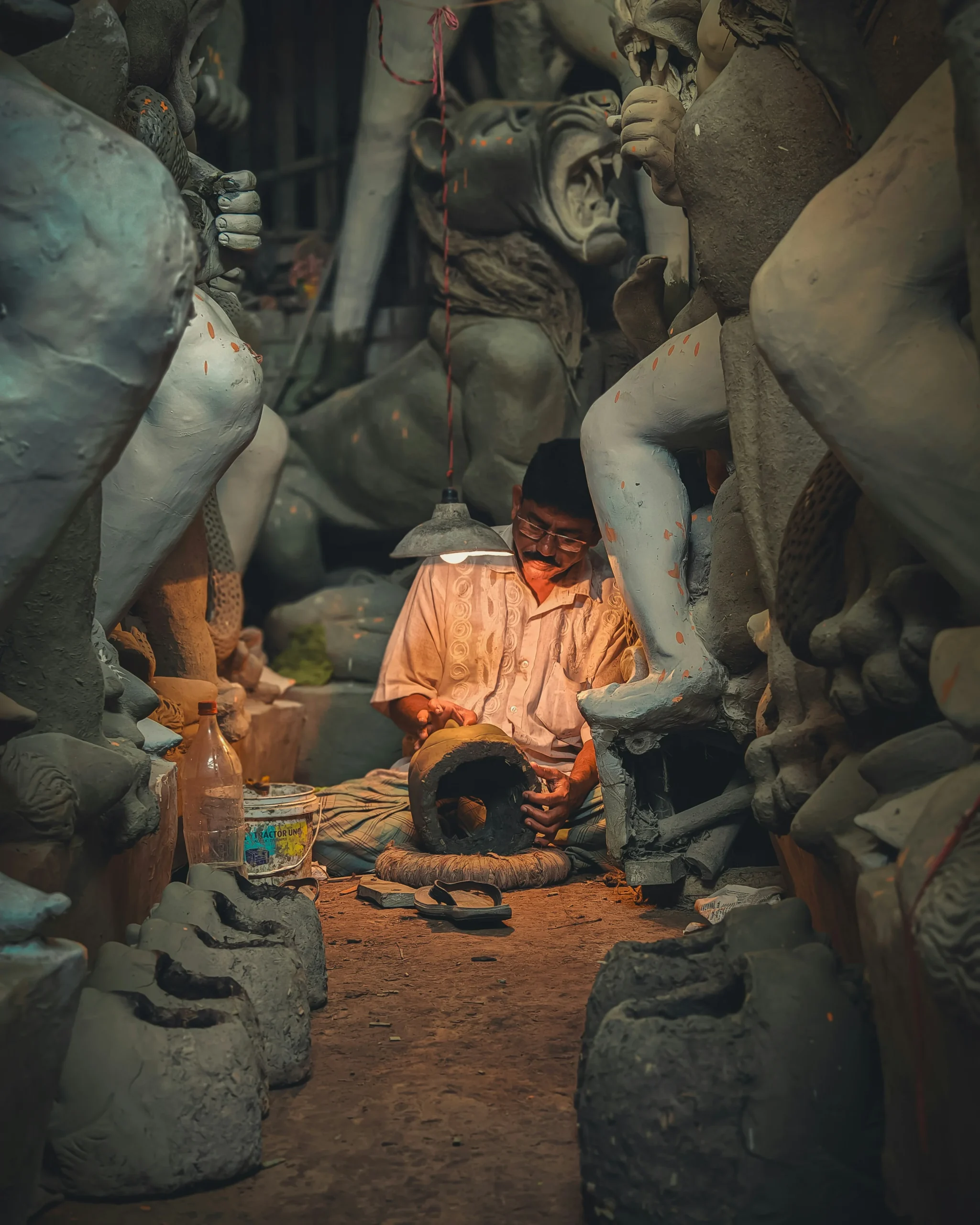
In Swamimalai, the artisan begins with beeswax. The material is softened by hand, shaped into form. The posture of the figure is defined through a series of proportional rules. The tilt of the head, the curvature of the torso, the extension of each finger, none of it is arbitrary.
The wax model is then encased in layers of clay, each applied with deliberate care. As the mould dries, it hardens into a shell capable of holding molten metal.
When heated, the wax melts and escapes, leaving behind a cavity.
The moment the metal is poured is brief, but decisive. A controlled stream fills the space, carrying with it both weight and heat. Once cooled, the mould is broken. The form emerges.
It is then worked upon.
Edges are refined. Surfaces are smoothed. Details are corrected.
The final object carries weight, not just physical, but conceptual. It is the result of a process that cannot be accelerated.
Alongside this, the auditory environment of the delta introduces another layer. The sound of the nadaswaram, played during temple rituals, extends across open space with a tonal sharpness that interacts with stone and air.
This is where Carnatic music heritage reveals its internal structure.
A raga defines the framework. It establishes the identity of the composition. Within this, the musician improvises, but never outside the boundaries of the raga.
The tala governs time.
A cycle of beats is maintained with precision, often subdivided into smaller units that require exact synchronization between performer and rhythm.
The musician does not abandon structure. He works within it.
For the incentive traveller, this is not passive listening. It is exposure to a system where discipline enables expression.
Access as the Ultimate Currency
Access, in the context of incentive travel, is often misunderstood as entry. But true access is not granted through availability. It is enabled through trust.
A Tamil Nadu classical arts tour designed with intent does not rely on scheduled performances. It operates through proximity to practitioners.
Within a private residence, a Bharatanatyam session begins without announcement. The dancer moves through foundational steps, repeating them until alignment is achieved.
The feet strike the ground in measured rhythm. The sound produced is not incidental, it must align with the beat cycle set by the nattuvangam.
The hands form mudras, each carrying defined meaning. A deviation alters interpretation.
The eyes move with intention, directing focus.
This is where Bharatanatyam travel India becomes precise.
It is not a performance. It is a system of transmission.
Similarly, in a Kanchipuram weaving space, the loom operates as a grid of calculation. Threads are arranged in patterns that must align perfectly to produce the intended design.
The weaver’s movements are repetitive, but not mechanical. Each action contributes to a structure that has been predetermined.
These experiences are not curated for display. They are ongoing processes.
Access, therefore, becomes the ability to witness without interruption.
To observe without altering.
To understand without simplification.
The Rhythm of Reward
In a well-designed South India arts itinerary, impact is not created through intensity, but through rhythm.
Incentives often rely on compression, multiple highlights layered into a short span of time. But in the Kaveri Delta, reward is structured differently. It unfolds through sequence, where each moment is allowed to register before the next begins.
The day opens not with urgency, but with sound. Temple bells resonate across stone courtyards, their vibrations travelling through corridors aligned to amplify them. The nadaswaram follows, its tone carrying across open air with a clarity that defines the morning. This is not incidental, it is part of the deeper structure of Carnatic music heritage, where sound is calibrated, not improvised without form.
For the high-performer, this introduces a different relationship with time.
Moments are not stacked. They are spaced.
This spacing creates clarity. A ritual is not followed immediately by another experience. It is allowed to settle. The environment itself dictates pace.
This rhythm extends beyond sound. The flow of the Kaveri River becomes part of the experience-steady, uninterrupted, shaping the landscape without drawing attention to itself. The repetition of movement, whether in water, in footsteps, or in ritual cycles, creates continuity.
Within a thoughtfully designed Tamil Nadu classical arts tour, this continuity becomes the framework through which reward is experienced. It is not about contrast between effort and indulgence. It is about alignment.
The individual begins to notice the intervals-the quiet moments between structured experiences. Sitting within a temple courtyard after ritual, or within a silent stretch of the delta, the absence of interruption becomes perceptible.
It is not emptiness. It is structure without noise.
This is where incentive travel begins to shift. The reward is no longer external. It becomes internalized as clarity, an understanding of pace, sequence, and the relationship between effort and time.
And in this clarity lies the true value of a South India arts itinerary, not as an experience that impresses, but as one that recalibrates.
Why Incentives Require Design, Not Assembly
The difference between assembling an itinerary and designing a journey lies in intent.
Assembly prioritizes logistics. It ensures that each element is in place, that transitions are smooth, that expectations are met.
Design prioritizes meaning.
It considers sequence. It understands that the order in which experiences are encountered shapes interpretation.
In South India, this distinction becomes essential.
Witnessing a dance performance without understanding its structure reduces it to spectacle. Observing a finished bronze without seeing its creation removes its context.
Design connects these elements.
It creates continuity.
Understanding how Lux Crafter designs bespoke India journeys reveals a methodology that operates on precision. It removes redundancy, aligns experiences, and ensures that each interaction contributes to a larger narrative.
The result is not an increase in activity, but an increase in clarity.
Incentives, when designed in this way, move beyond recognition. They become instruments of alignment.
They allow individuals to engage with systems that reflect their own, where discipline, repetition, and precision determine outcome.
The Close
A South India arts itinerary does not rely on scale to create impact. It operates through depth.
It begins as recognition, but evolves into understanding.
It introduces the individual to systems that have endured through precision, not expansion.
This is not a vacation.
It is an initiation.
And for those who engage with it fully, it does not conclude with the journey. It continues, informing perspective, shaping decisions, and redefining what achievement can mean.
Related Blogs
Why Goa’s Maritime Estates Make the Right Backdrop for a Private Event
A private event in Goa is often reduced to a familiar format, music by the shore, a sunset gathering, and…
Read More ›
Beyond Performance: Designing a Classical Arts Itinerary Through Tamil Nadu
The Static vs. The Living A dancer’s gesture does not begin on stage. It begins in stone. Most itineraries approach…
Read More ›