
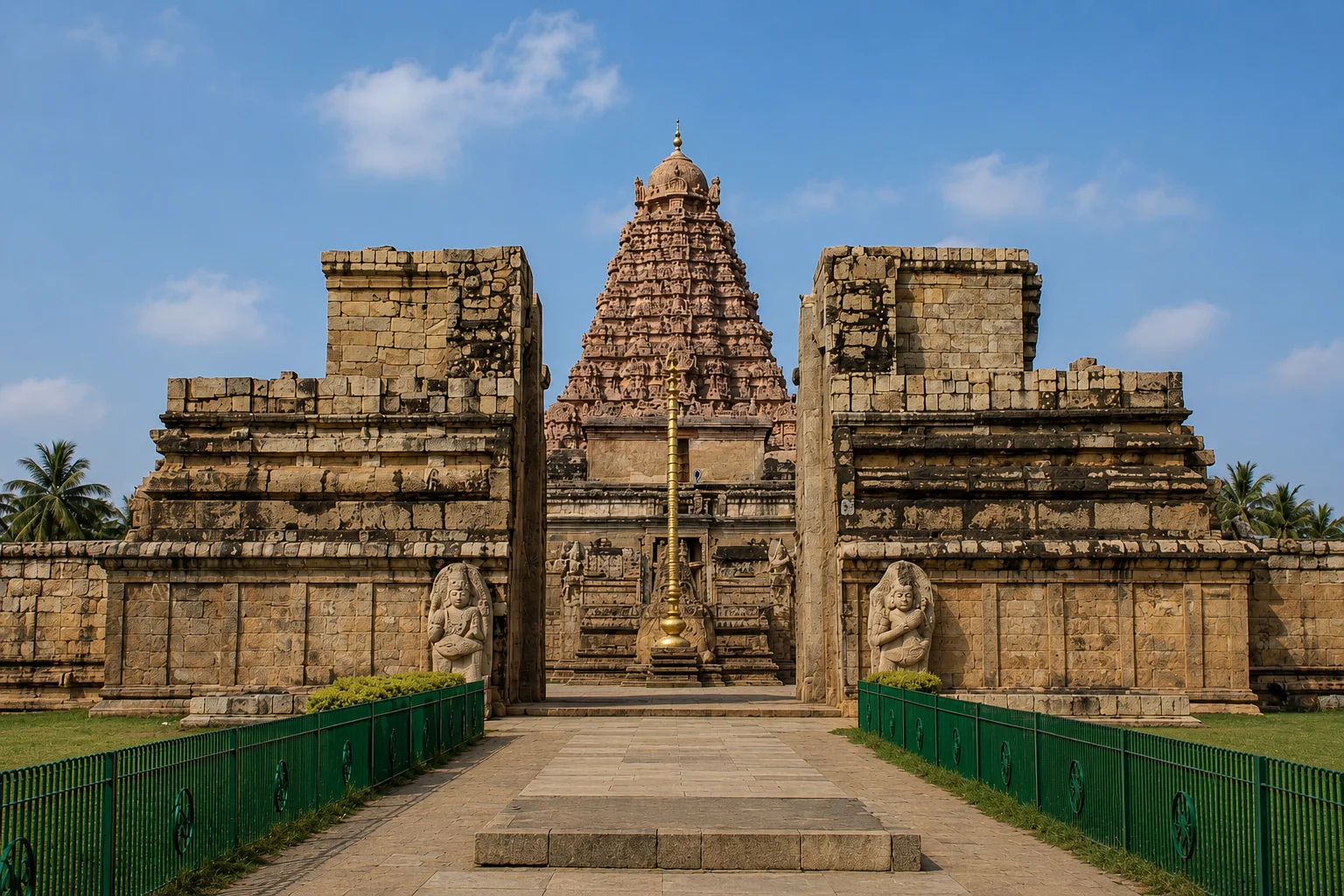
Gangaikonda Cholapuram: The Imperial Capital That Vanished
The Silence of a Lost Capital
There is an unusual stillness around Gangaikonda Cholapuram. The monument rises from an open landscape of fields and scattered settlements with a calmness that feels almost deceptive.
Nothing in the surrounding environment immediately suggests that this was once the capital of one of South India’s most powerful empires.
Unlike Brihadisvara Temple, which still exists within the movement and density of Thanjavur, Gangaikonda Cholapuram survives largely through absence.
The imperial city that once surrounded the temple has mostly disappeared, leaving the granite monument as the clearest surviving memory of Chola ambition and authority.
Built by Rajendra Chola I in the 11th century, the city emerged during the height of Chola expansion across the Indian subcontinent and beyond.
It was conceived not simply as another royal centre, but as a ceremonial capital commemorating Rajendra’s northern campaigns and his symbolic conquest of the Ganga plains.
Today, the city has largely vanished. The monument remains.
That contrast defines the experience of Gangaikonda Cholapuram. The temple does not overwhelm through scale alone. Instead, it reveals itself through proportion, refinement, and atmosphere.
Its vimana rises with a softer profile than the sharply vertical geometry of Brihadisvara Temple, suggesting a Chola architectural language that had evolved from assertion toward confidence.
The result is one of the most distinctive architectural landscapes in Tamil Nadu, a surviving imperial monument standing within the silence of a lost capital.
Rajendra Chola I and the Creation of an Imperial Capital
When Rajendra Chola I succeeded his father Rajaraja Chola I in the early 11th century, the Chola Empire had already become one of the dominant political powers in South India.
Rajaraja had consolidated territory, strengthened administration, and transformed Thanjavur into a monumental imperial centre through the construction of Brihadisvara Temple. Rajendra inherited a mature imperial structure capable of further expansion.
His reign marked one of the most ambitious phases in Chola history. Military campaigns extended Chola influence northward toward the Gangetic plains, an extraordinary achievement for a South Indian ruler of the period.
These victories became central to Rajendra’s political identity and earned him the title “Gangaikonda Chola”, meaning “the Chola who conquered the Ganga”.
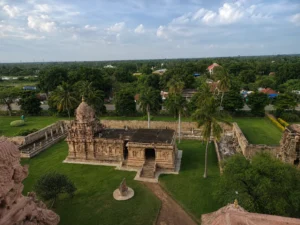
The establishment of Gangaikonda Cholapuram emerged directly from this imperial moment. Rather than ruling exclusively from Thanjavur, Rajendra created a new capital that would transform conquest into ceremonial geography.
Historical records suggest that sacred water from the Ganga was brought south and integrated into the symbolic identity of the city, reinforcing the connection between military victory and sacred legitimacy.
The city itself appears to have been conceived on an imperial scale. Alongside the great temple, Rajendra also commissioned the massive Chola Gangam reservoir, reflecting the close relationship between hydraulic engineering, political authority, and sacred planning within the Chola world.
Reservoirs and irrigation systems were not merely functional structures. They formed part of the larger imperial landscape through which power was organised and sustained.
For more than two centuries, Gangaikonda Cholapuram functioned as a major Chola capital. Administrative systems, ceremonial life, artistic production, and temple networks operated from this centre long after Rajendra’s reign.
Literary works such as Kalingattuparani and Muvar Ula preserved the prestige of the city even after its gradual decline.
Much of that urban world eventually disappeared. What survives most visibly today is the temple itself, standing within a landscape that no longer reflects the scale of the imperial city it once anchored.
The Architecture of Gangaikonda Cholapuram
The Softer Vimana
The defining architectural feature of Gangaikonda Cholapuram is its vimana, which immediately invites comparison with Brihadisvara Temple in Thanjavur. Yet the differences become apparent almost as quickly as the similarities.
Where Brihadisvara rises with sharply disciplined verticality, Gangaikonda Cholapuram introduces a more fluid architectural language.
The vimana ascends through a gentler concave profile, softening the rigid geometry associated with earlier Chola monumentality. The upward movement feels more sculptural than severe.
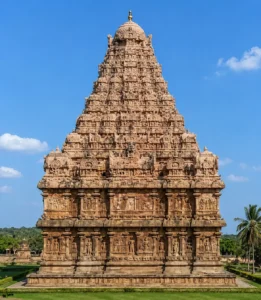
This shift represents one of the most important developments in Chola architecture. The monument preserves the structural grammar established under Rajaraja Chola I while transforming its visual expression into something more balanced and spatially controlled. Monumentality remains central, but it becomes more graceful.
The surrounding openness intensifies this effect. Because the vanished capital no longer crowds the monument with dense urban fabric, the vimana stands clearly against open sky and agricultural landscape.
Its curvature and massing become easier to perceive from a distance, giving the structure an expansive visual presence despite being smaller than Brihadisvara Temple.
The architecture reflects a civilisation no longer needing to prove its authority through overwhelming force alone. Imperial legitimacy had already been established. What emerged at Gangaikonda Cholapuram was confidence expressed through refinement and proportional control.
Sculpture, Detail, and Architectural Refinement
If Brihadisvara Temple communicates through monumental geometry, Gangaikonda Cholapuram reveals itself through detail.
The sculptural programme across the complex demonstrates remarkable sophistication, suggesting a tradition increasingly comfortable with ornament, variation, and surface articulation.
Lion motifs, threshold carvings, decorative panels, and sculptural transitions between architectural elements create a more fluid visual experience than the stricter treatment visible at Thanjavur. Ornamentation becomes richer, but the architecture still maintains discipline and coherence.
Several sculptures associated with the temple are considered among the finest examples of middle Chola artistic achievement.
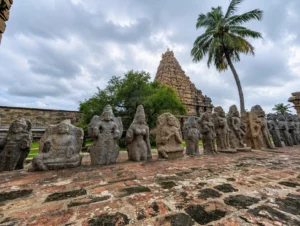
The Chandesanugraha Murti, depicting Shiva blessing Chandesha, reflects exceptional compositional balance, while sculptures of Saraswati and other deities reveal the extraordinary refinement of Chola stone carving during this period.
Historical accounts also suggest that sculptures brought from conquered regions, including parts of present-day Karnataka, Andhra Pradesh, and Bengal, were preserved within the wider sacred landscape surrounding the temple.
Whether viewed as imperial trophies or sacred acquisitions, these objects reinforced the monument’s relationship with Chola expansion and political memory.
Inside the sanctum, the massive Shiva lingam intensifies the scale of the interior spaces. The experience differs noticeably from Brihadisvara Temple.
The architecture feels less severe and more immersive, with sculptural detailing contributing to an atmosphere of controlled richness throughout the complex.
One of the most intriguing architectural elements within the temple precinct is the lion-well, where a stairway concealed within a sculpted lion structure descends toward the water below.
Details like this reveal how Chola architecture integrated engineering, symbolism, and spatial experience into a unified architectural language.
The Vanished Capital and the Open Landscape
The landscape surrounding Gangaikonda Cholapuram profoundly shapes how the monument is experienced today. Unlike Thanjavur, where layers of urban activity continue to surround Brihadisvara Temple, Gangaikonda Cholapuram stands within an environment marked by openness and historical absence.
The original imperial city has largely disappeared. What survives are fragments and archaeological traces of a much larger urban system that once functioned as the political centre of the Chola Empire for more than two centuries.
This disappearance creates a distinctive atmosphere. Open agricultural fields now occupy spaces where imperial processions, administrative networks, and ceremonial life once unfolded. The surrounding emptiness intensifies the monument’s presence rather than diminishing it.
The landscape itself becomes historical evidence.
Walking around the temple perimeter allows the scale of the surviving structure to register more clearly against the openness of the horizon. The vimana rises not from a dense capital city, but from a quieter landscape shaped by centuries of transformation.
The monument survives not only as architecture, but as the final visible centre of a vanished imperial world.
Engineering, Planning, and Sacred Order
Like the great Chola monuments before it, Gangaikonda Cholapuram reflects extraordinary engineering sophistication.
Constructed primarily from granite, the temple required advanced systems of quarrying, transportation, labour coordination, and structural planning on an imperial scale.
The architectural planning preserves the axial logic established at Brihadisvara Temple while softening its visual rigidity.
Movement through the complex remains carefully controlled. Gateways, courtyards, and sanctum progression continue to guide attention toward the sacred centre through alignment and proportion.
The temple also demonstrates how Chola architects refined established architectural systems rather than abandoning them.
Structural grammar, sacred orientation, and spatial sequencing remain consistent with earlier Chola traditions, but the visual language becomes more fluid and sculptural.
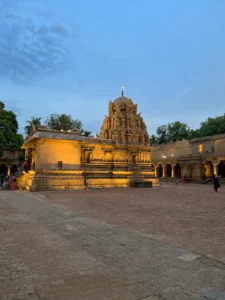
This continuity is what makes Gangaikonda Cholapuram so important within the broader evolution of Chola architecture.
The monument does not reject the monumental principles established at Thanjavur. It transforms them into something more spatially balanced and architecturally mature.
Experiencing Gangaikonda Cholapuram Beyond Monumentality
Most visitors arrive at Gangaikonda Cholapuram expecting another monumental Chola temple comparable to Brihadisvara Temple. Yet the experience unfolds differently.
The monument does not impose itself immediately through overwhelming scale. It reveals itself gradually through pacing, proportion, and atmosphere.
The quieter surroundings contribute significantly to this experience. Without the density of urban movement found in Thanjavur, the architecture can be encountered with fewer distractions.
Approaching the temple slowly from a distance changes how the vimana is understood. Its softer curvature becomes more apparent against open sky, particularly during early morning or late afternoon light when shadows move gradually across the granite surfaces.
Sculptural details that disappear in harsher light become more visually legible through slower observation.
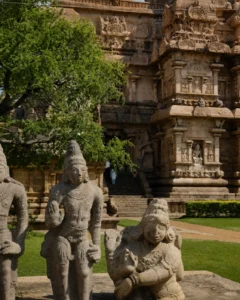
The temple rewards perimeter movement before entry. Walking around the structure first allows the monument to register as a complete spatial composition rather than as isolated architectural fragments.
The relationship between mass, proportion, and landscape becomes easier to understand externally before entering the inner spaces.
Inside the complex, the atmosphere shifts again. The sanctum retains the sacred density expected within Chola temple architecture, yet the transition inward feels less severe than at Brihadisvara Temple. Spatial control remains precise, but the emotional effect is more measured.
Even the traces of the vanished capital shape the experience indirectly. The awareness that this monument once stood within a vast imperial city changes how the surrounding emptiness is perceived. The silence around the temple no longer feels accidental. It feels historical.
This is what ultimately distinguishes Gangaikonda Cholapuram. The monument reveals itself not through spectacle alone, but through stillness, pacing, and the gradual recognition that architecture can preserve the memory of a civilisation long after its urban world has disappeared.
Gangaikonda Cholapuram Within the Great Living Chola Temples
Gangaikonda Cholapuram occupies a critical position within the architectural progression of the Great Living Chola Temples. The three UNESCO-recognised monuments are best understood not as isolated temples, but as successive stages within a continuous Chola architectural language.
Brihadisvara Temple established the monumental grammar of imperial Chola architecture through scale, axial precision, and geometric authority. Gangaikonda Cholapuram inherited that grammar but transformed it into something more fluid and refined.
This evolution becomes even clearer when viewed alongside Airavatesvara Temple at Darasuram. If Brihadisvara represents assertion and Gangaikonda Cholapuram represents refinement, Darasuram introduces a later phase of ornamental density and technical precision.
Together, the three monuments document the evolution of Chola architecture across generations of imperial stability.What also distinguishes these temples is continuity.
Worship traditions rooted in older Agamic systems continue within all three complexes, sustaining a sacred continuity that extends across centuries.
Within this sequence, Gangaikonda Cholapuram marks the moment when Chola architecture moved beyond monumental declaration alone and entered a phase of greater spatial and sculptural sophistication.
Why Gangaikonda Cholapuram Still Matters
Despite its architectural significance, Gangaikonda Cholapuram remains comparatively less discussed than Brihadisvara Temple in Thanjavur. Yet this relative quietness is partly what preserves the monument’s unusual atmosphere and interpretive depth.
Its importance extends far beyond UNESCO recognition. Gangaikonda Cholapuram preserves one of the clearest examples of how imperial architecture can evolve without losing coherence.
Rather than replicating Brihadisvara Temple, it transformed the language of Chola monumentality into something more balanced, sculptural, and spatially nuanced.
The temple also matters because it preserves the memory of a vanished capital city. Most visitors encounter the monument without fully realising that this landscape once functioned as the administrative and ceremonial centre of the Chola Empire for more than two centuries.
For Tamil cultural memory, the monument remains deeply significant. Literary works such as Kalingattuparani and Muvar Ula preserved the prestige of Gangaikonda Cholapuram long after the decline of Chola political authority.
The temple therefore survives not only as one of the great achievements of Chola architecture, but as one of the clearest surviving expressions of how architecture can preserve political memory long after empires themselves fade from the landscape.
Closing
Gangaikonda Cholapuram stands today as both monument and memory. Built during the height of Chola expansion under Rajendra Chola I, it transformed imperial conquest into architecture, sacred geography, and urban ambition on a monumental scale.
Yet what makes the site remarkable is not simply its historical importance. It is the way refinement emerged from power. Where Brihadisvara Temple asserted Chola authority through geometric force, Gangaikonda Cholapuram evolved that architectural language into something more fluid, balanced, and spatially controlled.
The vanished city surrounding the monument intensifies this experience. Open fields now occupy spaces once shaped by imperial administration and ceremonial life, leaving the granite temple as the clearest surviving centre of a lost capital.
More than a thousand years after its construction, Gangaikonda Cholapuram continues to preserve the memory of a civilisation that understood architecture not merely as construction, but as political expression, sacred order, and historical permanence.
The city faded.
The monument endured.
Related Blogs
Thanjavur Beyond Brihadeeswara Temple: Exploring the Cultural Heart of the Cauvery Delta
More Than a Temple City For many travellers, Thanjavur begins and ends with Brihadeeswara Temple. The soaring vimana, vast courtyards,…
Read More ›
Kanchipuram: Sacred Architecture and Living Traditions
More Than the City of a Thousand Temples Kanchipuram is often introduced as the “City of a Thousand Temples.” While…
Read More ›