
Beyond Performance: Designing a Classical Arts Itinerary Through Tamil Nadu
The Static vs. The Living
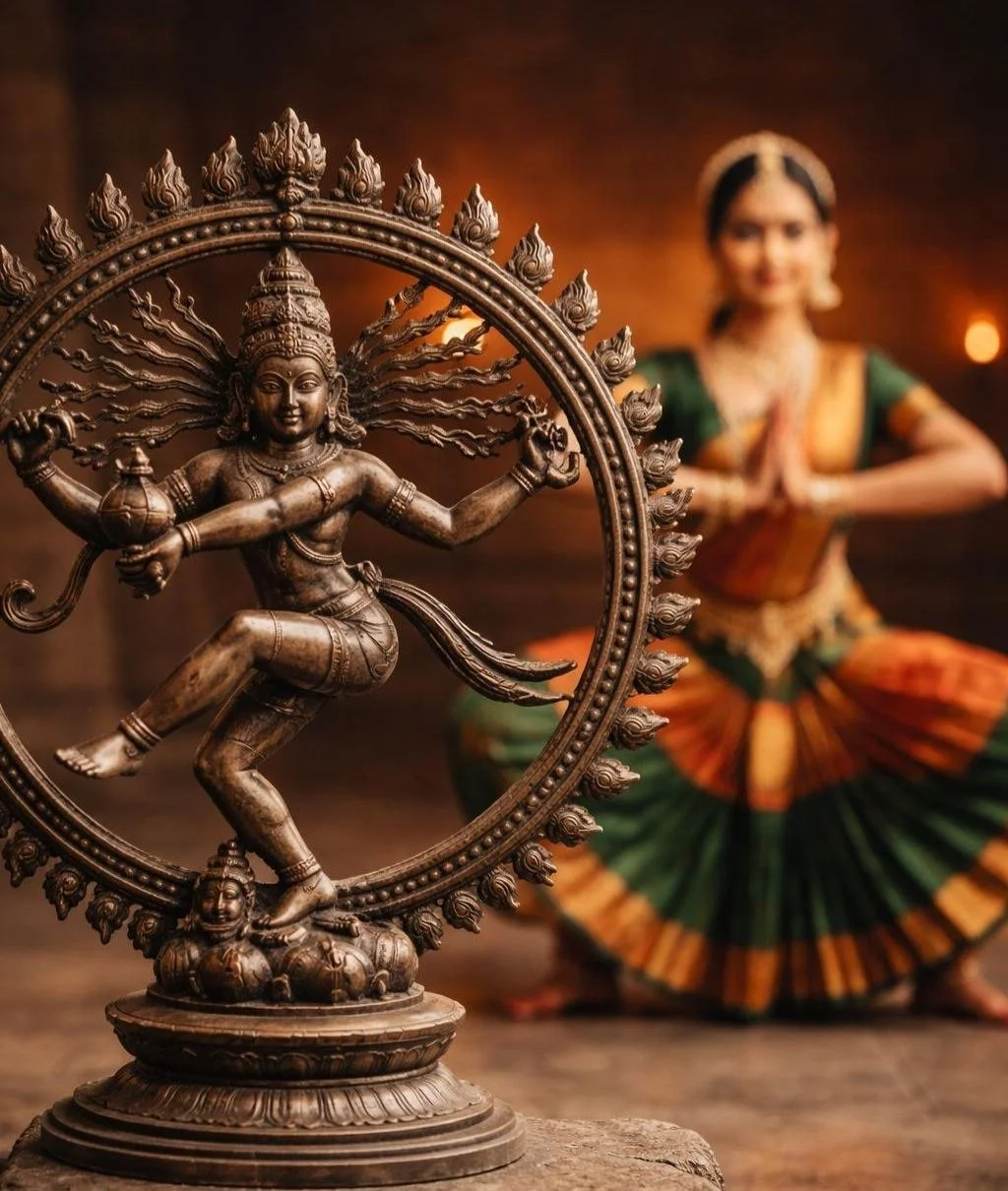
A dancer’s gesture does not begin on stage. It begins in stone.
Most itineraries approach the classical arts of Tamil Nadu as a sequence of performances, An evening recital, a seasonal festival, a ticketed experience that starts and ends within a proscenium frame. The audience arrives, watches, applauds, and leaves. The art remains contained within that duration, detached from the landscape that produced it.
A true Tamil Nadu classical arts tour does not begin with a performance. It begins with a question: what conditions made this art inevitable?
The answer cannot be found under stage lights alone. It lies in the way granite holds posture, in the rhythm of temple corridors and in the geometry that governs both architecture and movement.
The dancer’s araimandi stance echoes a sculptural logic. The musician’s cycle of beats reflects spatial repetition. What appears as performance is, in fact, a continuation.
To treat these traditions as static is to misunderstand them. They are not objects to be viewed, but systems to be entered, living structures that extend across land, craft, and ritual. The journey, therefore, is not about attending an event. It is about learning how to see what was always already in motion.
The Architectural Root
Before there was choreography, there was alignment.
The temples of the Chola period are not merely sites of worship; they are repositories of encoded movement. At Brihadisvara Temple and Gangaikonda Cholapuram, the stone does not decorate, it instructs. Each sculpted figure is not a frozen pose but a moment within a sequence, a precise articulation of balance, weight, and transition.
Consider the raised heel of a dancer carved into a pillar. The shift is subtle, but exact. It indicates not just form, but timing, the fraction of a second between stillness and motion. When a Bharatanatyam dancer assumes the same stance, it is not imitation. It is continuity. The body completes what the stone initiated.
The corridors themselves function as rhythmic spaces. Walking through them, one becomes aware of repetition, not monotonous, but measured. Pillar after pillar, interval after interval. This is not unlike the structure of a tala cycle in music, where repetition creates expectation, and expectation creates meaning.
To understand the dance without the temple is to isolate it from its grammar. The geometry of the sanctum, the axial alignment of the deity, the progression from outer mandapa to inner chamber, these are not architectural choices alone. They are frameworks that shaped how movement, sound, and devotion coalesced.
The dancer does not simply perform in a temple. The dancer emerges from it.
The Narrative of the Kaveri Delta
If the temple provides the grammar, the river provides the voice.
The Kaveri Delta is not just a fertile landscape; it is a field of transmission. Water moves, and with it, ideas, techniques, and tonalities. What begins in the formal spaces of Chennai’s academies finds its lived expression in the towns and villages that trace the river’s path.
A meaningful South India arts itinerary must follow this movement-from abstraction to application, from theory to practice.
In Swamimalai, the process of bronze casting continues as it has for centuries. The Chola bronze trail is not a metaphor; it is a working system. A sculptor prepares a wax model, shaping it with fingers that understand proportion without measurement. The wax carries intention-every curve, every contour decided before it is ever translated into metal.
The model is then encased in clay, heated until the wax drains out, leaving behind a hollow. Molten bronze is poured into this void. When the clay is broken, the figure emerges, Which is singular and unrepeatable. There are no moulds reused, no identical copies. Each piece is a one-time act of creation.
The discipline of this method lies in its refusal of repetition. Each casting carries the memory of its making-the temperature judged by eye, the timing governed by experience rather than instrumentation. When the outer clay is broken, what remains is not just a figure, but a record of process.
Small variations in surface, minute shifts in contour, these are not imperfections but signatures. They indicate that the object was not manufactured, but resolved.
This insistence on singularity parallels the way a raga is approached in performance. The framework exists, the notes are known, but the rendering is never identical. A musician does not reproduce; they interpret within constraint. In both bronze and music, structure provides stability, but expression emerges through deviation, Which are measured, controlled, and intentional.
The surface is then refined. The eyes are opened last, in a ritual that transforms object into presence.
This process is not separate from the performing arts. The same attention to proportion, the same awareness of balance, exists in the dancer’s body. A misalignment in bronze is visible. A misalignment in movement is felt.
Further along the Delta, the soundscape shifts. The Carnatic music heritage of the region is not confined to concert halls. It is embedded in daily rhythm. The low hum of temple chants at dawn, the sharp rise of the nadaswaram during processions, the cyclical patterns of percussion that mirror the river’s own cadence.
The tonal quality of this music, its oscillations, its microtonal inflections, cannot be separated from the environment in which it evolved. The open spaces, the reflective surfaces of water and the acoustics of temple courtyards, all shape how sound is produced and perceived.
To listen here is to understand that music is not performed in isolation. It is in dialogue with the land.
Access Beyond the Stage
The difference between observation and understanding lies in access.
To engage with Bharatanatyam travel India meaningfully, one must step outside the formal performance circuit. The “Season” in Chennai offers technical excellence, but it also standardizes experience. The stage is controlled, the lighting precise, the duration fixed.
In a village setting, the parameters shift.
A teacher receives visitors in a modest home. There is no stage, no audience in the conventional sense. The floor is marked not by tape, but by use. The lesson begins with the sound of feet striking earth, rhythmic and deliberate.
The teacher corrects a student’s posture, adjusting the angle of the knee by a few degrees. The difference is immediate. The stance stabilizes. The movement acquires weight.
The explanation is not abstract. It is demonstrated. Repeated. Internalized.
Elsewhere, in Kanchipuram, a weaver works at a loom that has been in use for decades. The silk threads are arranged with mathematical precision. Each pattern corresponds to a structure, often derived from temple architecture. A border reflects a column. A motif mirrors a ceiling panel.
The weaver counts silently, maintaining alignment across hundreds of threads. A single error disrupts the entire composition. The correction is not cosmetic; it requires undoing and reworking.
This is the same discipline found in music, where a misplaced beat alters the entire cycle, and in dance, where a slight imbalance affects the flow of movement.
Access, in this context, is not about exclusivity. It is about proximity to process. To see the art at its point of formation, before it is framed for presentation.
Why This Requires Design, Not Assembly
An itinerary can move you efficiently. It cannot make you understand.
The difference between assembling a journey and designing one lies in intention. An assembled itinerary ensures that you arrive on time, that the performance is scheduled, that logistics are seamless. It operates on coordination.
A designed journey operates on coherence.
In the context of a Tamil Nadu classical arts tour, coherence means that each experience builds upon the previous one. The temple is not visited as a standalone site, but as a foundation for what follows.
The bronze workshop is not an isolated craft stop, but a continuation of the same principles observed in stone. The music is not an evening event, but an echo of patterns already encountered.
Timing is critical. Visiting a temple at midday offers clarity of structure; visiting at dawn reveals sound. Meeting a sculptor before seeing a performance alters perception, the eye begins to notice proportion, the body begins to anticipate movement.
This is not accidental. It is constructed.
Design also requires restraint. Not every site is included, not every performance attended. The absence of excess is deliberate. By limiting exposure, attention sharpens. A single well-timed encounter, a rehearsal heard without amplification and a sculptor working in silence carries more weight than a sequence of scheduled events.
The traveller is not hurried from one point to another, but allowed to remain long enough for perception to adjust.
This pacing alters comprehension. What initially appears unfamiliar begins to organize itself. Patterns repeat, but not redundantly. They accumulate. The journey, then, is not defined by coverage, but by clarity.
At Lux Crafter, this approach is not about adding more experiences, but about sequencing them correctly. The objective is not to show everything, but to reveal connections.
To understand how Lux Crafter designs bespoke India journeys, one must consider not just where a traveller goes, but how each encounter prepares them for the next.
Without this design, the journey remains a collection of moments. With it, the journey becomes a narrative.
Closing
The classical arts of Tamil Nadu are not confined to performance. They are distributed across stone, metal, sound, and space, each element reinforcing the other.
A Tamil Nadu classical arts tour is therefore not a passage through locations, but an entry into a system of relationships. It begins with the desire to witness, but it does not end there.
At some point, the act of looking changes. The dancer is no longer separate from the temple. The music is no longer separate from the land. The object is no longer separate from the process that formed it.
What begins as observation becomes recognition.
And that is where the journey truly starts.
Related Blogs
Why Goa’s Maritime Estates Make the Right Backdrop for a Private Event
A private event in Goa is often reduced to a familiar format, music by the shore, a sunset gathering, and…
Read More ›
South India as an Incentive Destination: The Case Beyond the Obvious Choices
The Incentive Paradox The most effective incentives are not defined by where one stays, but by what one begins to…
Read More ›