
How We Design Bespoke South India Journeys That Have Never Been Run Before
We receive a brief.
A travel brand writes to us about a returning client. They have already been to Kerala-the backwaters, a few days in Kochi, the standard circuit. They want to return to South India, but not to repeat what they have already seen. They are looking for something more culturally specific, more considered. They trust the brand to design something they could not have assembled themselves. That trust is passed to us. This is where bespoke India journey design begins.
What we have been given is not a list of destinations. It is not a set of hotel preferences. It is not even a defined route. It is a direction of intent and a degree of trust. The brief tells us what the traveller does not want, and gives us a hint of what they might be looking for-but it does not yet tell us what the journey should be.
Most operators, at this point, would begin assembling an itinerary. That is not what we do. The brief tells us almost nothing yet. Before we decide where this traveller should go, we need to understand what they are actually looking for. Not in terms of activities or accommodation, but in cultural terms. What did Kerala give them, and what did it leave unresolved? When they say they want something more specific, what does that mean in practice? This is the part of how to design a custom India tour that is usually skipped. It is also the part that determines everything that follows.
At this stage, the work is not about places. It is about direction. Until that direction is clear, any itinerary would be premature.
The questions that shape everything
We go back to the travel brand with questions.
Some of them will seem unexpected. We ask what the traveller lingered in during their previous journey. Not what they visited, but where they stayed longer than planned. What they tried to understand but felt they only saw the surface of. Whether there was a moment-inside a temple, during a performance, or in a conversation-where something shifted and they wanted more time than the itinerary allowed.
These questions are not about preference. They are about behaviour.
This is part of our India DMC journey design process, and it is built on a different premise. We are not collecting inputs to match against a database. We are trying to understand how this traveller moves through unfamiliar environments-what draws them, what holds their attention, and what they feel they have not yet understood.
The answers begin to define the direction.
If the traveller kept returning to Kochi’s older quarters, spending time where histories overlap and leave visible traces, that tells us something specific. It suggests an interest in how cultures accumulate over time. If, instead, they spoke about the interior of Kerala-the rhythm of the landscape, the silence of the spice regions such as hilly district of Idukki (Munnar, Thekkady and Kumily), Wayanad, and Malabar coast-that suggests a different orientation entirely.
These are not minor differences. They lead to completely different journeys.
This is what private tour India first principles means in practice. We do not start with a destination and adapt it to the traveller. We allow the traveller’s way of engaging to determine which parts of India are relevant in the first place.
By the time we have these answers, the geography has already begun to narrow-even though we have not yet named it.
Building the cultural argument before the itinerary
Before we select a destination, we build a cultural argument.
In this case, the traveller’s responses point toward an interest in continuity-how a culture sustains itself across centuries, how it accumulates and maintains coherence over time. South India has a precise answer to that, and it is centred in Tamil Nadu. This becomes the foundation of the South India bespoke itinerary process we are about to construct.
The Chola period offers a particularly clear expression of this continuity. The temple architecture is not simply structural-it encodes cosmology, spatial logic, and ritual movement. The bronze-casting tradition continues to be practiced by hereditary artisans, using techniques that have remained consistent over generations. The Carnatic music system carries forward a transmission of form that is both preserved and actively performed.
This is not contextual information. It is the argument the journey will be built around.
Once the argument is established, the sequence begins to take shape.
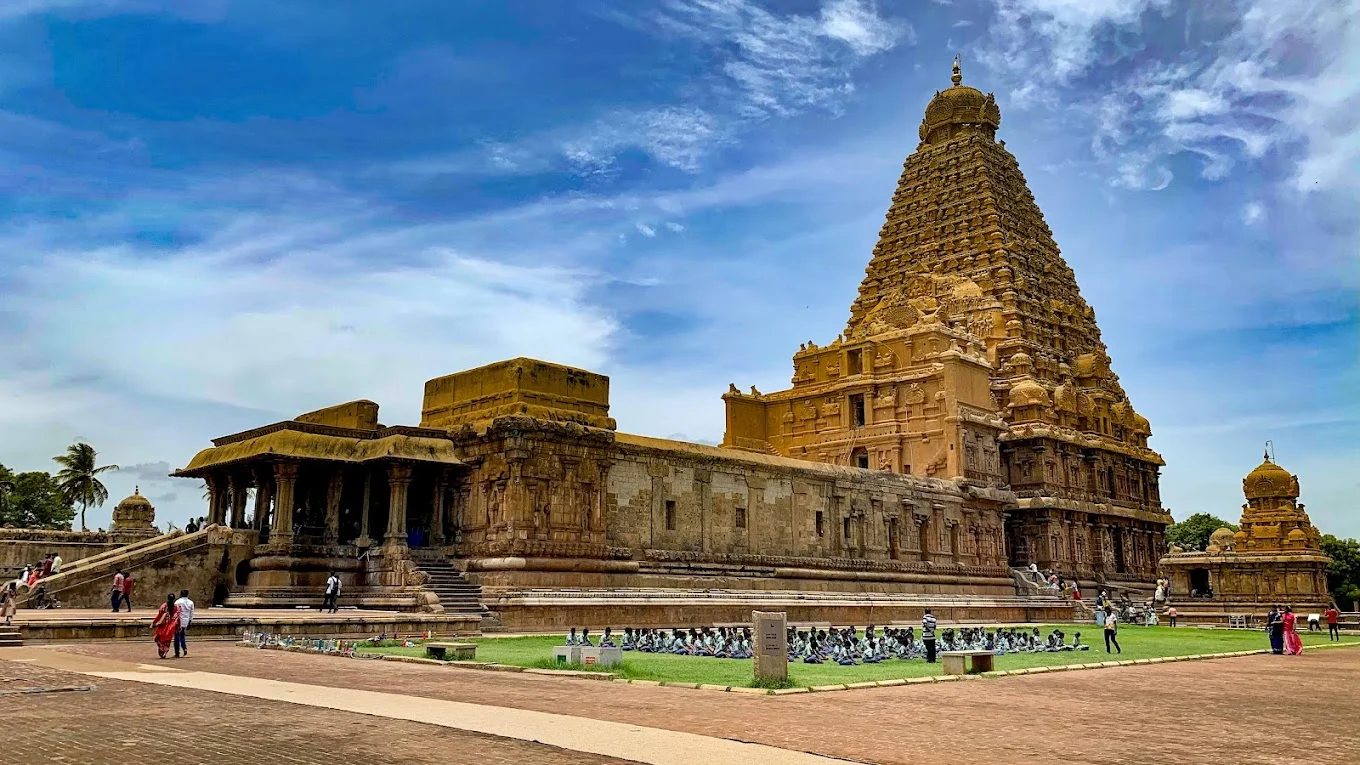
We do not begin with scale or recognition. We begin with legibility. The Brihadeeswara temple in Thanjavur is the clearest entry point into the Chola system. It allows the traveller to understand the logic before encountering variations of it.
From there, the journey expands outward. Kumbakonam introduces temple towns that function within everyday rhythms. Gangaikonda Cholapuram offers a contrast-monumental, but partially reclaimed by landscape. Madurai shows a later stage of evolution, where the Dravidian system continues to operate within an active urban context.
Each movement carries forward an understanding. Each place adds something that makes the next place more comprehensible.
At this stage, we are not yet working with days or bookings. We are working with sequence and meaning. The itinerary will emerge from this. It is not the starting point.
Pacing as a design decision
Once the structure is clear, pacing becomes part of the design.
Most itineraries are paced around efficiency-how much can be covered within a given timeframe. We approach this differently. The question is not how much can be seen, but how much can be understood.
In this journey, Thanjavur is given two full days. Not because there is too much to see in one, but because the nature of the encounter changes on a second visit. The first visit to the Brihadeeswara temple is guided. It introduces the structure, the symbolism, and the logic of the space. The second visit happens without that layer of explanation. The traveller returns with context and begins to see differently.
Details that were informational during the first visit become recognisable during the second.
This cannot be achieved if the visit is compressed into a schedule built around transit.
The same principle applies across the journey. Movement is limited not by distance, but by the time required for absorption. If a place requires time to be understood, it is given that time-even if it reduces the number of locations in the itinerary.
We also include periods that are deliberately unstructured. Not as rest, but as space. Time to return to something, to sit with what has been encountered, to allow the experience to settle. Without this, the journey becomes a sequence of impressions rather than a progression of understanding.
Pacing, in this context, is not logistical. It is interpretive.
What access requires and how it is arranged
Access is not something we add to a journey. It is something the journey is built around.
In Tamil Nadu, this includes an introduction to a Sthapathi—a bronze-casting artisan working within the Chola tradition. This is not an activity that can be booked. It exists because of a relationship that has been built over time.
We know when it is appropriate to make this introduction and when it is not. We know what level of engagement is expected. The encounter is structured in a way that reflects both the tradition and the traveller’s readiness to engage with it.
This is what distinguishes the experience. The traveller is not observing from the outside. They are being received in a context that has been prepared for them.
Arranging this requires more than scheduling. It requires judgment.
Timing matters. The artisan’s work cycle matters. The traveller’s level of understanding matters. Sometimes, preparation is required before the introduction can take place. The traveller may need to understand certain aspects of the tradition in advance so that the interaction operates at the right level.
This is not an additional layer. It is part of the design itself.
Without this, the journey remains within what is publicly accessible. With it, the experience shifts into a different register.
The first draft and what changes it
The first version of the journey brings all of this together.
It has a clear cultural argument rooted in Tamil Nadu. It has a sequence that builds understanding. It has pacing that allows for absorption. It has access points that have been identified and provisionally arranged.
This version goes back to the travel brand.
What comes back changes it.
Not because the design was incorrect, but because the traveller has dimensions we did not yet account for. There may be a physical constraint that alters how certain parts of the journey are approached. There may be a companion whose interests require a different balance. The timing may shift, introducing seasonal conditions that affect how certain experiences function.
The design absorbs these changes.
Because it was built from first principles, it can adjust without losing its structure. The sequence may shift. The pacing may adapt. Certain elements may be replaced. But the underlying logic remains intact.
This is what allows the journey to remain coherent as it evolves.
Every journey we build starts the same way-with a blank page and a question about what a traveller wants to understand by the end of it. If you are working on a South India program and want it designed this way, this is the place to begin:
see how Lux Crafter builds bespoke India journeys
Related Blogs
Why Goa’s Maritime Estates Make the Right Backdrop for a Private Event
A private event in Goa is often reduced to a familiar format, music by the shore, a sunset gathering, and…
Read More ›
South India as an Incentive Destination: The Case Beyond the Obvious Choices
The Incentive Paradox The most effective incentives are not defined by where one stays, but by what one begins to…
Read More ›