
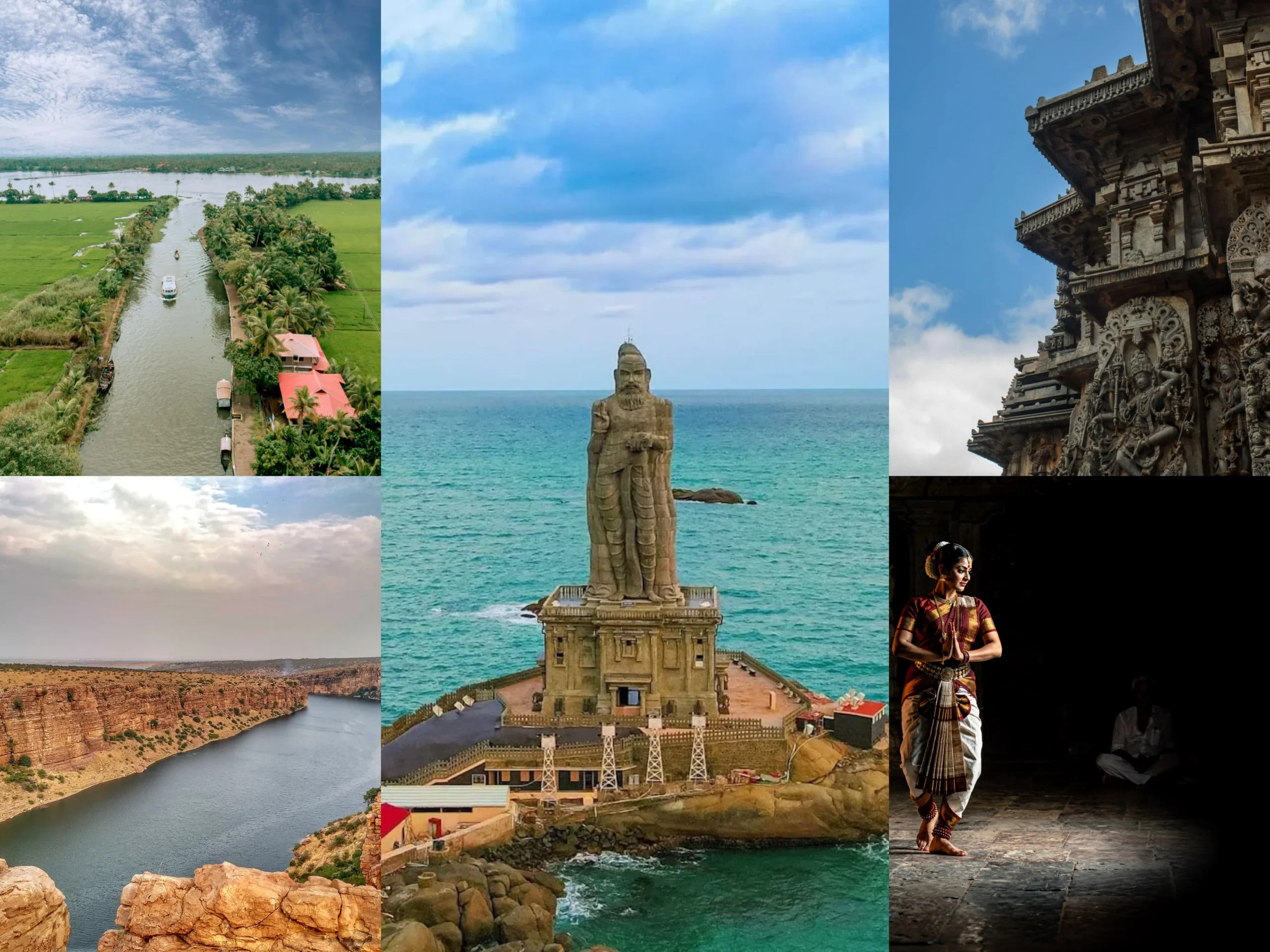
South India Travel Guide – Routes, Seasons & What to Expect
Introduction
South India travel covers a diverse and geographically distinct region that includes Kerala, Tamil Nadu, Karnataka, and parts of Andhra Pradesh and Telangana.
Each state presents a different combination of landscape, climate, culture, and travel pace, which makes planning more structured compared to single-destination trips. A well-designed south india travel guide therefore focuses not only on places to visit, but on how routes, seasons, and travel flow are aligned.
The region is characterised by coastal belts, hill ranges such as the Western Ghats, temple towns, and wellness destinations. Travel between these zones involves varying distances, road conditions, and climate patterns, all of which influence itinerary design.
Unlike short urban trips, South India journeys are typically spread across multiple days and require sequencing of locations to avoid fatigue and unnecessary transit.
This guide outlines how South India travel is approached from a planning perspective, covering route structure, seasonal considerations, and what travellers can expect during the journey. A more detailed perspective on culturally focused travel can be understood here.
What Defines South India Travel
South India travel is defined less by individual attractions and more by how a journey is structured across regions with distinct identities. Unlike single-city or short-distance travel, a south india travel guide typically involves moving through multiple states, each offering a different combination of landscape, climate, language, and cultural context.
This requires a planning approach that prioritises sequencing and balance rather than coverage.This level of structuring is typically developed through a defined approach to journey design
One of the defining aspects is variation. Coastal areas in Kerala follow a humid, tropical pattern, while hill regions such as Munnar, Coorg, and Chikmagalur present cooler conditions.
Temple towns in Tamil Nadu operate within a cultural and ritual framework that influences visiting hours, dress norms, and daily flow. These differences mean that travel decisions are not interchangeable across locations.
Pace is another important factor. Distances between destinations may appear moderate on a map, but actual travel time can be longer due to terrain, road conditions, and traffic patterns. As a result, a structured south india itinerary avoids frequent movement and instead groups locations logically to reduce transit fatigue.
Overall, South India travel is best approached as a layered journey, where climate, culture, and logistics are aligned, rather than a checklist of destinations.
South India Travel Routes – How to Structure Your Journey
A well-planned south india travel route is built by grouping destinations that share geography, climate, and travel flow, rather than by selecting locations individually. Because distances and terrain can extend travel time, a structured south india itinerary focuses on continuity and reduces unnecessary transit.
One common route is Kerala-focused, typically moving from Kochi to Munnar (hill region), then to Thekkady (forest zone), and onward to the Alleppey backwaters before ending along the coast. This sequence follows a logical descent from hills to plains, aligning with both climate and road connectivity.
A second route centres on Tamil Nadu’s cultural belt. Travel often begins in Chennai, moves to Mahabalipuram, then continues to temple cities such as Madurai and Thanjavur. This route is less about landscape variation and more about architectural and cultural continuity, which influences pacing and time allocation.
In Karnataka, routes are typically structured around Bengaluru, Mysore, and Hampi. While distances appear manageable, travel time between these locations requires careful planning, especially when combining them within limited durations.
Multi-state routes combine elements of these regions, such as a Kerala-Tamil Nadu or Karnataka-Kerala journey. These require additional attention to transitions between climates and travel durations.
Overall, an effective south india travel route is not defined by the number of destinations covered, but by how seamlessly they connect within a realistic travel plan.
Best Time to Visit South India – Season-Wise Breakdown
The best time to visit South India depends on how climate interacts with the regions included in the itinerary. Because the geography spans coastal areas, hill ranges, and interior plains, seasonal conditions vary across locations. A structured south india travel guide therefore considers timing as a key planning variable rather than a general recommendation.
From October to March, conditions are relatively stable across most regions. This period is commonly considered the best season to visit South India, as temperatures are moderate and humidity is comparatively lower. It is suitable for combining multiple states, including coastal Kerala, hill regions, and cultural circuits in Tamil Nadu.
Between April and June, temperatures rise in the plains and coastal areas, while hill destinations such as Munnar, Ooty, and Coorg remain comparatively cooler. Travel during this period is typically structured around higher-altitude regions to maintain comfort.
The monsoon season, from June to September, affects different parts of South India at varying intensities. While heavy rainfall can impact travel logistics and accessibility, certain experiences, particularly in Kerala, are planned during this period due to seasonal characteristics. However, routes during this time require careful adjustment to avoid disruption.
In practice, the best time to visit South India is not fixed, but depends on the combination of destinations, travel duration, and the type of experience being planned.
How to Plan a South India Trip
Planning a South India journey requires a structured approach that aligns destinations, duration, and travel flow rather than simply selecting locations. A practical south india travel plan begins with defining the total number of days available, as this directly determines how many regions can be included without creating unnecessary transit fatigue.
For shorter durations (7–8 days), it is advisable to focus on a single state or a tightly connected route, such as a Kerala circuit or a Tamil Nadu cultural itinerary. For 10–14 days, a broader south india itinerary can combine two regions, provided the sequence follows geographic continuity. Attempting to cover multiple states within limited time often results in excessive travel and reduced engagement with each destination.
Another important factor is route flow. Travel should generally move in a linear or circular pattern, avoiding repeated backtracking. Entry and exit points (such as Kochi, Chennai, or Bengaluru) should be selected based on the starting region to optimise connectivity.
Seasonal timing also influences planning decisions. The south india travel plan should account for climate differences across regions to ensure that destinations are visited under suitable conditions.
Overall, effective planning is less about the number of places included and more about how logically they are connected within a manageable travel duration.
Transport & Travel Logistics
Transport planning is a central component of any south india travel plan, as distances, terrain, and connectivity directly influence itinerary feasibility. While map distances between destinations may appear moderate, actual travel time is often extended due to road conditions, traffic patterns, and the transition between plains, hills, and coastal zones.
For most structured itineraries, a private vehicle with driver is preferred, as it allows flexibility in route sequencing and timing. This is particularly relevant when moving between regions such as hill stations and backwater areas, where public transport connections may be limited or indirect. A well-designed south india travel route takes into account realistic travel durations rather than relying on distance alone.
Rail networks connect major cities such as Chennai, Bengaluru, Kochi, and Madurai, and can be integrated into longer itineraries. However, train schedules and station locations need to be aligned carefully with the overall plan. Domestic flights are useful for covering longer distances between states, especially when time is limited.
It is also important to account for rest intervals between travel segments. Continuous long-distance movement can affect the overall experience, particularly in multi-state journeys. As a result, transport decisions should be integrated into the itinerary from the outset, rather than treated as a secondary arrangement.
What to Expect During Travel
Understanding what to expect in South India helps align travel plans with on-ground realities, particularly for first-time visitors. The region presents a combination of climatic variation, cultural diversity, and differing travel conditions, which influence the overall experience beyond itinerary structure.
One of the primary factors is climate. Coastal areas tend to be warm and humid, while hill regions offer cooler conditions. Travellers may encounter multiple climate zones within a single south india itinerary, making it necessary to plan clothing and daily schedules accordingly. Seasonal changes can also affect visibility, travel comfort, and access to certain locations.
Cultural context is another defining aspect. Temple towns and heritage areas often follow specific entry norms, including dress guidelines and restricted access timings. Food patterns vary across states but are generally regional, with rice-based meals and local preparations forming the core of daily cuisine.
Travel pace should also be considered. Distances between destinations can translate into longer travel hours than expected, and journeys are typically more gradual compared to urban or short-haul travel experiences. As a result, expectations around speed and coverage need to be adjusted.
Overall, what to expect in South India is not uniform across regions, and a well-planned journey anticipates these variations rather than reacting to them during travel.
Accommodation Types Explained
Accommodation choices are a key component of a south india travel plan, as they influence both travel flow and overall experience. Rather than selecting stays based only on category, it is important to understand how different accommodation types align with location, duration, and purpose within a south india itinerary.
In coastal and backwater regions, resorts are commonly used for short, contained stays where the environment itself is part of the experience. In contrast, heritage properties, particularly in Tamil Nadu and parts of Karnataka, are associated with cultural travel, where architecture, setting, and location within historic towns influence the stay.

Wellness retreats are distinct from standard accommodation, especially in Kerala, where they are integrated with structured programs such as Ayurveda-based treatments. These are typically not combined with active travel days, as they follow a fixed routine and controlled environment.
Functional city hotels serve a different purpose, often used as transit points in urban centres such as Chennai, Bengaluru, or Kochi. Their role is primarily logistical, supporting arrival, departure, or short overnight stays between regions.
Selecting accommodation within a south india travel plan is therefore not uniform across destinations, and each type should be positioned based on its role within the overall journey rather than treated interchangeably. This differentiation becomes more relevant in curated travel formats and guided journeys
Integrating Wellness & Ayurveda into Your Journey
Wellness travel in South India is most commonly associated with Kerala, where structured Ayurvedic programs are integrated within a controlled environment.
When included in a south india travel plan, these programs require a different approach compared to standard sightseeing, as they follow a defined schedule and clinical process. This is particularly important in structured Ayurvedic programs such as Panchakarma treatment.
Ayurvedic treatments such as Panchakarma are not typically combined with active travel days. Instead, they are positioned either at the beginning or end of a south india itinerary, depending on the purpose of the journey. This allows sufficient time for preparation, treatment, and recovery without disruption from transit or external activities.

The duration of a wellness component also influences overall planning. Short stays may include general wellness routines, while longer programs involve structured therapies that require consistency and minimal movement between locations. As a result, destinations within Kerala are often grouped around the treatment centre rather than spread across multiple regions.
Climate is another factor, as certain periods are preferred for Ayurveda-based programs due to environmental conditions. Integrating wellness into a south india travel plan therefore involves aligning treatment timelines, travel routes, and recovery phases in a way that maintains continuity.
In practice, combining Ayurveda with travel is not about adding an experience, but about structuring the journey to accommodate it appropriately.
Common Travel Mistakes to Avoid in South India
Planning errors in South India travel are often related to pacing, sequencing, and expectations rather than destination choice. A well-structured south india travel plan avoids these issues by aligning routes, duration, and seasonal factors from the outset.
One of the most common mistakes is overpacking the itinerary. Attempting to cover multiple states within a limited timeframe leads to extended travel hours and reduced time at each destination. A more effective south india itinerary focuses on fewer regions with logical connectivityThis is particularly evident in structured temple travel routes in Tamil Nadu
Another frequent issue is underestimating travel time. Distances that appear short on maps may take longer due to terrain, road conditions, and traffic. This can disrupt schedules and affect overall travel flow if not accounted for in advance.
Ignoring seasonal variations is also a key mistake. Climate differences across coastal, hill, and inland areas can impact comfort and accessibility. Selecting destinations without considering timing may lead to avoidable disruptions.
Travellers may also overlook cultural and logistical factors, such as temple entry norms, local food patterns, and regional travel pace. These elements influence daily planning and should be understood beforehand.
Overall, avoiding these common mistakes helps ensure that a south india travel plan remains structured, realistic, and aligned with on-ground conditions.
Closing
A well-structured south india travel guide is defined not by the number of destinations included, but by how effectively routes, seasons, and travel flow are aligned. The region’s diversity, across climate, culture, and geography, requires a planning approach that prioritises continuity and balance rather than rapid coverage.
When a south india itinerary is designed with realistic travel durations, appropriate sequencing, and seasonal awareness, it allows each destination to be experienced within its context. This reduces transit fatigue and supports a more stable travel rhythm across regions.
In practice, South India travel is best approached as a coordinated journey where logistics, environment, and purpose are integrated from the outset, rather than adjusted during the trip.
Related Blogs

North vs South India – Travel Differences, Climate & How to Choose
Introduction Travel across India is not defined by a single pattern, and the comparison of North vs South India reflects…
Read More ›