
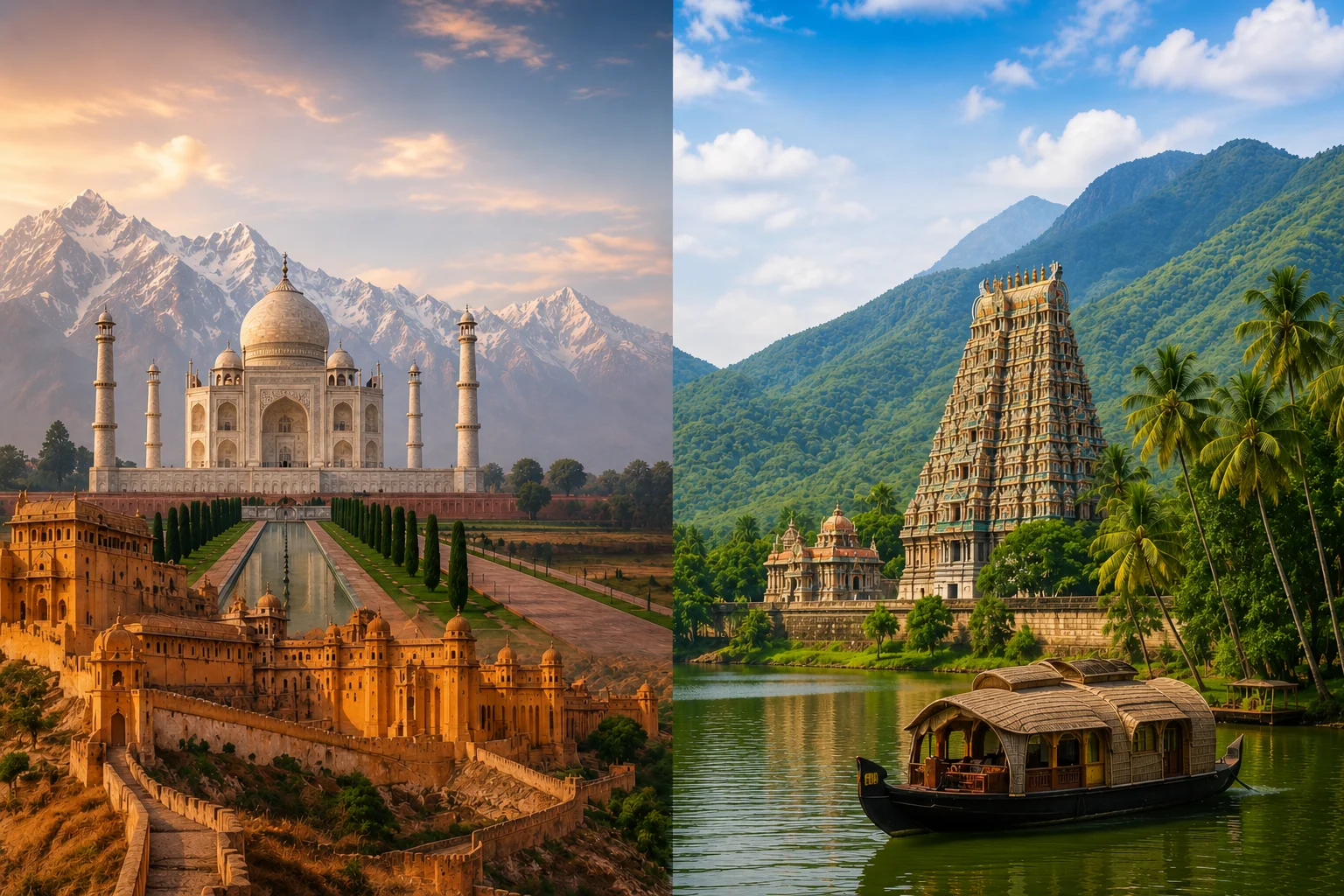
North vs South India – Travel Differences, Climate & How to Choose
Introduction
Travel across India is not defined by a single pattern, and the comparison of North vs South India reflects two distinct travel systems shaped by geography, climate, and cultural context. While both regions offer extensive travel possibilities, the structure and experience of a journey differ in terms of pacing, seasonal planning, and how destinations are connected.
North India is often associated with large historical landmarks, mountain regions, and compact travel circuits. In contrast, South India presents a more distributed landscape that includes coastal zones, hill ranges, temple towns, and wellness destinations, often requiring a more structured travel guide for regional planning. These differences influence not only what travellers experience, but how itineraries are planned.
This India travel comparison helps in understanding how each region differs in structure, climate, and experience. Choosing between the two depends on travel objectives, duration, and preferred pace. Understanding the differences between North vs South India travel helps in selecting a route that aligns with climate conditions, travel style, and overall expectations.
North vs South India: Geographic & Climate Differences
A key distinction in North vs South India lies in geography and climate, which directly influence travel timing and itinerary design. The two regions operate under different environmental conditions, making seasonal planning an essential part of travel.
North India includes the Himalayan ranges, northern plains, and desert regions. This creates a wider climatic range, with cold winters in northern areas and high temperatures during summer in cities such as Delhi and Jaipur. Travel planning often involves avoiding extreme weather conditions and selecting suitable time windows based on the destination.
In contrast, South India follows a tropical climate pattern, with relatively stable temperatures throughout the year. Seasonal variation is influenced more by humidity and monsoon cycles than by temperature extremes. Coastal regions remain warm, while hill areas such as Munnar and Coorg offer cooler conditions due to elevation.

Monsoon patterns also differ. South India is influenced by both southwest and northeast monsoons, affecting regions such as Kerala and Tamil Nadu at different times,particularly in regions associated with seasonal wellness retreats and coastal travel.
These variations highlight that North vs South India climate differences play a central role in determining travel feasibility and route planning, making it an important factor in any North India vs South India tourism decision.
Cultural & Historical Context
The contrast in North vs South India travel is strongly reflected in cultural and historical frameworks, which shape how destinations are experienced. These differences are visible in architecture, religious practices, and the organisation of cities.
North India’s historical identity is influenced by Indo-Islamic and Mughal periods, evident in large monuments, forts, and urban heritage structures. Cities such as Delhi, Agra, and Jaipur are structured around prominent landmarks, and travel is often organised through defined circuits.
Religious centres like Varanasi follow a different pattern, where river-based rituals and continuous activity define the experience.
In South India, cultural identity is closely linked to Dravidian traditions, where temple architecture and ritual systems play a central role. Temple towns in Tamil Nadu are organised around large temple complexes that influence daily movement, visiting patterns, and local life.
Cultural expression also differs in form. In South India, classical traditions such as Bharatanatyam and Carnatic music are regionally embedded, while in North India, cultural experiences are often associated with historic cities and broader regional practices.
These differences show that North vs South india travel is shaped not only by geography, but by how culture structures the journey itself, forming an essential part of a broader India travel comparison.
Travel Routes & Logistics
Route design is one of the clearest differences in North vs South India travel, as each region follows a distinct planning approach. North India is organised around defined travel circuits, while South India requires a more sequential structure across multiple regions.
In North India, routes such as the Golden Triangle (Delhi–Agra–Jaipur) are geographically compact and supported by strong connectivity. These circuits allow relatively faster movement between destinations and are often suitable for shorter travel durations. Extensions into Rajasthan or the Himalayan regions follow similarly structured patterns.
In contrast, South India travel spans coastal areas, hill ranges, and interior regions, often across multiple states. A typical South India travel guide focuses on sequencing destinations based on geography and climate rather than proximity alone. Routes may move from hill regions to plains or from cultural centres to coastal zones to maintain continuity.
Travel time is a key factor. Even moderate distances can take longer due to terrain and road conditions, making realistic transit planning essential. As a result, a South India itinerary prioritises fewer regions with logical connectivity rather than extensive coverage.
This distinction is important when evaluating South India vs North India travel from a planning perspective, as each region follows a fundamentally different route structure.
Travel Pace & Experience Style
Another defining difference in North vs South India travel lies in the pace of travel and the overall experience style. These factors are shaped by geography, route structure, and the nature of destinations.
In North India, travel is typically organised around major landmarks and city-based circuits. Locations such as Delhi, Agra, and Jaipur are well connected, allowing shorter travel durations and a faster itinerary pace. Multiple sites are often covered within a limited timeframe.
In contrast, South India travel follows a slower, more sequential rhythm. Movement between destinations may involve longer travel durations, especially when transitioning between hills, coastal areas, and interior regions. A typical South India itinerary is therefore designed with longer stays in fewer locations, reducing frequent transit and maintaining continuity.
The experience also differs. North India is largely centred on visiting key landmarks, while South India combines landscapes, cultural environments, and regional settings, creating a more distributed travel experience.
These differences in pace are often a deciding factor in where to travel in India, particularly for travellers seeking a more bespoke journey experience, depending on available time and preferred travel style. Overall, North vs South India travel differs not only in destinations but in how journeys are paced and experienced.
Food & Language Differences
Food and language are practical aspects that shape the everyday experience of North vs South India travel, influencing how travellers navigate routines, communication, and cultural environments.
In North India, food is largely wheat-based, with staples such as roti, naan, and paratha forming a core part of meals. Cuisine often includes richer gravies and dairy-based preparations. Hindi is widely spoken across many regions, and English is commonly used in tourism settings, making communication relatively straightforward.

In contrast, South India follows a predominantly rice-based food pattern, with meals centred around rice, lentils, and regional preparations such as sambar and rasam. Staple items like idli, dosa, and masala dosa are widely consumed, with variations across states reflecting local ingredients and traditions.
Language diversity is more pronounced in South India, with Tamil, Malayalam, Kannada, and Telugu spoken across regions. While English is widely used in hotels and travel services, local language usage may influence interactions outside structured environments.
These differences form an important part of India travel comparison, particularly for longer journeys where daily routines and communication play a larger role.
Who Should Choose South India
Within the comparison of North vs South India travel, South India is generally suited for travellers who prefer a structured, region-based journey with a slower and more consistent pace.
Travellers interested in cultural depth often find South India relevant due to its temple-based heritage systems and continuity of traditions within towns and cities. These experiences are integrated into daily life rather than limited to specific landmarks.
South India is also appropriate for those who prefer a less intensive travel schedule. A typical South India itinerary focuses on longer stays in fewer locations, allowing time to adjust to climate variations and reducing transit fatigue.
In addition, travellers seeking wellness-oriented journeys may find South India suitable, particularly in regions such as Kerala, where Ayurveda-based programs are integrated into travel planning.
This makes South India a suitable choice within South India vs North India travel for those prioritising continuity, cultural context, and a measured travel rhythm.
Who Should Choose North India
In the context of North vs South India travel, North India is typically suited for travellers who prefer a more direct, landmark-focused itinerary with faster movement between destinations.
First-time visitors often choose North India due to the concentration of historically significant sites within accessible distances. Cities such as Delhi, Agra, and Jaipur are commonly included in compact circuits, allowing multiple major landmarks to be covered within a shorter duration.
North India is also appropriate for travellers with limited time, as strong connectivity enables efficient route planning with fewer logistical adjustments.
Additionally, travellers interested in distinct geographic landscapes such as mountain regions or desert areas may find North India relevant, particularly in zones like the Himalayas or Rajasthan.
This aligns with travellers evaluating where to travel in India, especially when prioritising shorter durations and clearly defined routes.
Can You Combine North and South India in One Trip?
Combining both regions within a single itinerary is possible, but in the context of North vs South India travel, it requires careful planning and sufficient time. The primary challenge lies in the geographic distance between regions, along with differences in climate, travel pace, and route structure.
For shorter durations, including both regions can lead to extended travel time and reduced engagement with each destination. Frequent transitions, particularly involving internal flights, may disrupt continuity. As a result, such itineraries are more suitable for trips extending beyond 14–16 days.
When structured effectively, the journey is typically divided into two segments. For example, a North India circuit covering Delhi, Agra, and Jaipur may be followed by a South India segment focused on Kerala or Tamil Nadu. This maintains clarity in route design and avoids unnecessary backtracking.
Seasonal alignment is also important, as climate conditions differ across regions. This type of planning is often considered in advanced India travel comparison when structuring longer itineraries.
Closing
The comparison of North vs South India travel highlights two distinct approaches shaped by geography, climate, culture, and route structure. North India offers compact circuits and a more direct, landmark-focused travel pattern, while South India presents a distributed landscape requiring coordinated sequencing across regions.
The choice depends on how travel objectives align with these differences. Factors such as available time, preferred pace, and seasonal conditions play a central role in determining suitability.
Ultimately, South India vs North India travel is not about preference alone, but about aligning travel intent with regional characteristics. Understanding this distinction supports more structured planning within a broader India travel comparison.
Related Blogs

South India Travel Guide – Routes, Seasons & What to Expect
Introduction South India travel covers a diverse and geographically distinct region that includes Kerala, Tamil Nadu, Karnataka, and parts of…
Read More ›