
Precision in Stone: Orchestrating a ‘Guided Masterpiece’ Through the Great Living Chola Temples
The Generic vs. The Heritage
Most itineraries treat temple visits as compressed stops, arrive, circle the sanctum, take a photograph, and move on. In the Tamil Nadu circuit, this approach reduces complex sites to crowded pathways and fixed commentary, where timing is dictated by traffic rather than understanding.
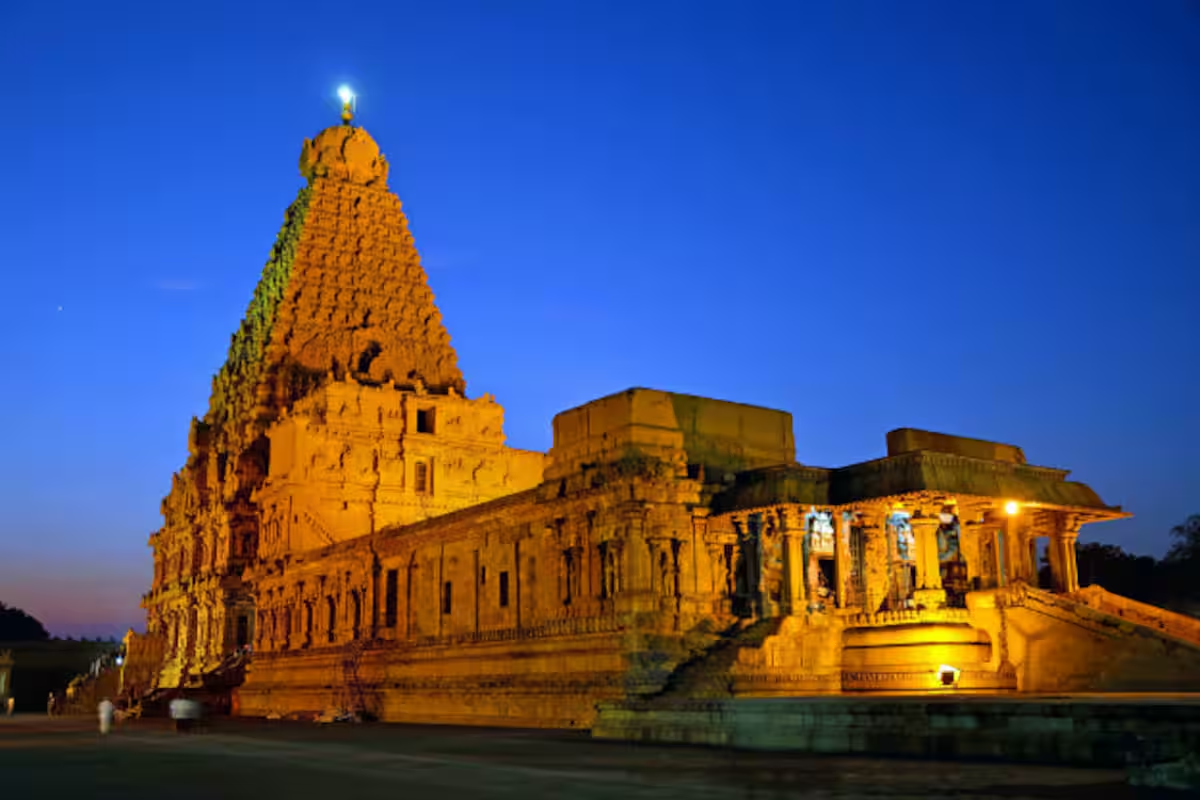
A Great Living Chola Temples guided masterpiece rejects that model. At Brihadeeswarar Temple, the granite superstructure rises in precisely interlocked tiers, culminating in a capstone estimated at 80 tons, positioned using an inclined ramp system rather than vertical lifting.
This is not a visual highlight; it is a question of engineering, labour organisation, and imperial scale.
A heritage-led approach uses space differently. It sequences entry before peak footfall, positions interpretation where inscriptions remain legible, and allows time to read how ritual movement intersects with architecture. The result is not a slower visit, it is a structured one, where each pause reveals intent embedded in stone.
That distinction separates a routine stop from a Great Living Chola Temples guided masterpiece.
For travellers seeking a broader understanding of these UNESCO monuments and their place within Tamil Nadu’s heritage landscape, our Great Living Chola Temples: A Complete Cultural & Travel Guide provides a comprehensive introduction.
The Architectural Root
Any Great Living Chola Temples guided masterpiece must begin with the architectural system that defines Chola power.
At Brihadeeswarar Temple, commissioned by Rajaraja I in the early 11th century, scale is not decorative, it is administrative and political. The temple’s axial alignment, elevated plinth, and 60+ metre vimana establish a controlled field of visibility across the Kaveri basin, signalling authority through geometry as much as mass.
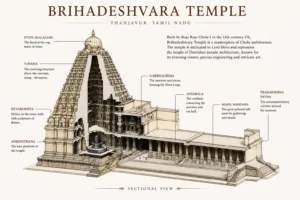
The construction method reinforces this intent. Granite blocks are interlocked without mortar, relying on precision cutting, gravity, and load distribution rather than binding agents.
This creates structural stability over centuries while allowing the monument to withstand climatic stress. The 80-ton capstone at the summit was not lifted vertically; it was transported along a gradually inclined earthen ramp extending several kilometres.
This reflects coordinated labour systems, material logistics, and state-level planning, architecture as an extension of governance.
For the visitor, this demands a different mode of engagement. The courtyard is not simply a gathering space; it is calibrated to frame the vimana’s vertical thrust against open sky.
Circulation paths align with sightlines, directing attention in stages rather than at once. The inscriptions along the walls function as operational records, documenting land grants, taxation structures, and temple management systems tied to the agrarian economy.
Without this context, the experience reduces to scale without meaning. With it, movement becomes analytical: pauses correspond to structural transitions, and observation follows the logic of construction rather than crowd flow.
This is where a Great Living Chola Temples guided masterpiece establishes its depth, by translating monumentality into readable engineering, political intent, and lived infrastructure, rather than passive viewing. This architectural reading must be sequenced deliberately within the itinerary.
The Narrative of the Kaveri Delta
A Great Living Chola Temples guided masterpiece cannot be understood through a single monument.
Its logic unfolds across the Kaveri Delta, where irrigation networks, agrarian surplus, and temple construction operate as one continuous system rather than separate achievements.
The river systems around Kaveri River sustained intensive wet cultivation through canals, sluices, and distributaries.
This agricultural base generated the surplus required for quarrying granite, transporting stone, and maintaining large labour forces.
The temples are not isolated expressions of devotion; they are infrastructure nodes within an agrarian economy, funded, administered, and recorded through inscriptional systems embedded in their walls.
At Brihadeeswarar Temple, under Rajaraja I, this system manifests as vertical dominance. The vimana rises in sharply defined tiers, asserting imperial consolidation through height and axial control.
Movement through the complex reinforces this authority, entry, progression, and sightlines are tightly structured, leaving little ambiguity in how the space is read.
The narrative evolves at Brihadeeswarar Temple, built by Rajendra I following campaigns that extended Chola influence northward.
Here, the architectural language shifts. The vimana softens into a more concave profile, reducing sheer vertical force while expanding lateral composition.
The result is a recalibrated expression of power, less rigid, more spatially distributed, reflecting expansion rather than consolidation.
At Airavatesvara Temple, the scale contracts but the detailing intensifies. The chariot-form mandapa is approached through steps carved with miniature relief panels, each compressing narrative sequences into tightly controlled surfaces. The emphasis moves from mass to precision, from scale to articulation.
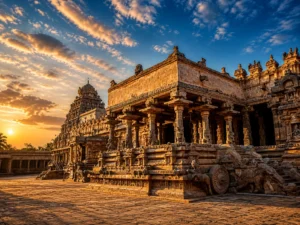
The journey across these sites must be paced with intent. Thanjavur establishes authority. Gangaikonda Cholapuram introduces variation and expansion. Darasuram concludes with refinement and technical control. This sequencing transforms three separate visits into a continuous architectural argument.
Without this rhythm, the experience fragments into disconnected stops. With it, the Kaveri Delta becomes legible as a coherent system of statecraft, engineering, and artistic evolution, where each temple advances the same architectural logic in a different register.
This continuity is what elevates the experience into a Great Living Chola Temples guided masterpiece, not through accumulation, but through structured progression across landscape, time, and form.
Access Beyond the Courtyard
A Great Living Chola Temples guided masterpiece is defined less by where you go and more by how access is controlled and interpreted on the ground.
This level of exclusivity is best realized through Chola architecture private tours that prioritize spatial clarity over mass-market convenience.
At sites like Brihadeeswarar Temple, the difference begins with timing. Entry is scheduled at first light, before general visitor flow builds.
The granite surfaces are cooler, inscriptions remain legible without glare, and the courtyard retains its intended geometric scale. This is not a aesthetic preference; it is a function of light angle, thermal management, and crowd dynamics.
Interpretation is equally precise. Instead of general guides, walkthroughs are led by conservation architects or trained interpreters who can read Tamil epigraphy in context.
They treat these not as mere translations, but as administrative records tied to land grants, temple economies, and ritual obligations. This shifts the experience from generic description to an evidence-based reading of the site.
Operationally, this requires disciplined Thanjavur heritage travel logistics. Vehicle movement is timed to avoid bottlenecks around temple streets, and entry points are selected based on current access conditions.
Transitions between Brihadeeswarar Temple and Airavatesvara Temple are structured to maintain narrative continuity, ensuring the focus remains on the transition from imperial scale to the refined chariot-form mandapas of the later period
Why This Requires Design, Not Assembly
A Great Living Chola Temples guided masterpiece cannot be assembled from standard components. It has to be designed with intent, because the subject itself, an 11th-century imperial system expressed through stone, does not reveal itself through casual observation.
Most itineraries operate on assembly. They arrange transport, fix entry times, and position a guide at the gate. The guest arrives, circulates, and leaves with fragments, scale without context, inscriptions without interpretation, movement without meaning.
For travellers interested in understanding why sequence matters across Brihadeeswarar Temple, Gangaikonda Cholapuram, and Airavatesvara Temple, our detailed guide to the Chola Temple Circuit in Tamil Nadu explores how these monuments function as a single architectural narrative rather than isolated destinations.
A designed journey works differently. Before reaching Brihadeeswarar Temple, the sequence has already been established: arrival timed to avoid thermal discomfort from heated granite surfaces, entry aligned with optimal light for reading reliefs, and interpretation layered progressively rather than delivered in bulk.
The narrative of the Chola dynasty is not introduced at the site, it is prepared for absorption before the first step onto the courtyard.
This distinction is operational, not philosophical. It depends on South India expert-led journeys, where historians, architects, and trained interpreters shape how information is delivered, and on-ground execution ensures that pacing remains uninterrupted.
You cannot “buy” understanding at the entrance of a monument. It has to be constructed through sequencing, timing, and expertise.
That is why a Great Living Chola Temples guided masterpiece is not a product of assembly. It is the outcome of design, where logistics, scholarship, and spatial experience are aligned before the journey even begins.
Closing the Journey
A Great Living Chola Temples guided masterpiece begins with scale but does not end there.
It progresses into a structured reading of imperial intent, where interlocking granite, axial planning, and epigraphic records converge into a system of governance expressed through architecture.
Across the Kaveri Delta, what appears monumental becomes legible through sequencing, timing, and expert interpretation. This is not passive observation; it is operational stewardship applied to heritage.
Travellers seeking a deeper understanding of how Brihadeeswarar Temple, Gangaikonda Cholapuram, and Airavatesvara Temple relate to one another should explore our complete Chola Temple Circuit Tamil Nadu Guide, where the architectural, historical, and cultural logic of the circuit is examined in greater detail.
Executed correctly, the journey is not a tour. It is a disciplined method of understanding history written in stone, precise, enduring, and intentionally constructed.
Related Blogs

The Temple Trail of Tamil Nadu – How to Structure a Meaningful Cultural Route
Introduction to Tamil Nadu’s Temple Landscape Tamil Nadu’s temple landscape is not defined by a collection of isolated monuments, but…
Read More ›