
The Temple Trail of Tamil Nadu – How to Structure a Meaningful Cultural Route
Introduction to Tamil Nadu’s Temple Landscape
Tamil Nadu’s temple landscape is not defined by a collection of isolated monuments, but by an interconnected cultural system shaped over centuries through religion, architecture, trade, music, and regional identity.
Across the state, temple towns developed as organised urban centres where ritual practice, community life, and cultural activity evolved together within a shared sacred geography.
Unlike many heritage destinations that are experienced primarily as historical sites, temples in Tamil Nadu continue to function as active religious and social spaces.
Daily rituals, seasonal festivals, processions, and local economies remain closely connected to temple environments, creating a form of living heritage that extends beyond architecture alone.
This continuity is one of the reasons a temple trail through Tamil Nadu differs from conventional monument-based travel.
The experience is not structured around viewing individual landmarks in isolation, but around understanding how temple networks shaped movement, settlement patterns, artistic traditions, and cultural identity across South India.
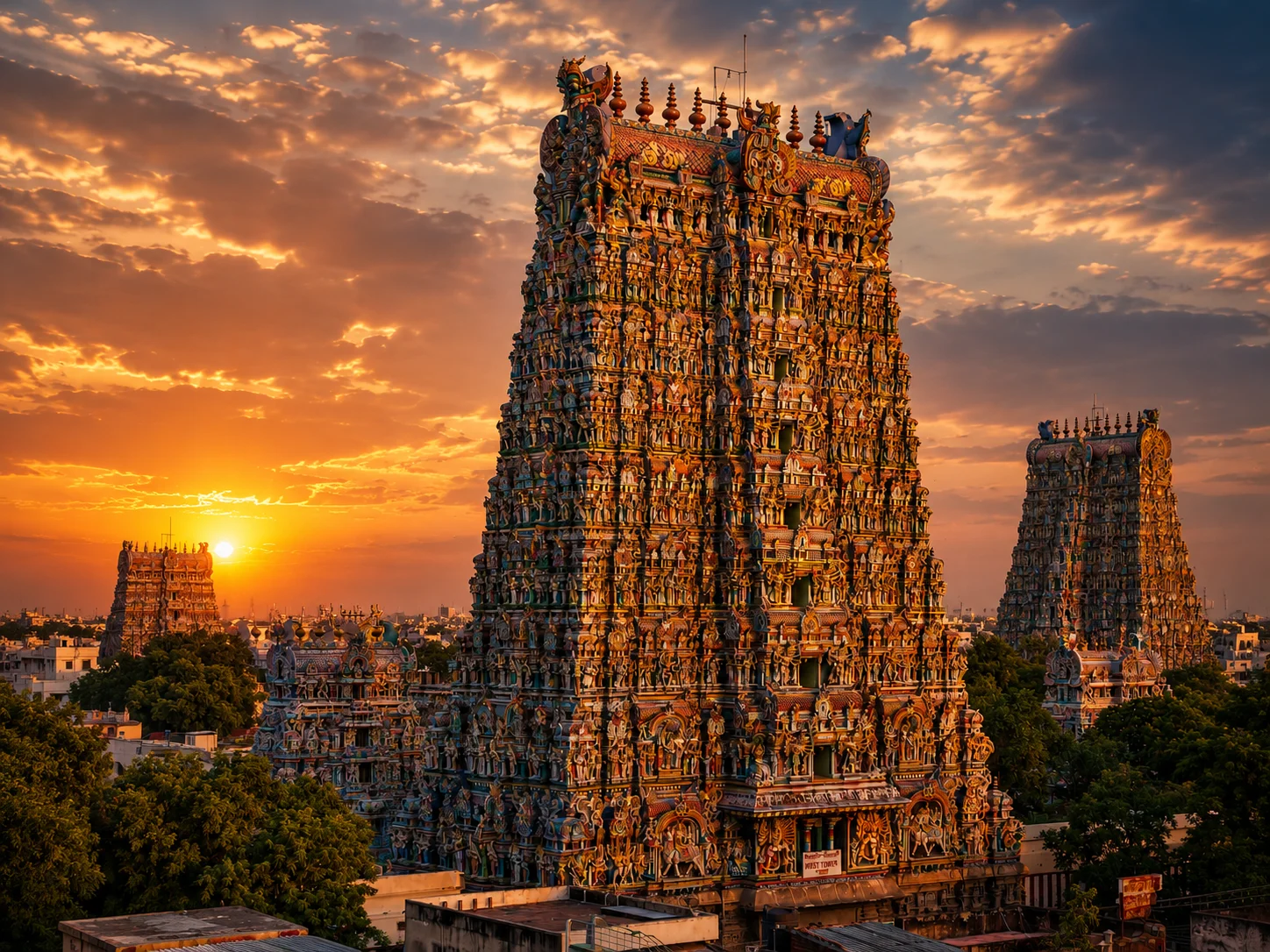
The scale of Dravidian temple architecture also contributes to the uniqueness of Tamil Nadu cultural travel. Large temple complexes with towering gopurams, expansive corridors, temple tanks, and intricately layered sculptures dominate both urban and rural landscapes.
These structures often function as the cultural centre of their surrounding regions rather than simply as places of worship.
A structured temple trail through Tamil Nadu therefore involves more than visiting major temples. It requires understanding the relationship between geography, dynastic history, ritual continuity, and regional culture.
From the Pallava heritage of the eastern coast to the Chola temple corridor and the sacred landscapes of southern Tamil Nadu, each region contributes differently to the broader temple ecosystem of South India.
For travellers interested in heritage travel, cultural immersion, and South India’s architectural traditions, Tamil Nadu offers one of the most layered and continuous temple landscapes in Asia.
Why Tamil Nadu’s Temple Networks Are Structurally Unique
Temple-Centric Urban Development
One of the defining characteristics of Tamil Nadu’s temple landscape is that temples were historically integrated into the structure of urban and regional life rather than positioned as isolated religious sites.
In many parts of the state, temple complexes influenced the layout of cities, market activity, water systems, artistic patronage, and patterns of daily movement.
This differs significantly from many heritage destinations where monuments exist primarily as preserved historical structures.
In Tamil Nadu, temples continue to function as active centres of worship and community life, maintaining ritual continuity that has evolved across centuries.
Continuity of Worship & Daily Life
The coexistence of historical architecture and ongoing religious practice creates a distinctly different travel experience compared to monument-focused tourism.
Temple rituals, festivals, devotional gatherings, and everyday community movement continue to remain deeply connected to these sacred environments.
Another important distinction is the density of temple geography across the state. Rather than being concentrated in a single region, temple networks extend across coastal corridors, river delta systems, and inland urban centres.
This creates a cultural route structure where temples are experienced not as isolated destinations, but as interconnected parts of a larger civilisational landscape.
Scale of Dravidian Temple Architecture
The scale and complexity of Dravidian temple architecture also contribute to the uniqueness of Tamil Nadu’s temple networks.
Temple complexes often expanded across multiple dynasties, resulting in layered architectural forms that include monumental gopurams, mandapams, corridors, temple tanks, and sculptural systems integrated into large urban environments.
In many temple towns, the surrounding streets and commercial areas continue to revolve around these sacred structures.
Because of these factors, a Tamil Nadu temple trail is best approached as a structured cultural journey rather than a checklist of major temples.
Understanding the relationship between architecture, ritual systems, geography, and regional identity provides deeper context for heritage travel across South India.
Understanding Temple Routes as Cultural Corridors
Coastal Temple Corridors
A structured temple trail through Tamil Nadu is best understood through the idea of cultural corridors rather than isolated travel stops.
Temple routes across the state developed historically through dynastic expansion, trade networks, pilgrimage movement, river systems, and regional cultural exchange.
The eastern coastal corridor, beginning near Chennai and extending through Mahabalipuram and Kanchipuram, reflects the architectural and cultural influence of the Pallava period.
These coastal regions introduced some of the earliest developments in Dravidian temple architecture and later influenced temple-building traditions across South India.
Many travellers combine this route with broader classical arts journeys through Tamil Nadu focused on music, dance, and temple heritage.
The Cauvery Delta Temple Region
Further south, the Cauvery delta region forms one of the densest temple landscapes in South India, particularly through the Chola temple corridor centred around Thanjavur, Gangaikonda Cholapuram, and surrounding heritage towns.
The region reflects the political influence, architectural ambition, and sacred geography that emerged during the Chola period, where temple construction expanded into monumental cultural systems integrated with river-fed agricultural landscapes.
Southern Sacred Geography
Southern Tamil Nadu introduces a different rhythm, where temple cities such as Madurai and Rameswaram combine pilgrimage movement, urban ritual life, and sacred geography within larger cultural systems.
These regions differ not only in architectural style but also in atmosphere, travel pacing, and ritual environments.
Because of this regional diversity, Tamil Nadu temple itineraries are most effective when structured geographically rather than organised around isolated landmark visits.
Sequencing routes carefully helps maintain continuity in travel flow while reducing unnecessary transit across long distances.
Temple travel in Tamil Nadu is often more immersive than monument-based tourism because many locations involve active worship environments, layered architectural interpretation, and broader cultural settings.
For travellers seeking more meaningful engagement with South India’s sacred and cultural landscapes, carefully structured South India cultural journeys often provide a deeper understanding of regional identity, ritual continuity, and historical context.
A well-structured South India temple trail therefore prioritises regional continuity, slower pacing, and contextual understanding rather than extensive coverage alone.
Chennai to Mahabalipuram: The Coastal Gateway
Pallava Foundations
For many travellers, the temple trail of Tamil Nadu begins along the eastern coastal corridor connecting Chennai and Mahabalipuram.
This region marks the transition from modern urban South India into the sacred and architectural landscapes that define Tamil Nadu heritage travel.
As the route moves south along the Bay of Bengal coastline, the influence of the Pallava dynasty becomes increasingly visible.
The Pallavas played a foundational role in the evolution of Dravidian temple architecture, particularly through the development of rock-cut temples, monolithic shrines, and early structural stone temples.
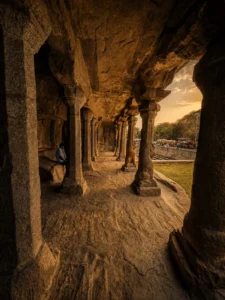
Mahabalipuram, also known as Mamallapuram, is one of the most historically significant heritage centres in South India.
The site reflects an important architectural transition where temple construction evolved from cave temples and pillared mandapas into monolithic Rathas and later structural temples that influenced temple-building traditions across Tamil Nadu.
Shore Temple & Maritime Heritage
The Shore Temple remains one of the defining landmarks of Mahabalipuram and among the earliest structural stone temples in South India. Positioned along the coastline, it reflects both religious symbolism and the maritime influence of the Pallava kingdom.
The wider heritage landscape of Mahabalipuram includes several architecturally important monuments that together illustrate the evolution of Pallava architecture.
The Pancha Rathas, often referred to as the Five Chariots, showcase monolithic rock-cut craftsmanship carved from single granite formations.
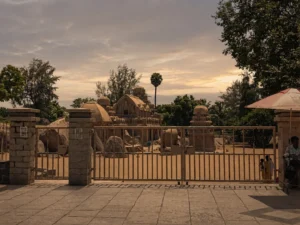
Cave structures such as the Varaha Cave Temple and Trimurti Cave Temple demonstrate the sculptural sophistication of early Pallava design, while Arjuna’s Penance remains one of the largest and most intricate open-air rock reliefs in India.
One of Mahabalipuram’s most recognisable granite landmarks is Krishna’s Butter Ball, a massive naturally balanced boulder positioned on a sloping rock surface overlooking the wider heritage zone.
The site reflects the close relationship between Mahabalipuram’s geological landscape and its sacred-cultural identity, where natural stone formations became integrated into mythology, visual symbolism, and the broader architectural environment shaped during the Pallava period.

Beyond its geological curiosity, Krishna’s Butter Ball also contributes to the open-air character of Mahabalipuram, where monumental stone forms, rock-cut architecture, and coastal terrain collectively define the region’s distinctive heritage atmosphere.
Beginning the Tamil Cultural Transition
Other important sites, including the Olakkanesvara Temple and Sthalasayana Perumal Temple, further reflect the diversity of architectural and religious traditions that shaped the region.
Unlike the denser temple cities found deeper within Tamil Nadu, Mahabalipuram offers a more open heritage landscape where architecture, coastline, and stonework interact closely.
For travellers planning a structured South India temple itinerary, the Chennai–Mahabalipuram corridor provides both historical context and an introduction to the foundations of Tamil Nadu’s temple culture.
Kanchipuram: The Sacred City of a Thousand Temples
Shaivite & Vaishnavite Traditions
From the coastal heritage landscape of Mahabalipuram, the temple trail gradually moves inland toward Kanchipuram, one of the most important sacred cities in South India.
Often referred to as the “City of a Thousand Temples,” Kanchipuram holds deep religious, architectural, and dynastic significance within Tamil Nadu’s cultural history.
Kanchipuram emerged as a major centre under the Pallava dynasty and later continued to flourish under the Cholas, Vijayanagara rulers, and other South Indian kingdoms.
The city became an important centre for Shaivism, Vaishnavism, Sanskrit scholarship, temple ritual traditions, and classical Dravidian architecture.
Temple Networks Within Urban Life
Unlike Mahabalipuram’s coastal monument landscape, Kanchipuram functions as a living temple city where religious practice continues alongside centuries-old architectural heritage.
The city’s temple networks reflect multiple phases of South Indian temple evolution, ranging from early Pallava stone structures to later monumental temple complexes.
The Kailasanathar Temple remains one of the earliest and most important structural stone temples associated with Pallava architecture.
Built during the reign of Narasimhavarman II (Rajasimha), the temple reflects the transition from rock-cut forms toward mature structural Dravidian design.
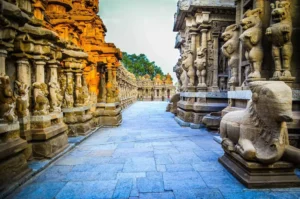
The Vaikuntha Perumal Temple similarly represents an important phase in Pallava temple planning and sculptural development. Kanchipuram is also home to major active pilgrimage centres including the Ekambareswarar Temple, Kamakshi Amman Temple, and Varadharaja Perumal Temple.
Silk, Ritual & Cultural Identity
Towering gopurams, pillared mandapas, temple tanks, and extensive sculptural systems define much of the city’s sacred landscape.
Beyond religion, Kanchipuram also remains internationally recognised for its silk weaving traditions, particularly Kanchipuram silk sarees, which continue to form an important part of the city’s cultural identity.
For travellers following a structured Tamil Nadu temple route, Kanchipuram offers a deeper understanding of how South Indian temple architecture evolved from dynastic patronage into large-scale sacred urban systems that continue to function as active spiritual centres today.
The Chola Temple Corridor
Brihadeeswarar Temple & Chola Power
The Chola temple corridor represents one of the most significant cultural and architectural regions within the Tamil Nadu temple trail.
Centred around the fertile Cauvery delta, this region reflects the political influence, artistic ambition, and temple-building legacy of the Chola dynasty, which played a defining role in the evolution of South Indian civilisation between the 9th and 13th centuries.
Unlike the earlier coastal temple landscapes associated with the Pallavas, the Chola region is characterised by monumental temple architecture integrated within river-fed agricultural systems and historic urban centres.
Temple construction during this period expanded significantly in both scale and complexity, transforming temples into symbols of political authority, cultural patronage, and sacred geography.
Thanjavur functions as the core of this cultural corridor and is home to the Brihadeeswarar Temple, one of the most important examples of Dravidian temple architecture in India.
Built during the reign of Rajaraja Chola I, the temple reflects the Chola dynasty’s emphasis on monumental scale, granite construction, axial planning, and sculptural precision.
Architecture as Civilisational Expression
The towering vimana, expansive courtyard, and integrated artistic detailing of Brihadeeswarar Temple continue to make it one of the defining heritage sites of South India.
The broader Cauvery delta region also includes temple centres such as Gangaikonda Cholapuram and Darasuram, which together form part of the UNESCO-listed Great Living Chola Temples.
Readers interested in exploring the history, architecture, and cultural significance of these monuments in greater depth can explore our guide to the Great Living Chola Temples.
These sites demonstrate how temple architecture evolved across different phases of the Chola period while maintaining continuity in ritual practice and sacred symbolism.
Beyond architecture alone, the Chola temple corridor reveals how temples functioned within larger cultural systems involving music, dance, administration, agriculture, and regional trade.
The Cauvery Delta Cultural System
The river networks of the Cauvery basin supported both economic prosperity and temple expansion, creating one of the densest sacred landscapes in Tamil Nadu.
Temple towns across the region developed as interconnected cultural centres where religion, governance, artistic patronage, and agrarian systems functioned together within a shared sacred geography.
For travellers undertaking a structured Tamil Nadu temple itinerary, the Chola corridor provides one of the deepest experiences of South India’s temple heritage, combining architectural scale, historical continuity, and regional cultural identity within a single interconnected landscape.
Madurai: Living Temple Urbanism
Meenakshi Temple & Urban Flow
As the temple trail moves deeper into southern Tamil Nadu, Madurai represents a transition from dynastic temple architecture into fully developed sacred urbanism.
Unlike heritage sites experienced primarily as monuments, Madurai functions as a living temple city where pilgrimage, ritual, commerce, food culture, and daily life remain deeply interconnected.
At the centre of the city stands the Meenakshi Amman Temple, one of the most important temple complexes in South India and a defining landmark of Dravidian architecture.
Located on the banks of the Vaigai River, the temple is dedicated to Goddess Meenakshi and Sundareshwarar, a form of Lord Shiva, and has remained an active religious centre for centuries.
Although the temple’s early origins are associated with the Pandya period and Sangam-era traditions, much of the present architectural form emerged through later Vijayanagara and Nayak patronage.
Temple Markets & Daily Ritual Life
The temple complex expanded into a monumental sacred urban centre with towering gopurams, vast pillared mandapas, ceremonial corridors, temple tanks, and intricately layered sculptural systems.
The Meenakshi Temple is particularly known for its richly ornamented gateway towers and extensive mandapa architecture.
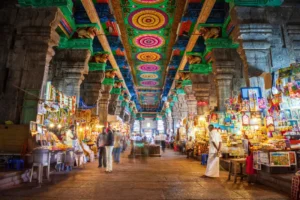
Spaces such as the thousand-pillared hall reflect the artistic and engineering sophistication that came to define later Tamil temple construction.
The temple’s sculptural density, ritual pathways, and festival infrastructure demonstrate how South Indian temples evolved beyond isolated religious structures into highly organised sacred urban systems.
Sacred Movement Within the City
Unlike the coastal monument landscapes of Mahabalipuram or the dynastic temple concentrations of Kanchipuram, Madurai offers travellers an immersive experience where temple culture remains fully integrated into everyday urban life.
Flower markets, devotional music, religious processions, traditional eateries, and ritual practices continue to shape the city’s atmosphere around the temple complex.
For travellers following a structured Tamil Nadu temple itinerary, Madurai represents one of the clearest examples of how architecture, religion, urban planning, and living cultural traditions continue to coexist within South India’s sacred geography.
Rameswaram & Southern Sacred Geography
Pilgrimage & Coastal Landscapes
As the temple trail moves toward the southern edge of Tamil Nadu, Rameswaram represents one of the most spiritually significant destinations within India’s sacred geography.
Located on Pamban Island between mainland India and Sri Lanka, the town combines pilgrimage traditions, coastal landscapes, mythology, and monumental temple architecture into a deeply symbolic spiritual environment.
Rameswaram holds a central place within Hindu pilgrimage traditions and forms part of the Char Dham circuit.
The town is closely associated with the Ramayana, where Lord Rama is believed to have worshipped Lord Shiva after the battle against Ravana in Sri Lanka.
These mythological associations continue to shape the religious identity of the region and attract pilgrims from across India.
Corridor Architecture & Sacred Movement
At the centre of the town stands the Ramanathaswamy Temple, one of the most important Shaivite pilgrimage temples in India and among the twelve Jyotirlinga sites traditionally associated with Lord Shiva.
While the temple’s origins are linked to earlier Pandya patronage, later expansions under various South Indian rulers contributed to its present architectural scale.
The temple is particularly known for its extraordinarily long pillared corridors, monumental gopurams, sacred water tanks (Theerthams), and highly symmetrical Dravidian temple planning.
Its outer corridors are considered among the longest temple corridors in the world, creating a powerful sense of spatial rhythm and ceremonial movement within the sacred complex.
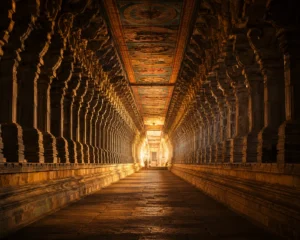
Ritual bathing also forms an important part of the Rameswaram pilgrimage experience. Sacred water bodies such as Agni Theertham and multiple temple Theerthams continue to hold strong ritual significance within Hindu pilgrimage traditions.
Symbolic Completion of the Southern Route
Unlike the dense urban sacred environment of Madurai, Rameswaram offers a slower and more contemplative atmosphere shaped by coastal geography, sea winds, island landscapes, and devotional movement.
The combination of mythology, pilgrimage, architecture, and shoreline spirituality creates a distinctly different experience within the Tamil Nadu temple route.
For many travellers, Rameswaram represents the spiritual culmination of a structured South India temple journey, where sacred mythology and living pilgrimage traditions remain deeply integrated with the landscape itself.
Final Thoughts: Understanding Tamil Nadu Through Its Temple Networks
The temple trail of Tamil Nadu is not simply a collection of religious monuments. It is a layered cultural route that reveals the evolution of South Indian civilisation through architecture, dynasties, pilgrimage systems, sacred geography, and living ritual traditions.
From the rock-cut experiments of the Pallavas in Mahabalipuram to the sacred city networks of Kanchipuram, the monumental temple traditions of the Cholas, the ritual urbanism of Madurai, and the pilgrimage landscapes of Rameswaram, each region reflects a different phase in the development of Tamil cultural history.
What makes Tamil Nadu unique is the continuity of these systems. Many temples along this route remain active centres of worship, social life, classical arts, and community identity even after centuries of political and cultural change.
For travellers seeking deeper cultural immersion in South India, a structured Tamil Nadu temple route offers far more than sightseeing.
It provides a framework for understanding how architecture, spirituality, landscape, and daily life continue to remain interconnected across one of India’s oldest living civilisational regions.
How to Structure a Tamil Nadu Temple Journey
A structured Tamil Nadu temple journey is most rewarding when approached as a cultural route rather than a checklist of monuments.
Because the state contains multiple dynastic regions, architectural styles, pilgrimage systems, and living ritual traditions, the sequencing and pacing of the journey significantly influence the overall experience.
Ideal Route Duration
For travellers seeking meaningful cultural immersion, a Tamil Nadu temple itinerary generally requires at least 7–14 days.
Shorter routes may focus on a single corridor such as Chennai–Mahabalipuram–Kanchipuram, while longer journeys can extend toward the Chola temple belt, Madurai, and Rameswaram.
A structured route allows travellers to gradually understand the evolution of South Indian temple architecture, from Pallava rock-cut systems to monumental Chola temples and later Nayak-era sacred urbanism.
Seasonal & Climate Planning
Climate plays an important role in planning temple travel across South India. The cooler months between November and February are generally considered the most comfortable for extended temple journeys, particularly for travellers exploring multiple cities and heritage regions.
Summer months can become physically demanding due to high temperatures, especially when visiting large temple complexes with extensive walking and exposed stone courtyards. Monsoon conditions may also affect coastal and rural segments differently across Tamil Nadu.
Understanding regional climate sequencing helps create smoother travel flow and allows travellers to experience temple sites with greater comfort and slower engagement.
Travel Pace & Cultural Fatigue
One of the most overlooked aspects of temple travel is cultural fatigue. Tamil Nadu contains an extraordinary density of sacred architecture, and attempting to cover too many temple sites within a short period can reduce both engagement and appreciation.
A slower pace allows travellers to experience not only architecture, but also rituals, local food traditions, sacred music, festivals, artisan communities, and the atmosphere surrounding temple towns themselves.
Balancing major temple centres with quieter heritage environments often creates a more immersive and sustainable cultural journey through South India.
Temple Etiquette & Cultural Considerations
Tamil Nadu’s temples are not simply heritage monuments, many remain highly active spaces of worship with deep religious significance for local communities. Understanding temple etiquette is therefore an important part of respectful cultural travel.
Dress & Entry Norms
Most major temples in Tamil Nadu expect modest attire that covers shoulders and knees. In some temples, restrictions may apply regarding footwear, photography, leather items, or access to specific sanctum areas.
Certain temples may also maintain separate rules for non-Hindu visitors in inner sanctum zones, particularly within active ritual spaces.
Photography & Ritual Sensitivity
While outer courtyards and temple exteriors are often photographable, photography inside sanctum areas, during rituals, or around worshippers may be restricted.
Travellers should remain attentive to local instructions and avoid interrupting ceremonial activity.
Temple environments frequently involve chanting, offerings, processions, and devotional practices that continue throughout the day. Respectful observation is generally more appropriate than treating rituals as staged cultural performances.
Respecting Active Worship Spaces
Unlike archaeological sites experienced primarily through history, Tamil Nadu temples continue to function as living spiritual systems.
Priests, pilgrims, musicians, flower vendors, artisans, and devotees all contribute to the atmosphere surrounding these sacred spaces.
Approaching temples with patience, quiet observation, and cultural sensitivity allows travellers to engage more meaningfully with the deeper spiritual and social dimensions of South Indian temple culture.
Beyond Temples: The Cultural Systems Around Them
Tamil Nadu’s temple traditions extend far beyond architecture alone. Across the state, temples continue to shape music, dance, cuisine, artisan traditions, festivals, and local economies, creating interconnected cultural ecosystems that remain active even today.
Carnatic Music & Temple Traditions
Many South Indian classical music traditions evolved in close association with temples and devotional systems. Temple festivals, processional rituals, and seasonal celebrations historically provided important spaces for the development of Carnatic music and devotional compositions.
Even today, music remains deeply connected to Tamil Nadu’s sacred environments through chants, recitations, instrumental traditions, and festival performances.
Bharatanatyam & Sacred Performance
Bharatanatyam, one of India’s oldest classical dance forms, also carries strong historical links to temple traditions. Originally associated with ritual and devotional performance, the dance form evolved within sacred cultural environments across Tamil Nadu.
Today, many travellers explore these traditions through structured South India classical arts itineraries that combine performance heritage, temple culture, and regional artistic traditions.
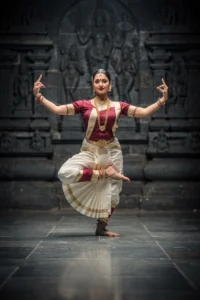
Temple sculpture, posture systems, mythology, and devotional storytelling continue to influence Bharatanatyam practice and visual language today.
Temple Food, Crafts & Local Economies
Temple culture also supports extensive networks of local livelihoods and artisanal traditions. Flower markets, bronze casting, silk weaving, ritual crafts, traditional food systems, and pilgrimage economies continue to operate around many temple towns across Tamil Nadu.
In cities such as Kanchipuram, Madurai, and Rameswaram, temple-centred economies remain closely tied to local identity and cultural continuity.
For travellers, engaging with these surrounding systems often creates a deeper understanding of Tamil Nadu heritage beyond architecture alone.
Closing
The temple trail of Tamil Nadu is far more than a religious or architectural journey. It is a layered cultural geography shaped by dynasties, pilgrimage systems, sacred landscapes, artistic traditions, and living ritual practices that continue to influence everyday life across South India.
From the Pallava heritage landscapes of Mahabalipuram and Kanchipuram to the monumental temple systems of the Cholas, the sacred urbanism of Madurai, and the pilgrimage atmosphere of Rameswaram, each region reveals a different dimension of Tamil civilisation and temple culture.
What makes Tamil Nadu exceptional is not simply the scale of its temples, but the continuity of the systems surrounding them.
Rituals, music, food traditions, crafts, festivals, and devotional practices remain deeply integrated into the social and cultural fabric of the region, shaping the kind of carefully curated bespoke South India journeys that prioritise depth, continuity, and cultural context over conventional sightseeing
For travellers seeking meaningful cultural immersion in South India, a structured Tamil Nadu temple route offers an opportunity to engage not only with history and architecture, but with one of the world’s oldest living sacred landscapes still active today.
Related Blogs

Precision in Stone: Orchestrating a ‘Guided Masterpiece’ Through the Great Living Chola Temples
The Generic vs. The Heritage Most itineraries treat temple visits as compressed stops, arrive, circle the sanctum, take a photograph,…
Read More ›